Smithsonite
Chemical formula: Zn<sup>2+</sup>CO<sub>3</sub>
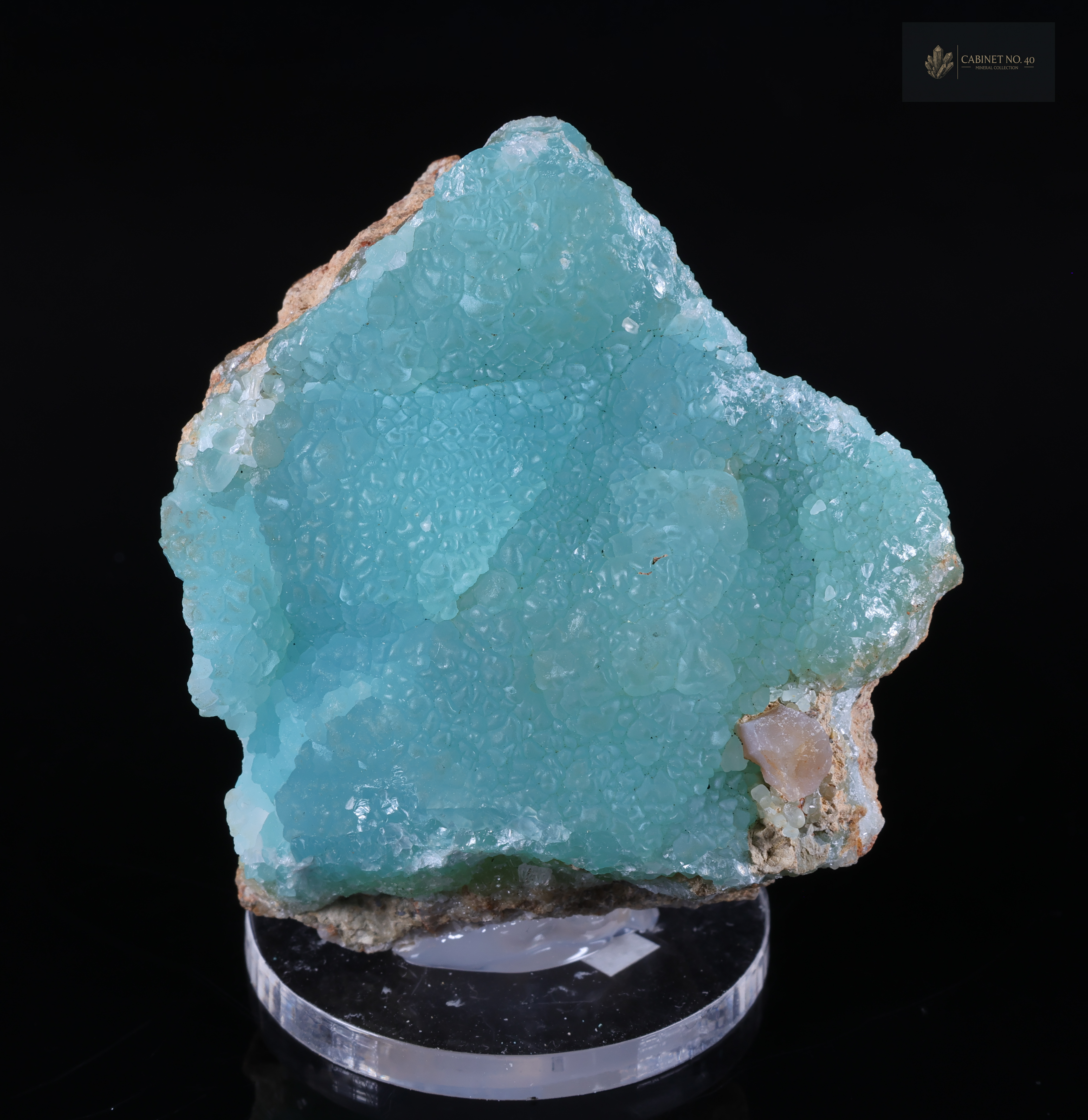
Smithsonite is a zinc carbonate, often forming characteristic reniform or botryoidal aggregates of various colors, valued by collectors.
Properties
- Mohs hardness
- 4-4.5
- Luster
- Vitreous to Pearly
- Streak
- White
- Density
- 4.42
- Cleavage
- On <mi>{10_11}</mi>.
- Fracture
- Muszlowy do nierównego
- Transparency
- Translucent
- Crystal system
- Trigonal
Diagnostic features
## Identification Smithsonite can be identified by its characteristic reniform, botryoidal, or stalactitic forms. It often occurs in attractive, pastel colors. Its hardness (4-4.5 on the Mohs scale) and white streak are also helpful in identification. ## Distinguishing from Similar Minerals Smithsonite is sometimes confused with hemimorphite, with which it co-occurs. They can be distinguished by hardness (hemimorphite is harder, 4.5-5 on the Mohs scale) and reaction to hydrochloric acid – smithsonite reacts, releasing carbon dioxide, while hemimorphite does not. Another similar mineral is calcite, which is significantly softer and has a different density. ## Crystal Forms Smithsonite crystals are rare, having a rhombohedral or scalenohedral habit. Most often, it forms aggregates with reniform, botryoidal, stalactitic, crusty, spherical, or earthy habits.
Geological environment
## Genesis Smithsonite is a secondary mineral, forming in the oxidation zones of zinc deposits. It forms as a result of the weathering of primary zinc minerals, such as sphalerite, in the presence of carbonates. It often occurs in limestones and dolomites, where zinc-rich solutions react with carbonates to form smithsonite. ## Mineral Associations Smithsonite often co-occurs with other minerals from the oxidation zone, such as hemimorphite, cerussite, anglesite, malachite, azurite, calcite, limonite, and goethite. ## Localities Known for beautiful smithsonite specimens are localities in Tsumeb (Namibia), Kelly Mine in Socorro County (New Mexico, USA), Laurion (Greece), Broken Hill (Australia), Sardinia (Italy), and Choix (Mexico).
Rarity
Very Common
For collectors
## Quality Criteria The most prized smithsonite specimens are those with intense and uniform color, especially blue, green, or pink. The form of the aggregate is also important – well-formed, reniform, or botryoidal shapes with a smooth, lustrous surface are highly sought after. The size of the specimen and the absence of mechanical damage also affect its collector's value. ## Popular Localities The most prized smithsonite specimens come from Tsumeb in Namibia, known for its blue and green varieties, and from the Kelly Mine in New Mexico (USA), where characteristic apple-green specimens occur.
Care and storage
## Cleaning Smithsonite is a relatively soft mineral, so it should be cleaned gently. It is best to use a soft brush or a cotton cloth moistened with distilled water. A mild soap solution can also be used, followed by thorough rinsing with clean water and drying. ## What to Avoid Avoid using strong chemicals, acids, and ultrasonic cleaners, which can damage the mineral's surface or alter its color. Smithsonite is sensitive to high temperatures and prolonged exposure to sunlight, which can cause colors to fade. Do not expose it to sudden temperature changes. ## Storage Smithsonite should be stored in a dry place, away from direct sunlight and heat sources. It is advisable to place the specimen in a closed display case or box to protect it from dust and mechanical damage. Due to its relative softness, avoid contact with harder minerals that could scratch it.