Scapolite
Chemical formula: (Na,Ca)₄(Al,Si)₁₂O₂₄(Cl,CO₃,SO₄)
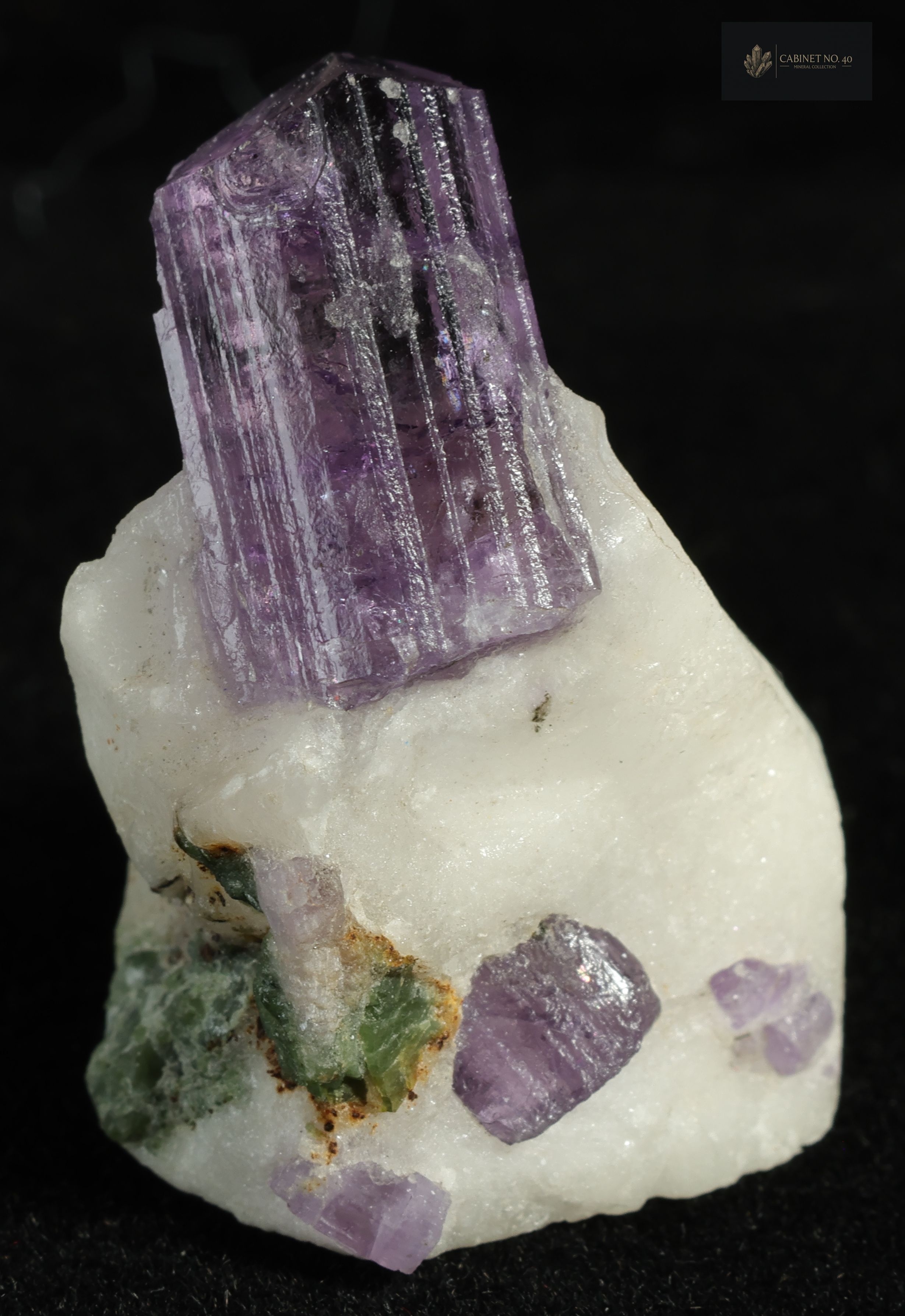
Scapolite is a group of silicate minerals, forming prismatic or tabular crystals, often found in metamorphic and igneous rocks.
Properties
- Mohs hardness
- 5-6
- Luster
- Szklisty do perłowego
- Streak
- Biała
- Density
- 0
- Cleavage
- Dobra wg {100} i {110}
- Fracture
- Nierówny do muszlowego
- Transparency
- Przezroczysty do przeświecającego
- Crystal system
- Tetragonalny
Diagnostic features
## Identification Scapolite can be identified by its characteristic prismatic or tabular habit, often with distinct striations. It occurs in a wide range of colors, and its Mohs hardness is 5-6. It often exhibits a vitreous or pearly luster. ## Distinguishing from Similar Minerals Scapolite can be confused with some plagioclase feldspars, tourmalines, or apatite. It is distinguished from plagioclase by the absence of characteristic twinning. It differs from tourmalines by crystal symmetry and the lack of a triangular cross-section. It is distinguished from apatite by its greater hardness. ## Crystal Forms Scapolite forms prismatic, acicular, or tabular crystals, often terminated pyramidally. Crystal faces are often longitudinally striated. It also occurs as granular aggregates, massive forms, or radial aggregates.
Geological environment
## Genesis Scapolite primarily forms in metamorphic rocks, such as marbles, gneisses, and schists, as a result of calcic or sodic metasomatism. It can also occur in pegmatites, especially in contact zones with limestones, and in some igneous rocks, such as gabbros and diorites. ## Mineral Associations Scapolite often co-occurs with minerals such as calcite, diopside, garnet, hornblende, plagioclase, epidote, titanite, and apatite. ## Localities Significant scapolite deposits are found in many places around the world. Important localities include: Mogok in Myanmar (Burma), where purple and yellow crystals have been found; Itremo in Madagascar; Quebec Province in Canada; Minas Gerais in Brazil; and various locations in Tanzania, Norway, and the USA.
Rarity
Very Rare
For collectors
## Quality Criteria The most prized scapolite specimens are those with well-formed, transparent crystals of intense and uniform coloration. Specimens with a cat's eye effect or asterism are particularly sought after. The size of the crystals, their clarity, and the absence of mechanical damage also affect their collector's value. ## Popular Localities Among the most valued scapolite localities are Mogok in Myanmar, known for its purple and yellow crystals, and Itremo in Madagascar, where transparent, yellow, and pink specimens occur. Other important locations include Minas Gerais in Brazil and various localities in Tanzania, which supply high-quality jewelry material.
Care and storage
## Cleaning Scapolite can be cleaned gently using a soft brush and lukewarm water with a small amount of mild soap. After washing, rinse the specimen thoroughly under running water and dry it with a soft cloth. For specimens with cracks or inclusions, it is advisable to avoid immersion in water. ## What to Avoid Avoid using aggressive chemicals such as acids or strong detergents, which can damage the mineral's surface. Scapolite is sensitive to sudden temperature changes, so it should not be exposed to extreme heat or cold. Prolonged exposure to direct sunlight can cause some colored varieties to fade. ## Storage Scapolite is best stored in a dry place, away from dust and direct light. Harder specimens can scratch other, softer minerals, so it is recommended to store them separately in soft pouches or padded boxes. Display cases that protect against dust and mechanical damage are best for exhibition.