Schumacherite
Chemical formula: Bi<sup>3+</sup><sub>3</sub>O(V<sup>5+</sup>O<sub>4</sub>)<sub>2</sub>(OH)
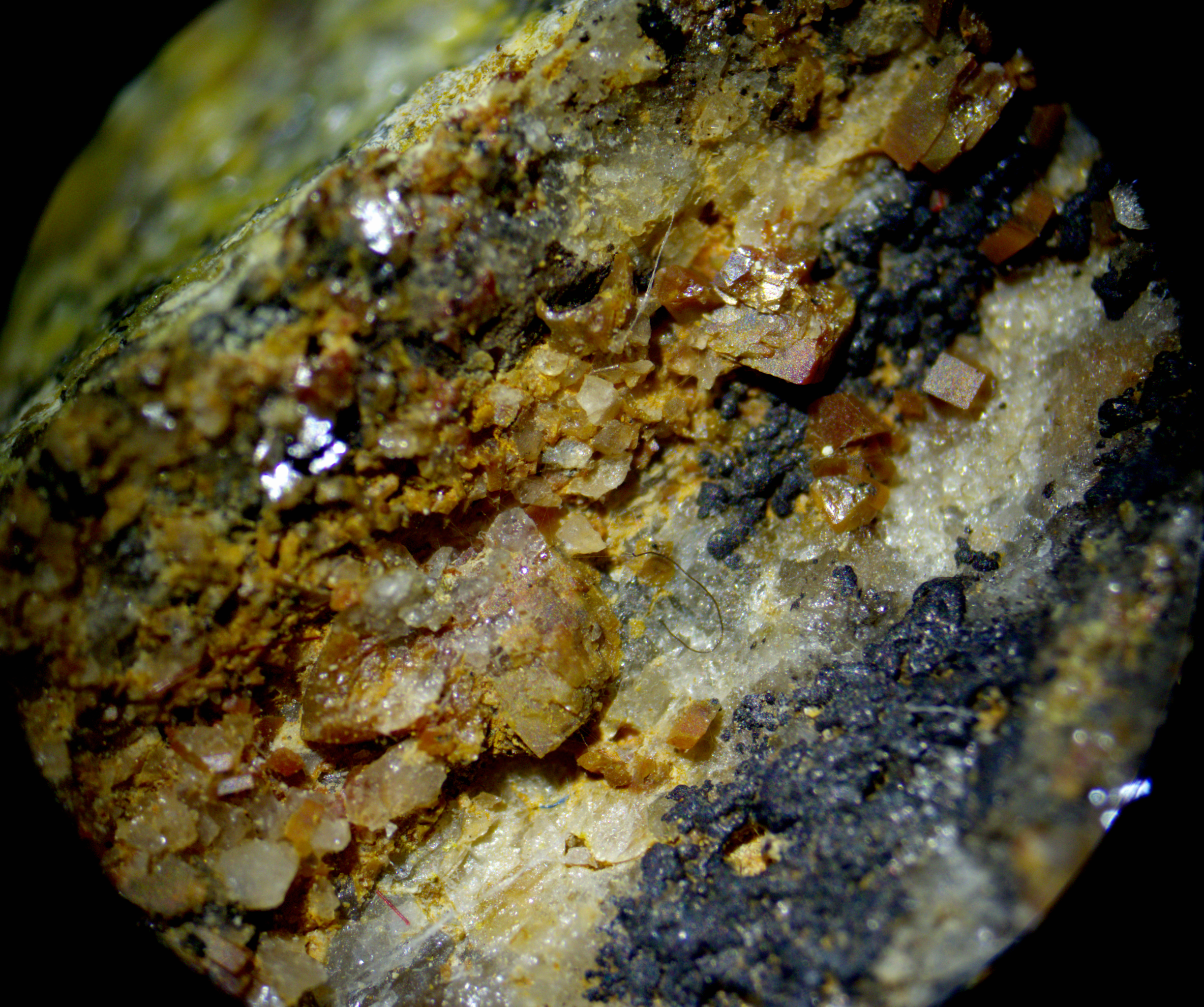
Schumacherite is a rare bismuth vanadate mineral, forming small, often radial aggregates of yellow to reddish-brown color.
Properties
- Mohs hardness
- 3
- Luster
- Szklisty do jedwabistego
- Streak
- Jasnozielona
- Density
- 0
- Cleavage
- Brak
- Fracture
- Nierówny
- Transparency
- Translucent
- Crystal system
- Triclinic
Diagnostic features
## Identification Schumacherite can be identified by its characteristic color (yellow, yellowish-brown, reddish-brown) and its tendency to form radial or fibrous aggregates. Low hardness (3 on the Mohs scale) is also a diagnostic feature. For precise identification, laboratory tests such as X-ray diffraction are often necessary. ## Distinguishing from Similar Minerals Schumacherite can be confused with other rare vanadate or bismuth minerals of similar color and habit. Differentiation from these usually requires chemical and structural analysis. For example, some minerals from the pyromorphite group may have similar coloring but differ in chemical composition and hardness. ## Crystal Forms Schumacherite typically occurs as very fine, acicular or fibrous crystals that form radial or dense aggregates. Well-formed, single crystals visible to the naked eye are rarely observed.
Geological environment
## Genesis Schumacherite is a secondary mineral, forming in the oxidation zones of hydrothermal deposits containing bismuth and vanadium. It forms as a result of weathering processes and the transformation of primary bismuth and vanadium minerals in an oxygen-rich environment. ## Mineral Associations Schumacherite often co-occurs with other secondary minerals, such as bismuthinite, vanadinite, mimetite, as well as quartz and iron minerals. ## Localities Schumacherite is a very rare mineral, and its occurrences are limited. One of the most famous localities is the Clara mine in the Black Forest, Germany, where it was first described. Other, few localities include mines in Chile and the USA, but specimens from these places are even rarer and often less well-formed.
Rarity
Very Rare
For collectors
## Quality Criteria The most prized schumacherite specimens are those that exhibit distinct, well-formed radial or fibrous aggregates with intense color. The size of the aggregates, their aesthetics, and the contrast with the matrix are key factors influencing collector's value. Specimens with well-documented provenance are also more desirable. ## Market Prices Due to its rarity and small size, schumacherite is a mineral sought after by collectors of rare species. Market prices vary widely and depend on the size, aesthetics, and rarity of the specimen. Small specimens can cost from tens to hundreds of dollars, while exceptionally well-formed and aesthetic examples can fetch significantly higher prices. ## Popular Localities The most prized schumacherite specimens come from the Clara mine in the Black Forest, Germany, which is the type locality for this mineral. Specimens from this location are usually the best formed and most aesthetic.
Care and storage
## Cleaning Due to its relatively low hardness (3 on the Mohs scale) and delicate nature, schumacherite requires careful cleaning. It is best to use a soft brush and lukewarm water. For more stubborn dirt, distilled water can be used to avoid mineral deposits. ## What to Avoid Avoid using strong chemicals, acids, and bases, which can damage the mineral. Schumacherite is susceptible to scratches, so avoid contact with harder materials. Prolonged exposure to direct sunlight may potentially affect its color, although there are no detailed studies in this regard. Also, avoid sudden temperature changes. ## Storage Schumacherite specimens are best stored in closed display cases or boxes, away from dust and moisture. It is advisable to place them on a soft surface to prevent mechanical damage. Due to their small size, they are often stored in small containers or protective capsules.