Scheelite
Chemical formula: CaW<sup>6+</sup>O<sub>4</sub>
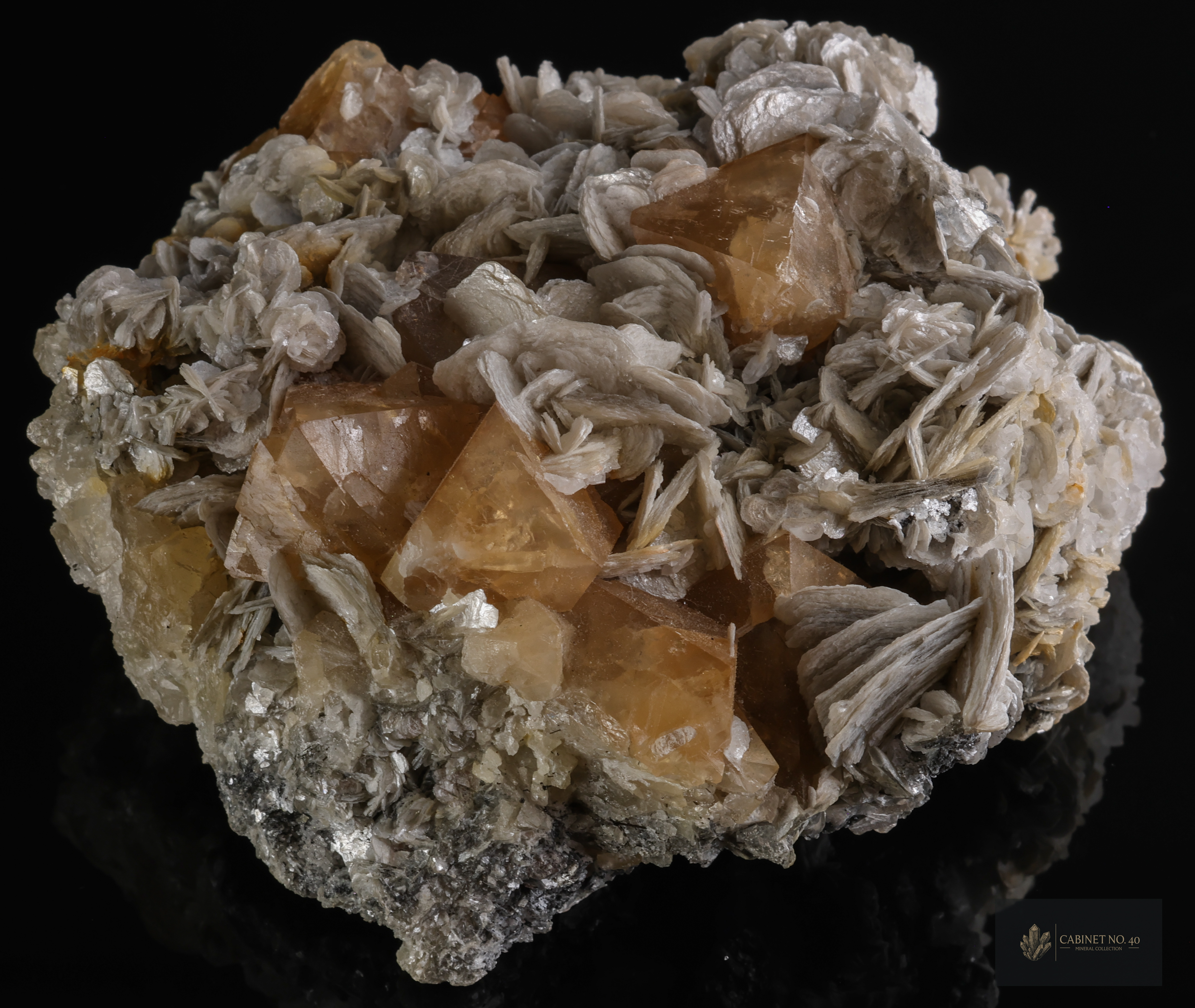
Scheelite is a mineral from the tungstate group, an important tungsten ore, often occurring as characteristic bipyramidal crystals.
Properties
- Mohs hardness
- 4.5-5
- Luster
- Vitreous, adamantine
- Streak
- White
- Density
- 6.1
- Cleavage
- Distinct on {101}, interrupted on {112}, indistinct on {001}.
- Fracture
- Muszlowy do nierównego
- Transparency
- Transparent,Opaque
- Crystal system
- Tetragonal
Diagnostic features
## Identification Scheelite can be identified by its characteristic bipyramidal crystals, vitreous to adamantine luster, and high density. A key diagnostic feature is its strong fluorescence under ultraviolet light, usually blue or white, which is very helpful for identification, especially in the field. ## Distinguishing from Similar Minerals Scheelite can be confused with some varieties of garnets, zircon, or cassiterite due to similar crystal habit and luster. It is distinguished from garnets by its lower hardness and fluorescence. It is distinguished from zircon and cassiterite by its lower hardness and characteristic fluorescence. A density test can also be helpful, as scheelite is relatively heavy. ## Crystal Forms Scheelite most often forms bipyramidal crystals, often resembling octahedra. Tabular crystals may also occur. In addition to crystalline forms, scheelite also occurs as granular aggregates, massive occurrences, or crusts.
Geological environment
## Genesis Scheelite forms in high-temperature hydrothermal veins, often associated with granitic intrusions. It also occurs in skarns, formed as a result of contact metasomatism between magmatic intrusions and carbonate rocks. It is less commonly found in pegmatites and alluvial deposits. ## Mineral Associations Scheelite often co-occurs with other tungsten minerals, such as wolframite, as well as with quartz, fluorite, calcite, garnets, epidote, diopside, molybdenite, and chalcopyrite. In skarns, it can be associated with silicate and carbonate minerals. ## Localities Known scheelite deposits are found in many places around the world. Important localities include: Złoty Stok in Poland, Erzgebirge in Germany, Panasqueira in Portugal, Felbertal in Austria, Pingwu in China, as well as areas in South Korea, Bolivia, Peru, USA (California, Arizona), and Canada.
Rarity
Very Common
For collectors
## Quality Criteria The most valued by collectors are well-formed, transparent scheelite crystals with intense color, especially yellow, orange, or colorless. The purity of the crystals, absence of cracks and mechanical damage are also important. Specimens with distinct fluorescence are particularly sought after. The size and aesthetics of the matrix on which the crystals are embedded also influence the collectible value. ## Popular Localities The most prized scheelite specimens come from localities such as Pingwu in China, known for large, well-formed crystals, and Felbertal in Austria, where beautiful yellow crystals occur. Other important localities include Panasqueira in Portugal and Złoty Stok in Poland.
Care and storage
## Cleaning Scheelite is a mineral of moderate hardness, so it should be handled with care. For cleaning specimens, it is best to use a soft brush and lukewarm water. For heavier soiling, a mild soap can be used, followed by thorough rinsing of the mineral with distilled water to avoid deposits. ## What to Avoid Avoid using strong acids and bases, which can damage the mineral's surface. Scheelite is sensitive to sudden temperature changes, which can lead to cracks. Prolonged exposure to direct sunlight is not recommended, although there is no evidence of fading. Due to its moderate hardness, it should be protected from scratches. ## Storage Scheelite specimens are best stored in closed display cases or boxes, away from dust and potential mechanical damage. It is advisable to place them on a soft surface to prevent scratches. Due to its fluorescence, storing it in a dark place will help preserve this property.