Rutile
Chemical formula: Ti<sup>4+</sup>O<sub>2</sub>
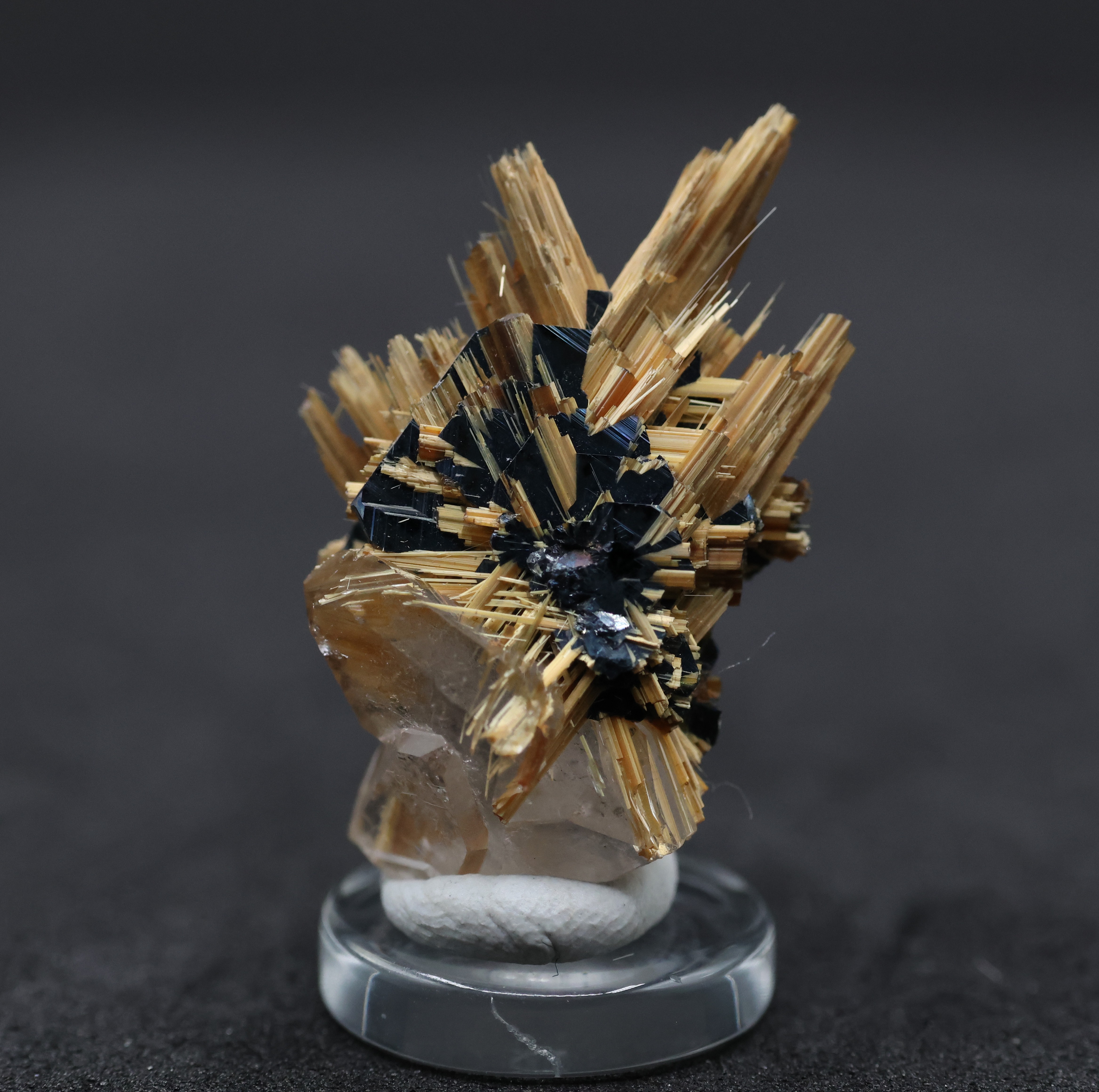
Rutile is a mineral from the oxide group, one of the three naturally occurring varieties of titanium dioxide, characterized by high luster and varied color.
Properties
- Mohs hardness
- 6-6.5
- Luster
- Adamantine
- Streak
- Greyish black, pale brown, light yellow
- Density
- 4.23
- Cleavage
- {110} distinct, {100} less distinct; and, {111} in traces.
- Fracture
- Muszlowy do nierównego
- Transparency
- Transparent
- Crystal system
- Tetragonal
Diagnostic features
## Identification Rutile can be identified by its characteristic adamantine luster, prismatic crystal habit, and often occurring geniculated twins. The color is variable, but often occurs in shades of red, brown, and black. Acicular rutile inclusions in quartz are also easily recognizable. ## Distinguishing from Similar Minerals Rutile can be confused with tourmaline or staurolite due to similar crystal habit. However, rutile is distinguished by its higher adamantine luster and different hardness. It also differs from tourmaline by the absence of a trigonal crystal system, and from staurolite by the absence of characteristic cross-shaped twins. ## Crystal Forms Rutile usually forms columnar or acicular crystals, often with distinct longitudinal striations. Geniculated twins are very typical, where crystals intergrow at an angle, forming characteristic shapes. It can also occur as fibrous or granular aggregates, as well as inclusions in other minerals.
Geological environment
## Genesis Rutile forms under a wide range of geological conditions. It occurs in igneous rocks, such as pegmatites and granites, as well as in metamorphic rocks, including gneisses, crystalline schists, and eclogites. It can also form in hydrothermal veins. It is resistant to weathering, so it is often found in alluvial deposits as a heavy mineral. ## Mineral Associations Rutile often co-occurs with quartz, feldspar, mica, ilmenite, hematite, corundum, garnet, zircon, as well as with anatase and brookite, which are other polymorphic varieties of TiO₂. ## Localities Known rutile localities are found in many places around the world. In Europe, these include the Alps (Switzerland, Austria, Italy), Norway, Russia (Urals). In North America, rutile occurs in the USA (e.g., Arkansas, North Carolina) and Canada. Other important localities include Brazil, Australia, and Madagascar.
Rarity
Very Common
For collectors
## Quality Criteria Collectors value rutile specimens for their well-formed crystals, intense color, high luster, and interesting twinning forms. Specimens with rutile inclusions in quartz, where acicular rutile crystals form spectacular patterns, are particularly sought after. The size and clarity of the crystals also affect their collector's value. ## Popular Localities The most prized rutile specimens come from localities such as the Alps (especially Switzerland), where beautiful, well-formed crystals are found. Brazil is known for rutilated quartz of exceptional quality. Other important sources include Arkansas in the USA and Madagascar.
Care and storage
## Cleaning Rutile specimens can be cleaned using a soft brush and lukewarm water. For heavier dirt, a mild soap can be used, followed by thorough rinsing of the mineral with distilled water. ## What to Avoid Rutile is relatively hard, but contact with strong acids and bases, which can damage the mineral's surface, should be avoided. Specimens should also be protected from sudden temperature changes and prolonged exposure to direct sunlight, which can lead to fading of some colored varieties. ## Storage Rutile is best stored in a dry place, away from dust and other minerals that could scratch it. It is ideal to place the specimen in a closed display case or a box with soft lining, which will provide protection against mechanical damage and contamination.