Ruby
Chemical formula: Al₂O₃
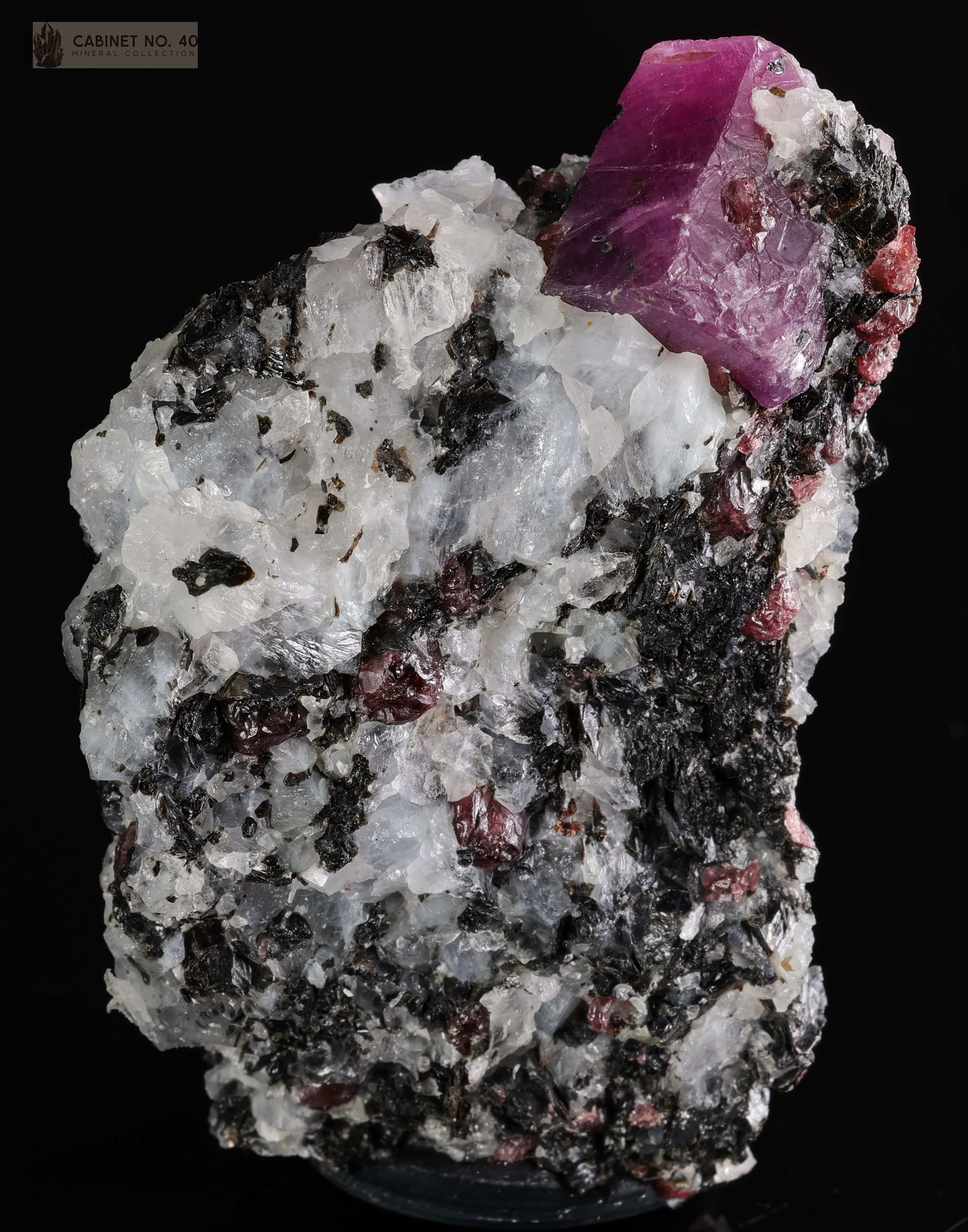
Ruby is a red variety of corundum, valued as a gemstone for its color, hardness, and luster.
Properties
- Mohs hardness
- 9
- Color
- Red
- Luster
- Szklisty do diamentowego
- Streak
- Biała
- Density
- 0
- Cleavage
- Brak
- Fracture
- Muszlowy do nierównego
- Transparency
- Przezroczysty do przeświecającego
- Crystal system
- Trigonal
Diagnostic features
## Identification Ruby can be identified by its characteristic red color, high hardness (scratches most minerals except diamond), and vitreous to adamantine luster. It often exhibits strong fluorescence under ultraviolet light, glowing red. Ruby crystals typically have a hexagonal habit. ## Distinguishing from Similar Minerals Ruby is sometimes confused with garnet, spinel, tourmaline (rubellite), and topaz. It can be distinguished from garnet and spinel by its hardness (ruby is harder). Garnet usually does not exhibit fluorescence. Ruby differs from tourmaline in its crystallographic system and lack of distinct cleavage. Topaz is also harder but has a different color and cleavage. Hardness testing and observation of fluorescence are key in diagnosis. ## Crystal Forms Ruby most commonly occurs as hexagonal prisms, tabular crystals, or barrel-shaped crystals. Crystals can be well-formed, with distinct faces, or have rounded edges. It also often forms granular or massive aggregates in the host rock.
Geological environment
## Genesis Ruby forms in metamorphic rocks, such as marbles, gneisses, and schists, as a result of high-temperature and high-pressure processes. It can also occur in igneous rocks, especially in pegmatites and basalts. It is often found in alluvial secondary deposits, where it is resistant to weathering and transport. ## Mineral Associations Ruby often co-occurs with other minerals, such as marl, muscovite, biotite, phlogopite, spinel, garnet, zircon, rutile, and calcite. In alluvial deposits, it is accompanied by other heavy minerals, such as gold or sapphire. ## Locations The most important ruby deposits are located in Myanmar (Mogok Valley, Mong Hsu), Thailand, Sri Lanka, Tanzania, Vietnam, Madagascar, Afghanistan, and Pakistan. Smaller deposits also occur in other countries, including the USA (North Carolina, Montana) and Australia.
Rarity
Rare
For collectors
## Quality Criteria The most important quality criteria for collector's rubies are color, transparency, size, and crystal form. Specimens with intense, deep red color, without visible inclusions and fractures, are most valued. Well-formed, large crystals with distinct faces are particularly sought after. Specimens embedded in an aesthetic matrix also have high collector's value. ## Popular Localities The most prized ruby specimens come from Myanmar, especially from the Mogok Valley, where rubies of the famous “pigeon's blood” color are mined. Other important sources include Thailand, Sri Lanka, and Tanzania, which also supply high-quality stones.
Care and storage
## Cleaning Rubies can be cleaned with warm water, mild soap, and a soft brush. After washing, they should be thoroughly rinsed with clean water to remove any soap residue, and then dried with a soft cloth. Ultrasonic cleaners can also be used, but caution should be exercised with specimens that have fractures or inclusions. ## What to Avoid Rubies are resistant to most chemicals, but contact with hydrofluoric acid should be avoided. High temperatures can affect the color of the stone, so it should not be exposed to sudden temperature changes. Prolonged exposure to strong sunlight usually does not negatively affect ruby, but in some specimens, it can lead to subtle color changes. Strong impacts that could cause fractures should also be avoided. ## Storage Rubies should be stored separately from other gemstones, especially those with lower hardness, to prevent scratching. It is best to wrap them in a soft cloth or store them in separate compartments in a jewelry box. Collector's specimens should be displayed in stable conditions, away from dust and direct sunlight.