Rabbittite
Chemical formula: Ca<sub>3</sub>Mg<sub>3</sub>(U<sup>6+</sup>O<sub>2</sub>)<sub>2</sub>(CO<sub>3</sub>)<sub>6</sub>(OH)<sub>4</sub>·18H<sub>2</sub>O
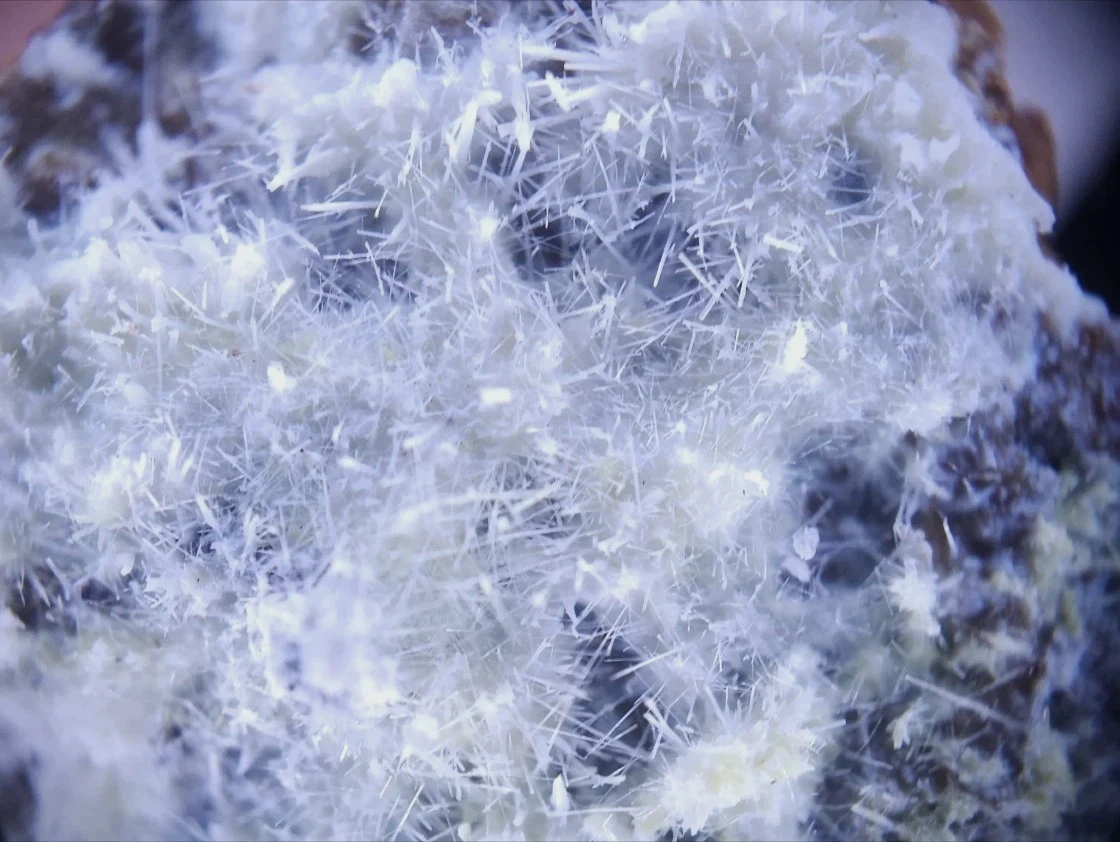
Rabbittite is a rare hydrated uranyl magnesium carbonate, forming fibrous or acicular crystals of a pale green color.
Properties
- Mohs hardness
- 2.5
- Luster
- Silky
- Streak
- Brak danych
- Density
- 2.57
- Cleavage
- Parallel to the c-axis. Under the microscope the crystals show a cleavage across the fibers, which is probably parallel to {001}, and two easy and perfect prismatic cleavages.
- Fracture
- Brak danych
- Transparency
- Translucent
- Crystal system
- Monoclinic
Diagnostic features
## Identification Rabbittite can be identified by its characteristic pale green color, fibrous or acicular crystal habit, and silky luster. Its occurrence in the oxidation zones of uranium deposits is also an important diagnostic clue. Due to radioactivity, a radiation detector can aid in identification. ## Distinguishing from Similar Minerals It can be confused with other uranyl minerals of similar color, such as uranophane or tyuyamunite. Differentiation usually requires laboratory analysis, such as X-ray diffraction, due to visual similarities and often microscopic crystal sizes. The geological environment of occurrence is also crucial. ## Crystal Forms Typical forms are fibrous or acicular crystals, often forming radial or spherical aggregates. Crystals are elongated along the c-axis.
Geological environment
## Genesis Rabbittite is a secondary mineral, formed in the oxidation zones of uranium deposits. It forms as a result of the weathering of primary uranium minerals in the presence of carbonates and magnesium. ## Mineral Associations It co-occurs with other uranium minerals, such as uraninite, carnotite, tyuyamunite, uranophane, as well as calcite and gypsum. ## Localities Known localities of rabbittite include mines in the United States (e.g., Lucky Strike mine in Emery County, Utah; Delta mine in San Juan County, Utah) and in Canada (e.g., Beaverlodge mine, Saskatchewan).
Rarity
Very Rare
For collectors
## Quality Criteria The most prized rabbittite specimens are those that display distinct, well-formed aggregates of fibrous or acicular crystals with an intense, uniform pale green color. Larger aggregate sizes and their aesthetic arrangement on the matrix also increase collectible value. Minimal mechanical damage is also important. ## Popular Localities The most sought-after specimens typically come from well-known localities in the United States, particularly from uranium mining regions in Utah, where the first specimens were discovered.
Care and storage
## Cleaning Due to its radioactivity and delicacy, rabbittite should not be wet cleaned. Any cleaning procedures should be limited to gently removing dust with a soft brush or compressed air. Avoid skin contact. ## What to Avoid Avoid exposure to water, chemicals, high temperatures, and direct sunlight, which can negatively affect the mineral's stability and color. Due to its uranium content, the mineral is radioactive, so prolonged and direct contact with it should be avoided. ## Storage Rabbittite should be stored in a sealed container, preferably in a separate, ventilated area, away from other minerals and materials that could be damaged by radiation. Due to radioactivity, it is recommended to use appropriate personal protective equipment when handling the specimen.