Purpurite
Chemical formula: Mn<sup>3+</sup>☐PO<sub>4</sub>
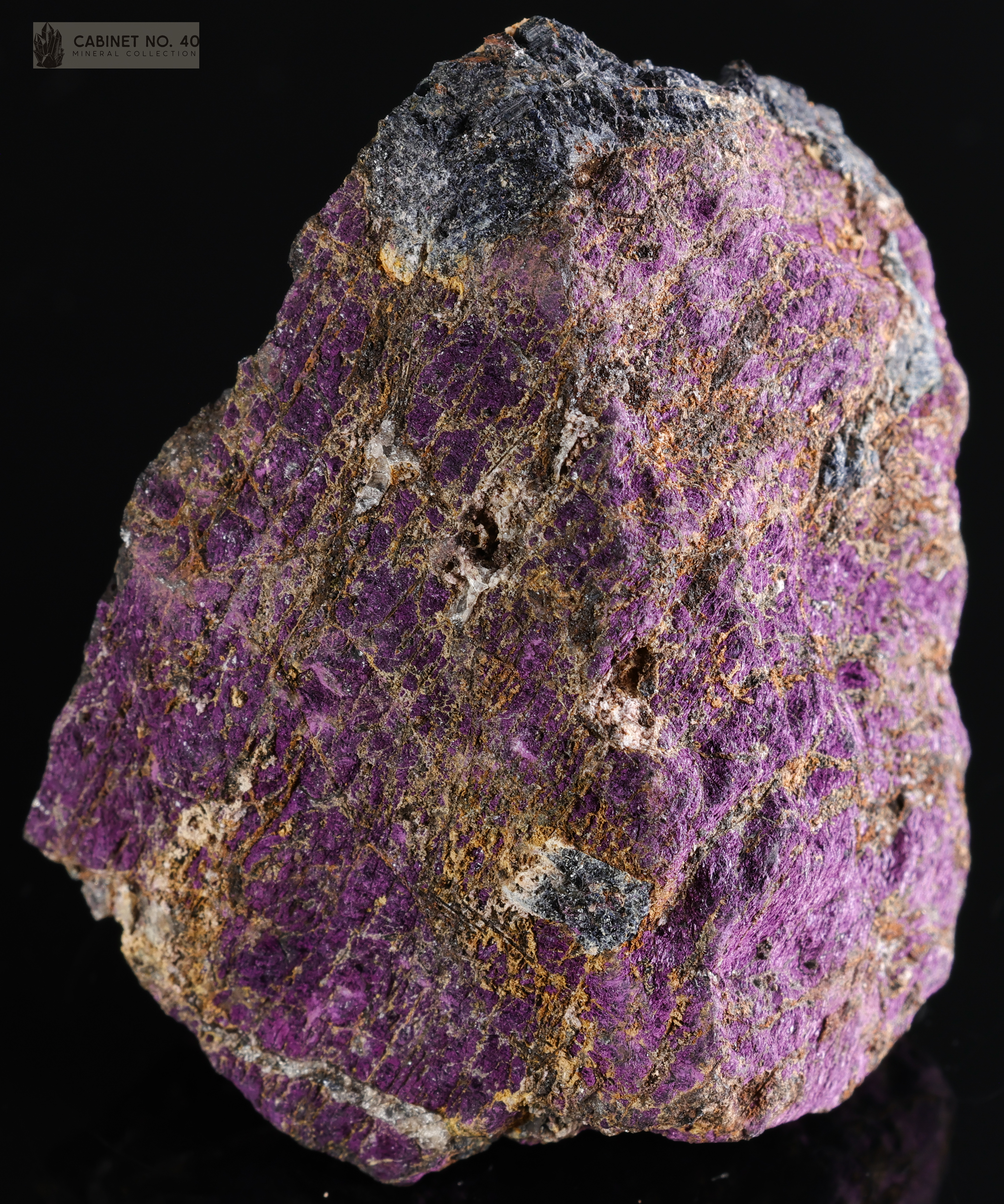
Purpurite is a rare manganese phosphate mineral, characterized by its intense purple color, often found in massive aggregates.
Properties
- Mohs hardness
- 4-4.5
- Luster
- Vitreous, dull
- Streak
- Light to medium purple, lighter than the colour of the massive mineral.
- Density
- 3.2
- Cleavage
- On {100}, good; on {010}, imperfect. Cleavage surfaces curved or crinkled at times.
- Fracture
- Nierówny
- Transparency
- Opaque
- Crystal system
- Orthorhombic
Diagnostic features
## Identification Purpurite can be identified by its characteristic dark purple color, which is its most distinguishing feature. It often occurs in massive aggregates, and its streak is lighter than the mineral's color. The luster is vitreous to dull. ## Distinguishing from Similar Minerals Purpurite can be confused with some varieties of lithiophilite or rhodonite, however, its intense, dark purple color and a lighter purple streak are diagnostic features. Lithiophilite is usually lighter, and rhodonite has a pink color. In case of doubt, hardness and density testing are helpful. ## Crystal Forms Purpurite most commonly occurs as massive, compact aggregates. Less frequently, it forms small, tabular or prismatic crystals with an orthorhombic crystal system. Crystals may exhibit cleavage on {100} and {010} faces.
Geological environment
## Genesis Purpurite forms in pegmatites, especially in oxidation zones, where manganese undergoes chemical transformations. It often forms as a result of weathering and alteration of other manganese phosphate minerals, such as lithiophilite. ## Mineral Associations Purpurite often coexists with other phosphate minerals, such as lithiophilite, triphylite, as well as with quartz, feldspar, and muscovite in pegmatites. It can also be found in association with manganese minerals. ## Localities Known purpurite localities include pegmatites in the United States (e.g., North Carolina, South Dakota), Namibia (Usakos area), Brazil (Minas Gerais), and Portugal (Mangualde).
Rarity
Uncommon
For collectors
## Quality Criteria The most prized purpurite specimens are those with an intense, uniform, dark purple color. Large, massive aggregates with a distinct luster are also highly valued. The absence of cracks, defects, and contamination by other minerals increases collector value. Clean, well-formed crystals are rare and constitute valuable specimens. ## Popular Localities The most sought-after purpurite specimens come from Namibia, where specimens of exceptionally intense color are found. Specimens from pegmatites in the United States and Brazil are also valued.
Care and storage
## Cleaning Purpurite can be cleaned gently using a soft brush and lukewarm water. For heavier soiling, distilled water can be used. Avoid vigorous scrubbing to prevent scratching the mineral's surface. ## What to Avoid Avoid contact of purpurite with strong acids and bases, which can damage its surface or alter its color. Prolonged exposure to direct sunlight can lead to color fading. The mineral is sensitive to sudden temperature changes. ## Storage Purpurite is best stored in a dry place, away from direct sunlight and heat sources. It should be placed in a closed display case or box to protect it from dust and mechanical damage. More valuable collector's specimens can be stored in individual containers with soft padding.