Pseudolaueite
Chemical formula: Mn<sup>2+</sup>Fe<sup>3+</sup><sub>2</sub>(PO<sub>4</sub>)<sub>2</sub>(OH)<sub>2</sub>(H<sub>2</sub>O)<sub>6</sub>·2H<sub>2</sub>O
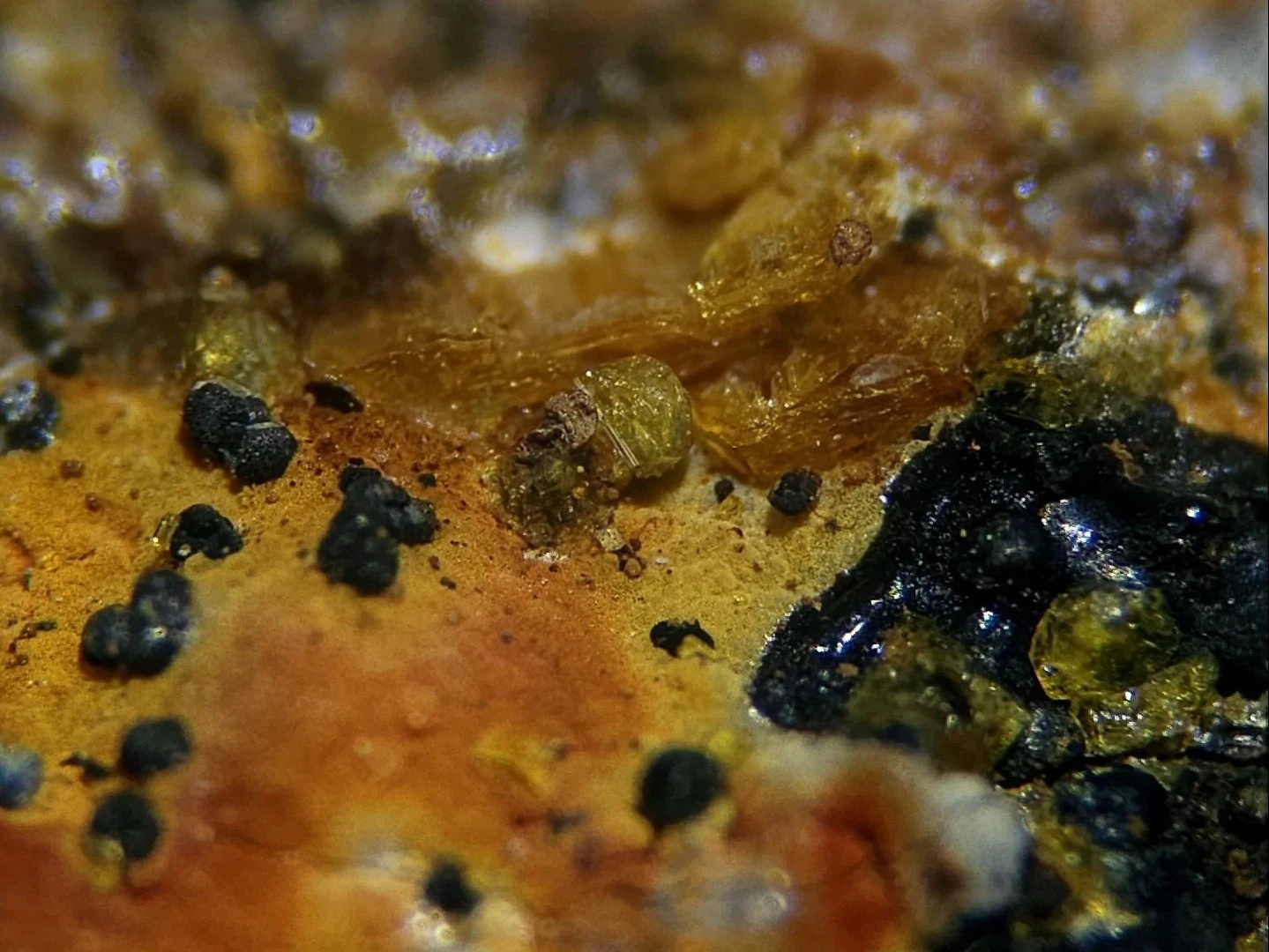
Pseudolaueite is a rare manganese and iron phosphate mineral, typically forming small, yellow-orange crystals.
Properties
- Mohs hardness
- 3
- Luster
- Szklisty
- Streak
- White
- Density
- 2.463
- Cleavage
- Doskonała wg {100}
- Fracture
- Nierówny
- Transparency
- Transparent,Translucent
- Crystal system
- Monoclinic
Diagnostic features
## Identification Pseudolaueite can be identified by its characteristic yellow-orange to amber-yellow color and typical habit of small, often tabular or prismatic crystals. It usually occurs in radial aggregates or as druses on other minerals. Its softness (Mohs hardness of 3) is also a diagnostic feature. ## Distinguishing from Similar Minerals Pseudolaueite is often confused with laueite, with which it co-occurs. The differences between them are subtle and often require X-ray analysis or other specialized tests for definitive distinction. It is distinguished from other phosphates by its specific chemical composition and crystallographic system. ## Crystal Forms Pseudolaueite crystals are usually small, with a tabular or prismatic habit. They often form radial aggregates or druses, covering the surfaces of other minerals in geodes or rock fissures.
Geological environment
## Genesis Pseudolaueite is a secondary mineral, formed in the oxidation zones of phosphate deposits, often in pegmatites. It forms as a result of hydrothermal processes or the weathering of other phosphate minerals, in an environment rich in manganese and iron. ## Mineral Associations Pseudolaueite often co-occurs with other phosphate minerals, such as laueite, strunzite, rockbridgeite, vivianite, as well as with quartz and mica group minerals. ## Localities The most known occurrences of pseudolaueite are found in pegmatites, including the Hagendorf-Süd mine in Bavaria (Germany), the Boldut mine in Romania, and pegmatites in Maine (USA).
Rarity
Very Rare
For collectors
## Quality Criteria The most prized pseudolaueite specimens are characterized by an intense, uniform yellow-orange or amber-yellow color. The size and perfection of crystal development are also important, as is their aesthetic arrangement in druses or radial aggregates. Transparency and the absence of mechanical damage further increase the specimen's value. ## Popular Localities The most sought-after pseudolaueite specimens come from classic localities, such as the Hagendorf-Süd mine in Germany, known for its well-formed and aesthetic crystals. Other valued sources include pegmatites in Romania and the USA.
Care and storage
## Cleaning Pseudolaueite is a relatively soft mineral, so it should be handled with care. For cleaning, it is best to use a soft brush or paintbrush to gently remove dust. For heavier soiling, lukewarm distilled water can be used, avoiding prolonged soaking. ## What to Avoid Avoid using any chemical cleaning agents, which can damage the mineral's surface. Pseudolaueite is sensitive to temperature changes and direct sunlight, which can cause color fading. High humidity is also not recommended, as it can lead to the degradation of the specimen. ## Storage Pseudolaueite specimens are best stored in enclosed display cases or boxes, away from dust and direct light. Due to its softness, avoid contact with harder minerals that could scratch it. Stable temperature and low humidity are crucial for preserving its appearance.