Prehnite
Chemical formula: Ca<sub>2</sub>Al(Si<sub>3</sub>Al)O<sub>10</sub>(OH)<sub>2</sub>
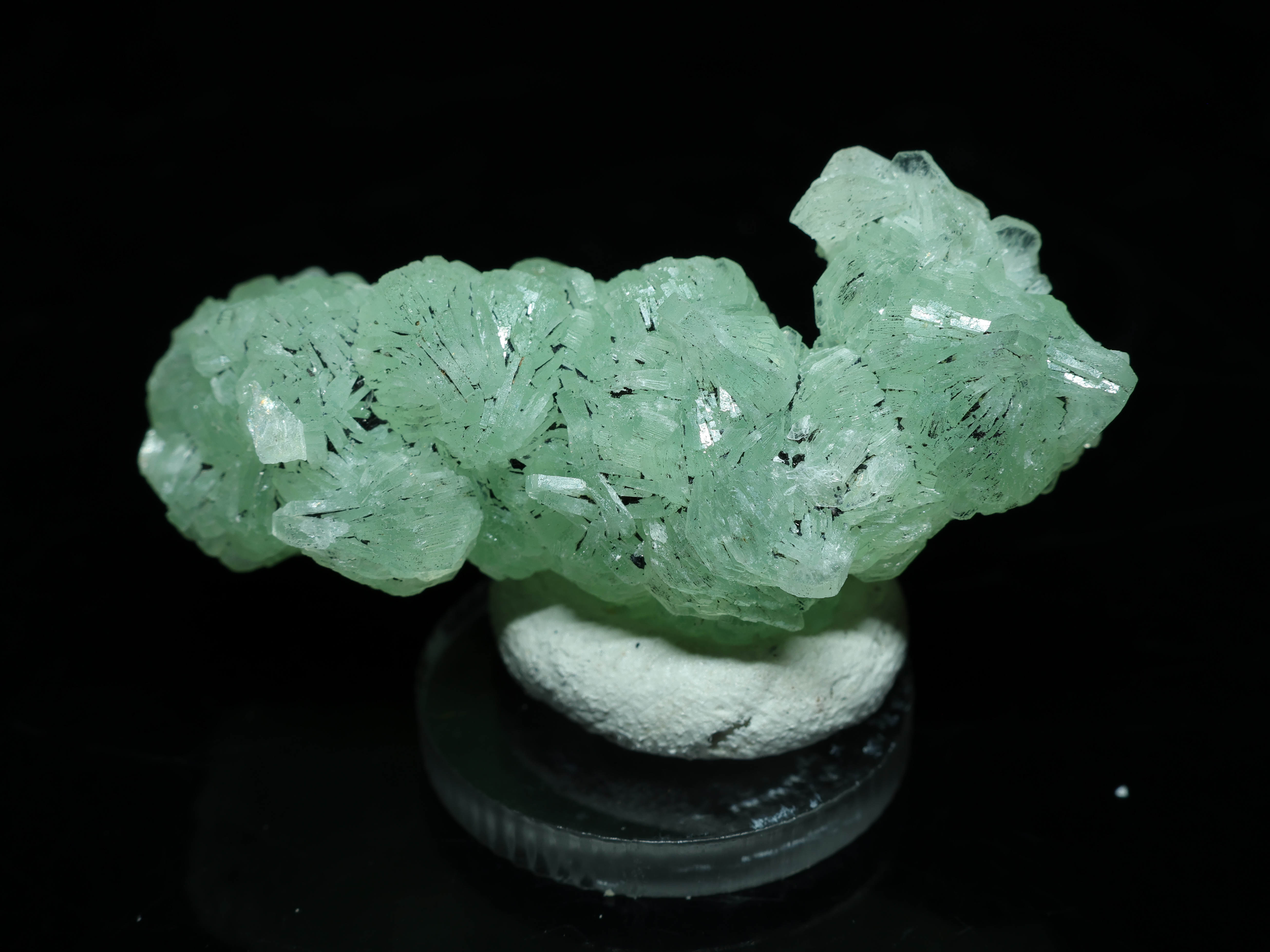
Prehnite is a hydrated calcium aluminum silicate, often forming reniform or botryoidal aggregates with a characteristic greenish coloration.
Properties
- Mohs hardness
- 6-6.5
- Luster
- Vitreous to Pearly
- Streak
- White
- Density
- 2.8
- Cleavage
- Good on {001}, poor on {110}
- Fracture
- Nierówny
- Transparency
- Translucent
- Crystal system
- Orthorhombic
Diagnostic features
## Identification Prehnite can be identified by its characteristic reniform, botryoidal, or radial aggregates, often with a greenish coloration. Its vitreous to pearly luster and Mohs hardness of 6-6.5 are also helpful in identification. It often occurs in basaltic cavities and other volcanic rocks. ## Distinguishing from Similar Minerals Prehnite is sometimes confused with chalcedony, although chalcedony is usually more homogeneous and does not exhibit such a distinct radial structure. It can also be confused with some varieties of jadeite or nephrite, but prehnite is usually more transparent and has a different hardness. Differentiation from serpentine is possible due to prehnite's greater hardness and its characteristic structure. ## Crystal Forms Prehnite most often forms reniform, botryoidal, spherical, or radial aggregates. Crystals are usually tabular or prismatic, but rarely occur as well-formed, single specimens. It often forms concretions or coatings on other minerals.
Geological environment
## Genesis Prehnite forms under low-temperature hydrothermal conditions, often in fractures and cavities of volcanic rocks, such as basalts, andesites, and diabases. It also forms in some metamorphic rocks, especially in the prehnite-pumpellyite facies, where it is a product of the alteration of plagioclase and other calcium-aluminum minerals. ## Mineral Associations Prehnite often co-occurs with zeolites (such as stilbite, heulandite, laumontite), calcite, apophyllite, epidote, quartz, pumpellyite, and native copper. In some deposits, it may be associated with garnets. ## Localities Known prehnite deposits are found in many places around the world. The most important include: South Africa (Karoo region, where it was first discovered), India (Deccan Traps), Australia (Broken Hill, Northern Territory), United States (New Jersey, Virginia), Canada (Quebec), Scotland, France, and China.
Rarity
Very Common
For collectors
## Quality Criteria The most prized prehnite specimens are those with an intense, uniform, apple-green coloration. The aesthetics of the aggregate are also important – well-formed reniform, botryoidal, or radial shapes are highly sought after. Transparency and the absence of visible inclusions also increase the value of the specimen. Large, well-formed specimens are particularly valuable. ## Popular Localities The most prized prehnite specimens come from South Africa, especially from the Karoo region, where beautiful, green aggregates occur. India, from the Deccan Traps region, also provides high-quality specimens. Other important localities include Australia (Broken Hill) and the United States (New Jersey).
Care and storage
## Cleaning Prehnite can be cleaned with a soft brush and lukewarm water. For heavier soiling, a mild soap can be used, followed by thorough rinsing with clean water. It is important to dry the specimen thoroughly after washing, preferably with a soft cloth. ## What to Avoid Avoid using aggressive chemicals, such as acids or strong detergents, which can damage the mineral's surface. Prehnite is sensitive to high temperatures and sudden temperature changes, which can lead to cracking. Prolonged exposure to direct sunlight can cause some color varieties to fade. This mineral is not particularly sensitive to moisture, but prolonged storage in a very humid environment is not recommended. ## Storage Prehnite is best stored in a dry place, away from direct sunlight and heat sources. Due to its hardness, specimens can be stored with other minerals of similar hardness to avoid mutual scratching. Smaller specimens can be placed in separate boxes or pouches to prevent damage.