Pyrite
Chemical formula: Fe<sup>2+</sup>(S<sub>2</sub>)<sup>2-</sup>
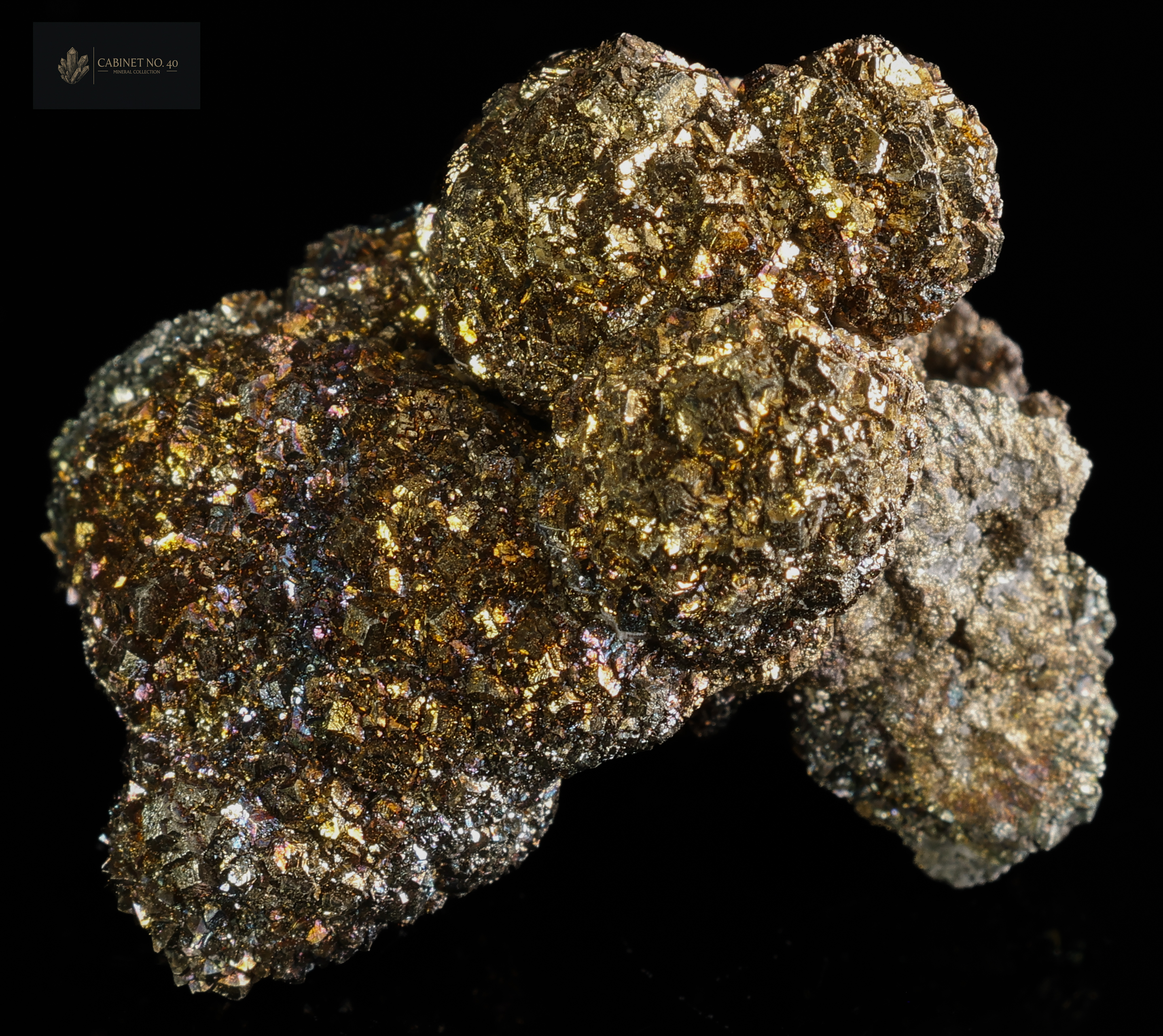
Pyrite is a common sulfide mineral, often called "fool's gold" due to its metallic luster and brass-yellow color, resembling gold.
Properties
- Mohs hardness
- 6-6.5
- Luster
- Metaliczny
- Streak
- Greenish-black
- Density
- 4.8
- Cleavage
- Indistinct on {001}.
- Fracture
- Muszlowy do nierównego
- Transparency
- Opaque
- Crystal system
- Isometric
Diagnostic features
## Identification Pyrite can be identified by its characteristic brass-yellow color and metallic luster. It often occurs as cubes, octahedra, or pentagonal dodecahedra, often with visible striations on the crystal faces. The streak of pyrite is greenish-black, which is an important diagnostic feature. ## Distinguishing from similar minerals Pyrite is sometimes confused with native gold, but it differs significantly in its much greater hardness (gold is soft and can be scratched with a knife) and brittleness (gold is malleable). The streak of pyrite is greenish-black, while the streak of gold is yellow. Pyrite can also be confused with chalcopyrite, which has a more yellow color and lower hardness (3.5-4). Marcasite, an isopolymorph of pyrite, has the same chemical formula but crystallizes in the orthorhombic system and often forms characteristic radiating or botryoidal forms. ## Crystal forms Pyrite most commonly forms isometric crystals with cubic, octahedral, or pentagonal dodecahedral (pyritohedral) habits. Striations are often present on the crystal faces, especially on cubes. Pyrite can also form granular, massive, radiating, reniform aggregates, as well as concretions and coatings.
Geological environment
## Genesis Pyrite is a common mineral, occurring in a wide range of geological environments. It forms under hydrothermal, sedimentary, metamorphic, and magmatic conditions. It is frequently found in hydrothermal veins, in sedimentary rocks (e.g., shales, coal), in metamorphic rocks (e.g., gneisses, crystalline schists), and in igneous rocks as an accessory mineral. ## Mineral associations Pyrite often co-occurs with other sulfides, such as chalcopyrite, galena, sphalerite, arsenopyrite, as well as with quartz, calcite, fluorite, and other ore and rock-forming minerals. ## Localities Spain (Rio Tinto), Peru (Huaron, Quiruvilca), Italy (Elba), United States (Colorado, Arizona), Russia (Urals), Canada (Ontario), and many other places worldwide are known for rich pyrite deposits. In Poland, pyrite occurs, among other places, in Lower Silesia, the Świętokrzyskie Mountains, and in coal deposits.
Rarity
Very Common
For collectors
## Quality criteria The most valued pyrite specimens by collectors are those with well-formed, large, and undamaged crystals, especially those with rare forms, such as perfect cubes, octahedra, or pentagonal dodecahedra. An intense, uniform color and strong metallic luster are also important. Specimens with iridescent tarnish, creating spectacular rainbow colors, are also highly sought after. Specimens with interesting mineral associations also increase their value. ## Popular localities Among the most famous and valued pyrite localities are: Navajún in Spain, known for its perfectly formed cubes; Peru, from where specimens with diverse forms and often with iridescent tarnish originate; and Elba in Italy, known for its beautiful pyrite crystals.
Care and storage
## Cleaning Pyrite can be cleaned using a soft brush and distilled water. Gently remove dust and dirt from the mineral's surface. For heavier soiling, a mild soap can be used, followed by thoroughly rinsing the specimen with clean water and drying it. ## What to avoid Pyrite is sensitive to acids and strong chemicals, which can damage its surface or cause corrosion. Avoid prolonged exposure to moisture, which can lead to pyrite oxidation and tarnish formation. It is also not recommended to expose specimens to direct sunlight for extended periods, as this may affect their color. ## Storage Pyrite is best stored in a dry place, away from moisture and heat sources. It is advisable to place it in a closed display case or box to protect it from dust and mechanical damage. Specimens with iridescent tarnish may be more sensitive to touch, so they should be handled with care.