Pyrolusite
Chemical formula: Mn<sup>4+</sup>O<sub>2</sub>
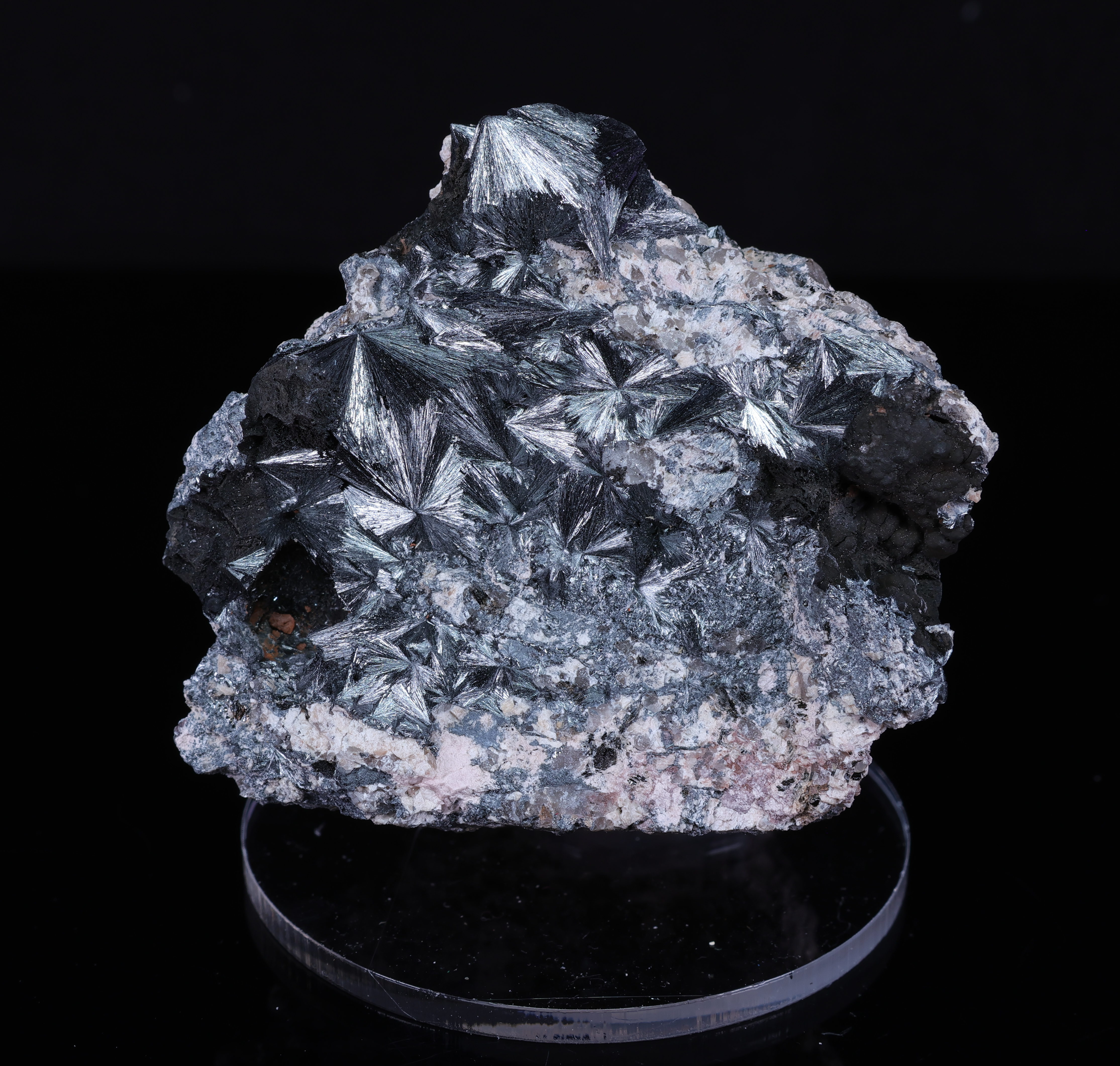
Pyrolusite is a manganese oxide mineral, an important ore of this metal, characterized by its black color and variable hardness.
Properties
- Mohs hardness
- 2-6.5
- Luster
- Metaliczny do matowego
- Streak
- Black to bluish-black.
- Density
- 5.04
- Cleavage
- Perfect on {110}.
- Fracture
- Nierówny
- Transparency
- Opaque
- Crystal system
- Tetragonal
Diagnostic features
## Identification Pyrolusite can be identified by its black or dark gray color, black streak, and often earthy or fibrous habit. This mineral is opaque and has variable hardness. It often occurs in dendritic forms. ## Distinguishing from Similar Minerals Pyrolusite can be confused with other black manganese minerals, such as manganite or hausmannite. It differs from manganite by its lower hardness and lack of metallic luster. It differs from hausmannite by its lack of magnetism. The streak of pyrolusite is always black, which is an important diagnostic feature. ## Crystal Forms Pyrolusite crystals are rare and usually have a columnar, acicular, or prismatic habit. More commonly, massive, earthy, reniform, botryoidal, fibrous, or dendritic aggregates are found.
Geological environment
## Genesis Pyrolusite forms under oxidizing conditions, often as a product of weathering of other manganese minerals. It is a typical mineral of the oxidation zone of manganese deposits, as well as marine and lacustrine sediments. It also occurs in some metamorphic and hydrothermal rocks. ## Mineral Associations Pyrolusite often co-occurs with other manganese oxides and hydroxides, such as manganite, hausmannite, braunite, as well as with goethite, limonite, barite, and calcite. ## Localities Important pyrolusite deposits are found in Ghana, India, Brazil, Russia (Urals), United States (Arkansas, Virginia), Mexico, Australia, and South Africa. In Europe, it occurs, among other places, in Germany (Hesse) and the Czech Republic.
Rarity
Very Common
For collectors
## Quality Criteria The most prized pyrolusite specimens are well-formed crystals, especially those with a distinct columnar or acicular habit. Aesthetic dendritic aggregates on a light background are also attractive. Size, clarity, and color contrast are key to collector value. ## Popular Localities Specimens from Brazil (Minas Gerais) are particularly sought after due to their well-formed crystals, as are those from Germany (Ilfeld) known for their beautiful dendrites.
Care and storage
## Cleaning Pyrolusite is a relatively stable mineral, but due to its variable hardness and brittleness, it should be handled with care. Specimens can be cleaned gently using a soft brush and lukewarm water. For earthy aggregates, avoid vigorous scrubbing to prevent damage to the structure. ## What to Avoid Avoid using strong acids and bases, which can react with pyrolusite. Exposure to high temperatures is not recommended, as it can lead to changes in the mineral's structure. Direct and prolonged exposure to sunlight is not harmful to the mineral itself, but it may affect the stability of other co-occurring minerals. ## Storage Pyrolusite is best stored in a dry place, away from moisture, which can promote the growth of coatings. Specimens should be protected from mechanical damage, especially those with lower hardness. For crystals, it is recommended to store them in separate boxes with soft padding to prevent chipping.