Okenite
Chemical formula: Ca<sub>10</sub>Si<sub>18</sub>O<sub>46</sub>(H<sub>2</sub>O)<sub>18</sub>
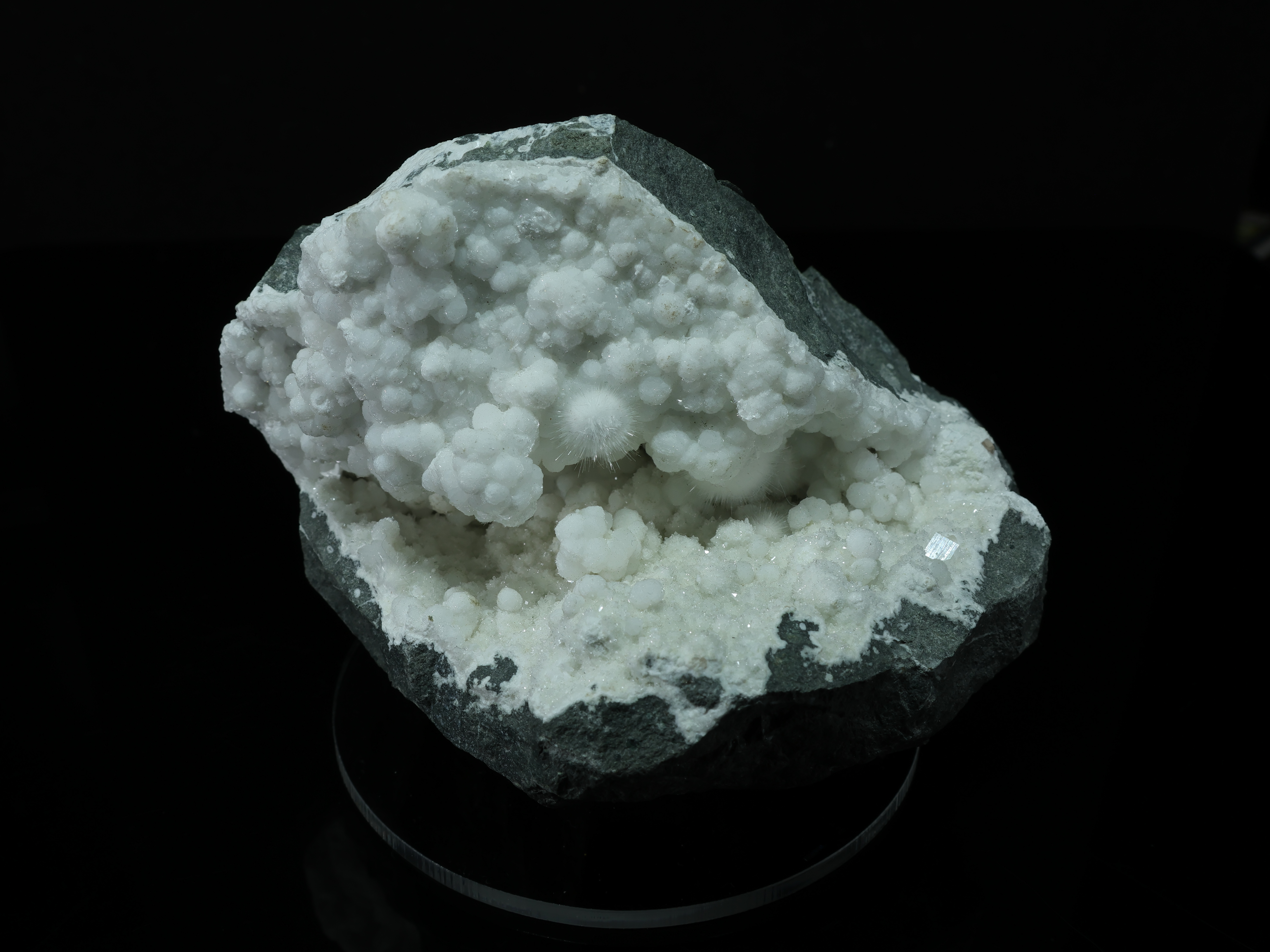
Okenite is a rare calcium silicate mineral, known for its characteristic fibrous aggregates forming spherical shapes, often called "cotton balls."
Properties
- Mohs hardness
- 4.5-5
- Luster
- Jedwabisty
- Streak
- White
- Density
- 2.28
- Cleavage
- on {001}
- Fracture
- Nierówny
- Transparency
- Transparent,Translucent
- Crystal system
- Triclinic
Diagnostic features
## Identification Okenite is easily recognizable by its characteristic, spherical aggregates of fibrous crystals, which resemble cotton balls. These white or slightly yellowish forms, often with a silky luster, are unique to this mineral. Its softness (4.5-5 on the Mohs scale) and perfect cleavage also aid in identification. ## Distinguishing from Similar Minerals Okenite can be confused with some zeolites, such as scolecite or mesolite, which also form fibrous aggregates. However, okenite's spherical forms are usually more compact and cotton-like, while zeolites often form more radial or acicular clusters. Differences in hardness and density can also help in differentiation. ## Crystal Forms Okenite most commonly occurs as spherical or hemispherical aggregates, composed of numerous, fine, acicular crystals. These crystals are usually very thin and flexible, which gives the aggregates their characteristic soft appearance. Single, well-formed crystals are rarely found.
Geological environment
## Genesis Okenite is a secondary mineral, forming under low-temperature hydrothermal conditions. It typically forms in gas vesicles (geodes) and fractures in volcanic rocks, especially basalts. It is a product of the alteration of primary silicate minerals in the presence of solutions rich in calcium and silica. ## Mineral Associations Okenite often co-occurs with other secondary minerals, such as zeolites (e.g., stilbite, heulandite, apophyllite), calcite, chalcedony, prehnite, and quartz. These minerals often form beautiful, complex aggregates in basaltic geodes. ## Localities The most known and valued okenite localities are in India, especially in the Deccan region (e.g., Pune and Nashik areas in Maharashtra state), where it occurs in basalts. Other localities include the Faroe Islands, Greenland, and some areas in the United States.
Rarity
Rare
For collectors
## Quality Criteria The most prized okenite specimens are those with large, well-formed, and undamaged spherical aggregates, resembling cotton balls. Color purity (preferably snow-white) and the absence of mechanical damage are also important. Specimens with aesthetic associations with other minerals, such as zeolites or calcite, are also highly valued. ## Market Prices Okenite prices vary and depend on the size, quality, and aesthetics of the specimen. Small, simple specimens can cost from several tens to one hundred Polish zlotys. Larger, perfectly formed aggregates, especially those with attractive associations, can reach prices from several hundred to even several thousand Polish zlotys. ## Popular Localities The most sought-after okenite specimens come from India, especially from the Deccan region. Localities around Pune and Nashik are known for producing the highest quality "cotton balls," which are highly valued by collectors worldwide.
Care and storage
## Cleaning Okenite is a delicate mineral, so it requires careful cleaning. It is best to use a soft brush, such as a makeup brush, to gently remove dust. For heavier soiling, lukewarm distilled water can be used, but prolonged soaking should be avoided, as the mineral is porous and can absorb water. ## What to Avoid Avoid using any chemical agents, including detergents and acids, which can damage the surface of okenite. The mineral is sensitive to impact and abrasion, so it should be handled with care. Prolonged exposure to direct sunlight can lead to fading of delicate colors. High temperatures and sudden temperature changes can also be harmful. ## Storage Okenite is best stored in a closed display case or box to protect it from dust and mechanical damage. Due to its delicacy, specimens should be placed in such a way that they do not come into contact with other, harder minerals. Ideal conditions are stable temperature and moderate humidity.