Natrolite
Chemical formula: Na<sub>2</sub>(Si<sub>3</sub>Al<sub>2</sub>)O<sub>10</sub>·2H<sub>2</sub>O
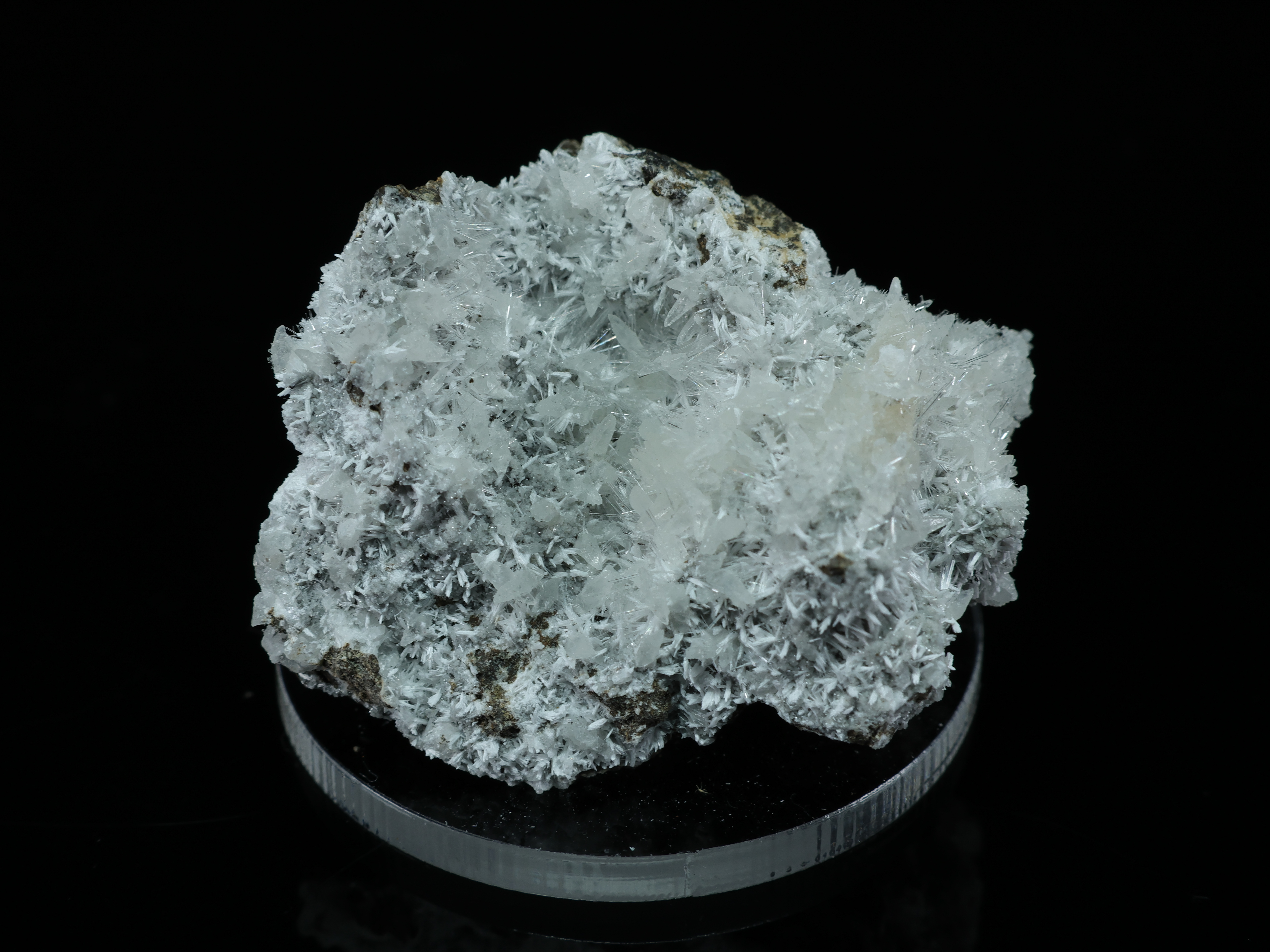
Natrolite is a mineral from the zeolite group, a hydrated sodium and aluminum silicate, often forming acicular or fibrous crystals.
Properties
- Mohs hardness
- 5-5.5
- Luster
- Szklisty
- Streak
- White
- Density
- 2.2
- Cleavage
- on {110}
- Fracture
- Nierówny
- Transparency
- Transparent,Translucent
- Crystal system
- Orthorhombic
Diagnostic features
## Identification Natrolite can be identified by the characteristic acicular or columnar habit of its crystals, often forming radial aggregates. Its hardness (5-5.5 on the Mohs scale) and vitreous luster are also helpful. ## Distinguishing from Similar Minerals Natrolite can be confused with other zeolites, such as scolecite or mesolite, which also form acicular crystals. Distinguishing them often requires microscopic examination or chemical analysis. Scolecite has different cleavage and often forms crystals with more curved surfaces. ## Crystal Forms Natrolite most commonly occurs as elongated, acicular or columnar crystals with a square or rhombic cross-section. These crystals often form radial, stellate, or fibrous aggregates. It can also occur in massive or granular forms.
Geological environment
## Genesis Natrolite primarily forms in low-temperature hydrothermal conditions, filling fissures and gas vesicles in volcanic rocks, especially basalts. It can also form in some metamorphic and sedimentary rocks as a product of alteration of other minerals. ## Mineral Associations Natrolite often co-occurs with other zeolites, such as heulandite, stilbite, scolecite, laumontite, as well as with calcite, apophyllite, and prehnite. In some locations, it is also accompanied by quartz and chalcedony. ## Localities Known localities of natrolite include India (Deccan Traps), Iceland, Northern Ireland (Giant's Causeway), the United States (New Jersey, Oregon), Canada (Nova Scotia), and Russia (Kola Peninsula).
Rarity
Very Common
For collectors
## Quality Criteria The most valued natrolite specimens by collectors are those with well-formed, long, and transparent crystals, forming aesthetic, radial or stellate aggregates. The intensity and uniformity of color are also important if the mineral is colored. Specimens on matrix are particularly sought after. ## Popular Localities Particularly prized natrolite specimens come from India, especially from the Deccan region, where they occur in basalt vesicles. Other popular localities include Iceland, where beautiful white crystals are found, and New Jersey in the USA, known for large, well-formed specimens.
Care and storage
## Cleaning Natrolite is a relatively soft mineral, so it should be cleaned gently. It is best to use a soft brush and lukewarm water. For more stubborn dirt, distilled water can be used. ## What to Avoid Avoid using aggressive chemical agents that can damage the mineral's surface. Prolonged exposure to direct sunlight can lead to fading of some colored varieties. Natrolite is sensitive to acids. ## Storage Natrolite specimens are best stored in enclosed display cases or boxes to protect them from dust and mechanical damage. Due to its fragility, impacts and drops should be avoided. It is advisable to maintain stable temperature and humidity to prevent possible changes in the mineral's structure.