Natanite
Chemical formula: Fe<sup>2+</sup>Sn<sup>4+</sup>(OH)<sub>6</sub>
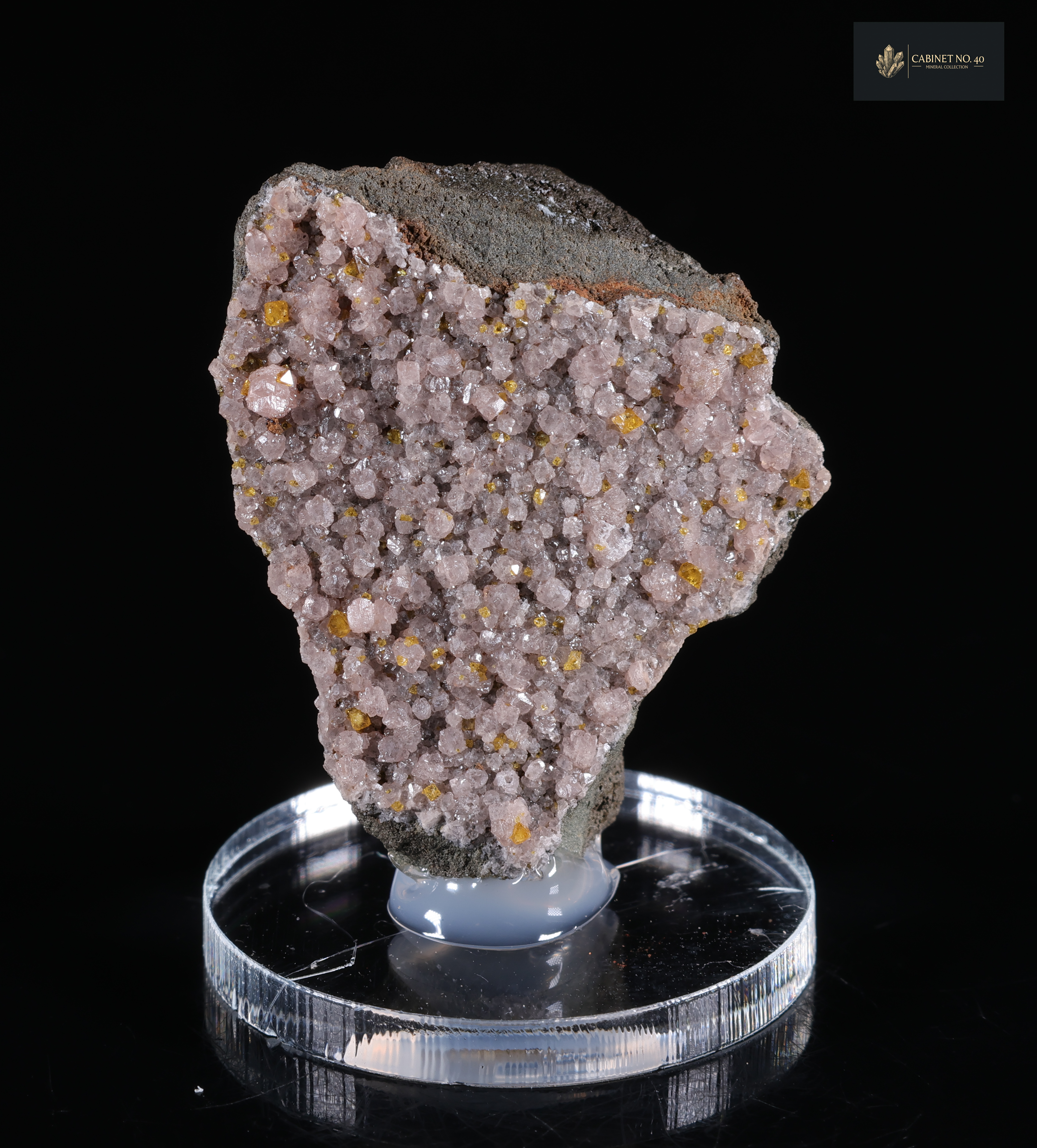
Natanite is a rare mineral, an iron(II) hydroxystannate with the formula Fe²⁺Sn⁴⁺(OH)₆, occurring as small greenish-brown crystals.
Properties
- Mohs hardness
- 5
- Luster
- Metaliczny
- Streak
- Czarna
- Density
- 0
- Cleavage
- Brak
- Fracture
- Nierówny
- Transparency
- Transparent
- Crystal system
- Isometric
Diagnostic features
## Identification Identifying natanite in the field and in collections is difficult due to its rarity and small crystal size. Key features include its greenish-brown color and isometric crystal habit. This often requires chemical analysis or X-ray diffraction to confirm its identity. ## Differentiation from Similar Minerals Natanite can be confused with other tin or iron minerals that exhibit similar colors and forms. It is distinguished from similar minerals by its specific chemical composition, which requires specialized testing. Visually, without advanced tools, differentiation can be very challenging. ## Crystal Forms Natanite typically forms small, isometric crystals. They can occur as individual crystals or in the form of fine-grained aggregates. Their size rarely exceeds a few millimeters.
Geological environment
## Genesis Natanite forms in hydrothermal deposits, often in oxidation zones or in pegmatites where tin is present. Its presence is associated with hydrothermal processes that lead to the precipitation of tin and iron compounds. ## Mineral Associations Natanite often co-occurs with other tin minerals, such as cassiterite, and with iron minerals and other secondary minerals formed in oxidation zones. It can also be found in association with quartz and feldspars. ## Localities Natanite is a very rare mineral, and its occurrence is limited to a few localities worldwide. One of the most famous localities is Russia, where it was first described.
Rarity
Very Rare
For collectors
## Quality Criteria Due to the rarity of natanite, every specimen is valuable to collectors. The most desirable specimens are those with well-formed, though small, crystals, with a distinct greenish-brown color and no visible damage. The size of the crystals, their transparency, and the overall aesthetics of the specimen influence its collectible value. ## Popular Localities The most prized natanite specimens come from the localities where it was first discovered and described, mainly from Russia. Other occurrences are much rarer and yield few specimens of collectible significance.
Care and storage
## Cleaning Due to the delicacy and rarity of natanite, careful cleaning is recommended. For dust removal, it is best to use a soft brush or compressed air. For heavier soiling, the specimen can be gently rinsed with distilled water, avoiding prolonged soaking. ## What to Avoid Avoid using any chemical cleaning agents that may damage the mineral's surface or alter its color. Natanite specimens should not be exposed to direct sunlight for extended periods, as this can lead to fading. It is also important to avoid sudden temperature changes and high humidity, which can negatively affect the mineral's stability. ## Storage Natanite should be stored in a dry and stable environment, away from direct sunlight and heat sources. It is best to place it in a closed display case or a box with soft padding to prevent mechanical damage and dust accumulation. Individual containers or zip-lock bags can further protect small specimens.