Mottramite
Chemical formula: Pb<sup>2+</sup>Cu<sup>2+</sup>V<sup>5+</sup>O<sub>4</sub>(OH)
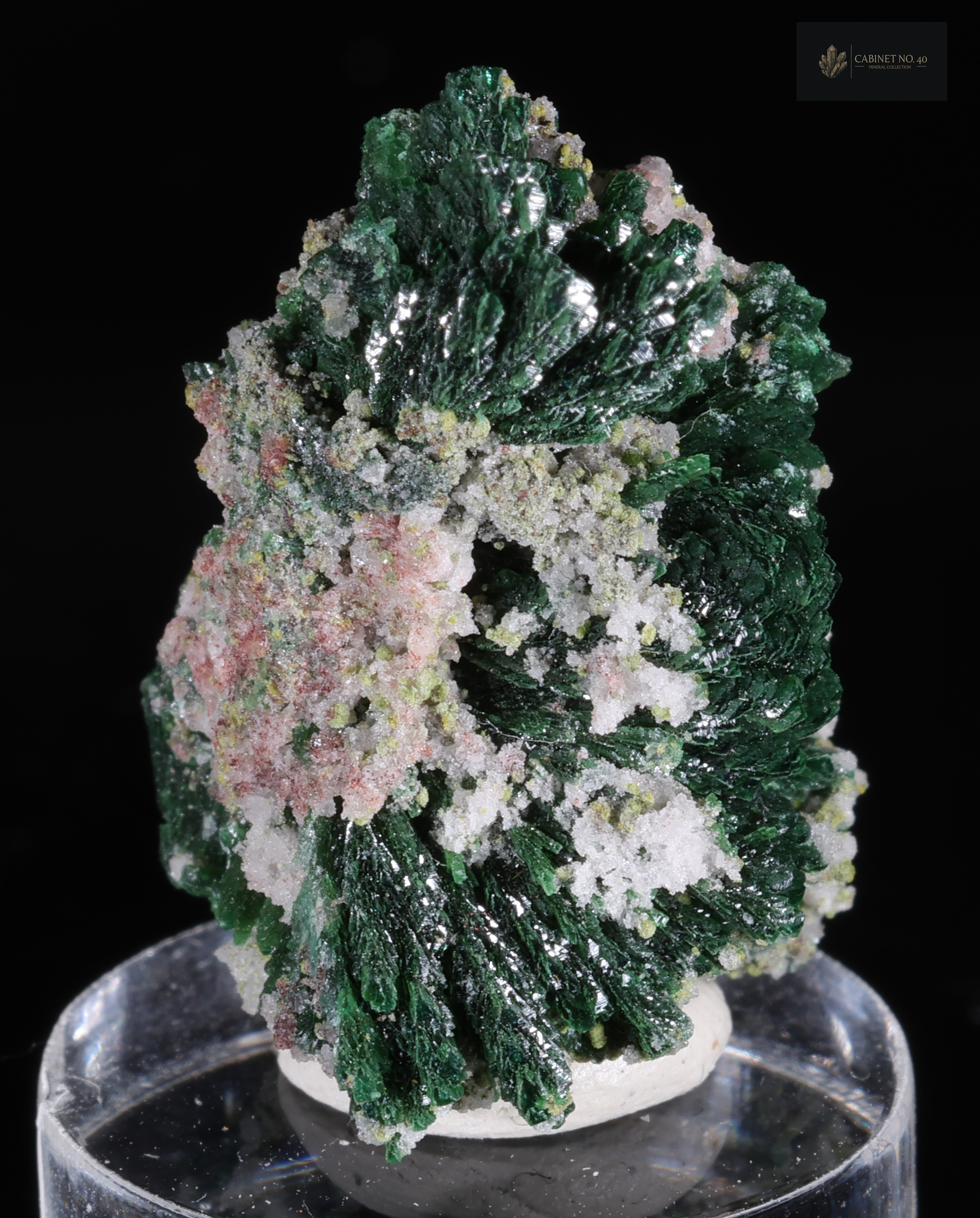
Mottramite is a rare secondary lead, copper, and vanadium mineral, typically forming crusts and radial aggregates of variable color.
Properties
- Mohs hardness
- 3-3.5
- Luster
- Tłusty do szklistego
- Streak
- Yellowish green
- Density
- 5.9
- Cleavage
- Brak
- Fracture
- Nierówny
- Transparency
- Transparent,Opaque
- Crystal system
- Orthorhombic
Diagnostic features
## Identification Mottramite can be identified by its characteristic color, which often oscillates in shades of green, and by its typical forms of occurrence, such as crusts, radial or fibrous aggregates. A yellowish-green streak is also an important diagnostic feature. It often occurs in the oxidation zones of lead and copper deposits. ## Distinguishing from Similar Minerals Mottramite is sometimes confused with other vanadate minerals, such as wanamite or descloizite, with which it forms an isomorphic series. Differences in chemical composition and subtle variations in color and density can help distinguish these minerals. Accurate identification often requires laboratory tests, such as X-ray diffraction. ## Crystal Forms Mottramite most commonly forms small, acicular or tabular crystals, which arrange into radial, fibrous, or spherical aggregates. It often occurs as crusts on other minerals. Well-formed, single crystals are less common.
Geological environment
## Genesis Mottramite is a secondary mineral, formed in the oxidation zones of lead and copper deposits. It forms as a result of reactions of vanadium-containing solutions with lead and copper minerals. This process occurs under conditions of weathering and oxidation of primary ores. ## Mineral Associations Mottramite often co-occurs with other secondary minerals of the oxidation zone, such as malachite, azurite, cerussite, vanadinite, mimetite, and limonite. It can also occur with quartz and other silicate minerals as a matrix. ## Localities Known localities of mottramite include the Mottram St Andrew mine in Cheshire (England), Tsumeb (Namibia), Broken Hill (Australia), as well as numerous locations in the United States, such as Arizona and New Mexico. It also occurs in some regions of Europe, including Germany and the Czech Republic.
Rarity
Uncommon
For collectors
## Quality Criteria The most prized mottramite specimens are those characterized by intense and uniform color, well-formed crystals, or aesthetic aggregates. Large crusts with distinct radial or spherical texture are also highly valued. The purity of the specimen, lack of mechanical damage, and an attractive matrix increase its collector's value. ## Popular Localities Specimens from historical localities, such as Tsumeb in Namibia, known for its perfectly formed crystals and abundance of secondary minerals, are particularly sought after. Specimens from the Mottram St Andrew mine in England, its discovery site, also have historical and collector's value.
Care and storage
## Cleaning Gentle cleaning of mottramite can be performed using a soft brush and lukewarm water. For more stubborn dirt, distilled water can be used to avoid hard water deposits. Strong scrubbing should be avoided to prevent damage to delicate crystals or crusts. ## What to Avoid Avoid contact of mottramite with acids and strong chemicals, which can damage its surface or alter its color. The mineral is sensitive to high temperatures, which can lead to its decomposition. Prolonged exposure to direct sunlight can also affect color intensity. Due to its lead content, caution should be exercised when handling the mineral, and hands should always be washed after contact. ## Storage Mottramite is best stored in a dry place, away from direct sunlight and heat sources. It is advisable to place the specimen in a closed display case or box, which protects it from dust and mechanical damage. Due to its brittleness, impacts and falls should be avoided.