Morganite
Chemical formula: Be₃Al₂(Si₆O₁₈)
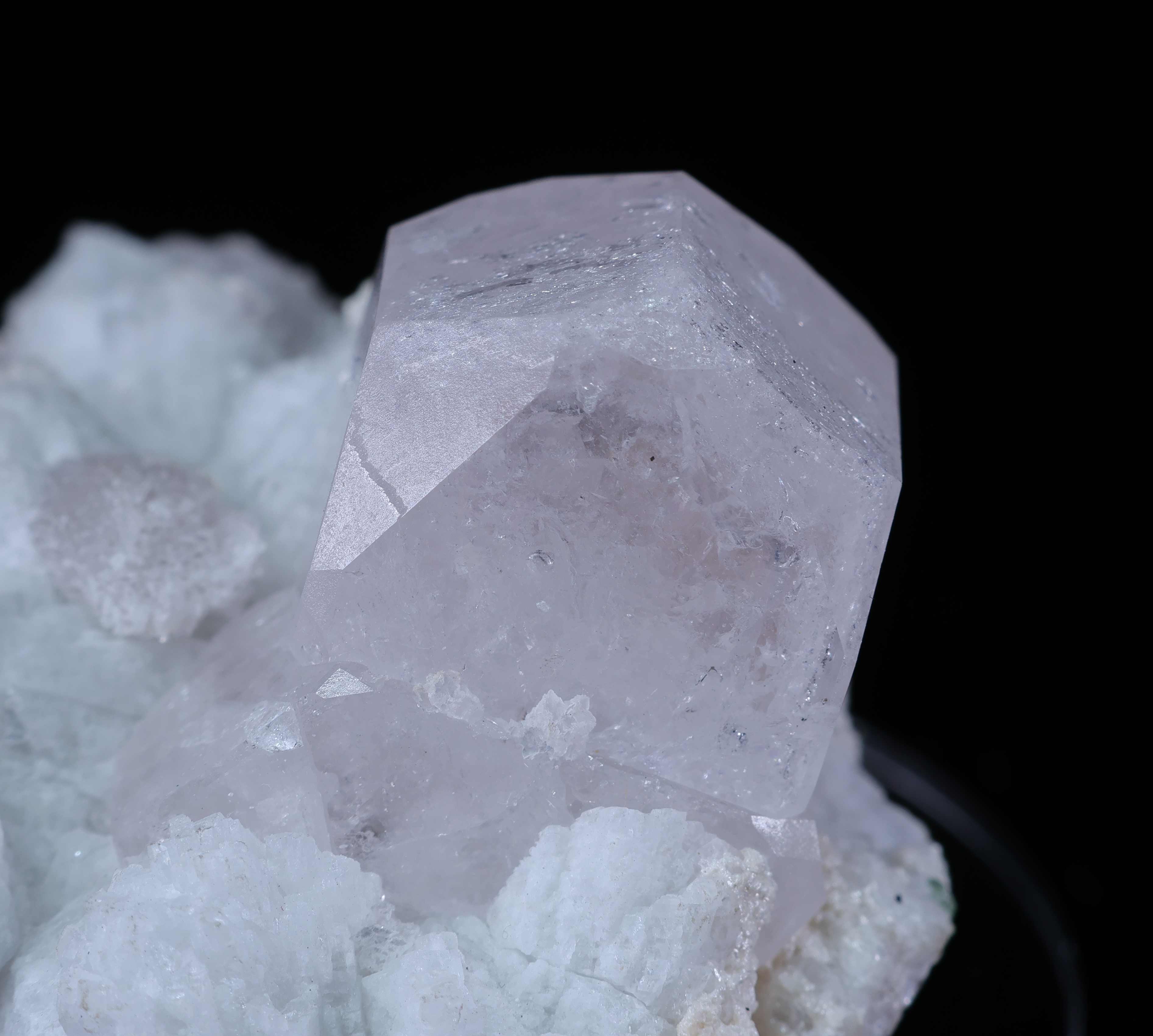
Morganite is a pink, manganese-bearing variety of beryl, prized in jewelry for its delicate colors and transparency.
Properties
- Mohs hardness
- 7.5-8
- Luster
- Vitreous
- Streak
- White
- Density
- 0
- Cleavage
- Weak
- Fracture
- Conchoidal
- Transparency
- Transparent to translucent
- Crystal system
- Hexagonal
Diagnostic features
## Identification Morganite can be identified by its characteristic pink, peach, or violet-pink color, vitreous luster, and transparency. It often occurs as prismatic crystals. A hardness of 7.5-8 on the Mohs scale is also an important diagnostic feature. ## Distinguishing from Similar Minerals Morganite can be confused with other pink minerals, such as rose quartz, kunzite, topaz, or tourmaline. It differs from rose quartz by its greater hardness and often better transparency. It differs from kunzite by its hardness and lack of distinct cleavage. It differs from topaz and tourmaline by its chemical composition and often different crystal habit. ## Crystal Forms Morganite forms prismatic or tabular crystals, often with well-developed faces. It can also occur as granular aggregates.
Geological environment
## Genesis Morganite forms in granitic pegmatites, which are igneous rocks with a high content of silica and rare elements. It forms in the final stages of magma crystallization, in the presence of beryllium, aluminum, and silicon, as well as trace amounts of manganese, which gives it its pink color. It also occurs in some hydrothermal deposits. ## Mineral Associations Morganite often co-occurs with other pegmatitic minerals, such as quartz, feldspars (orthoclase, albite), muscovite, biotite, tourmalines (schorl, elbaite), garnets, spodumene, and other varieties of beryl (e.g., aquamarine, emerald). ## Localities The most important morganite deposits are found in Madagascar, Brazil (Minas Gerais), the United States (California, Maine), Afghanistan, Pakistan, Russia, Mozambique, and Namibia. Particularly prized specimens come from Madagascar and Brazil.
Rarity
Uncommon
For collectors
## Quality Criteria The most prized morganite specimens are characterized by an intense, uniform pink color, high transparency, and lack of inclusions. Large, well-formed crystals with distinct faces are also highly sought after. The clarity and cut of the stone are crucial for its gemological value. ## Popular Localities The most valued morganite specimens come from Madagascar, where the first deposits were discovered, and from Brazil, which is currently one of the main suppliers of high-quality stones. Deposits in California also yield beautiful specimens.
Care and storage
## Cleaning Morganite can be cleaned with a mild soap solution and warm water. A soft brush can be used to remove dirt from hard-to-reach areas. After washing, the stone should be thoroughly rinsed with clean water and dried with a soft cloth. ## What to Avoid Avoid cleaning morganite in ultrasonic and steam cleaners, as these can damage the stone or weaken its setting. Also avoid contact with strong chemicals, acids, and bases, which can negatively affect the mineral's surface. Prolonged exposure to direct sunlight can, in some cases, lead to color fading. ## Storage Morganite is best stored separately from other gemstones and jewelry to prevent scratching. It is ideal to store it in a soft pouch or a separate compartment of a jewelry box, away from heat sources and direct light.