Mixite
Chemical formula: Cu<sup>2+</sup><sub>6</sub>Bi<sup>3+</sup>(As<sup>5+</sup>O<sub>4</sub>)<sub>3</sub>(OH)<sub>6</sub>·3H<sub>2</sub>O
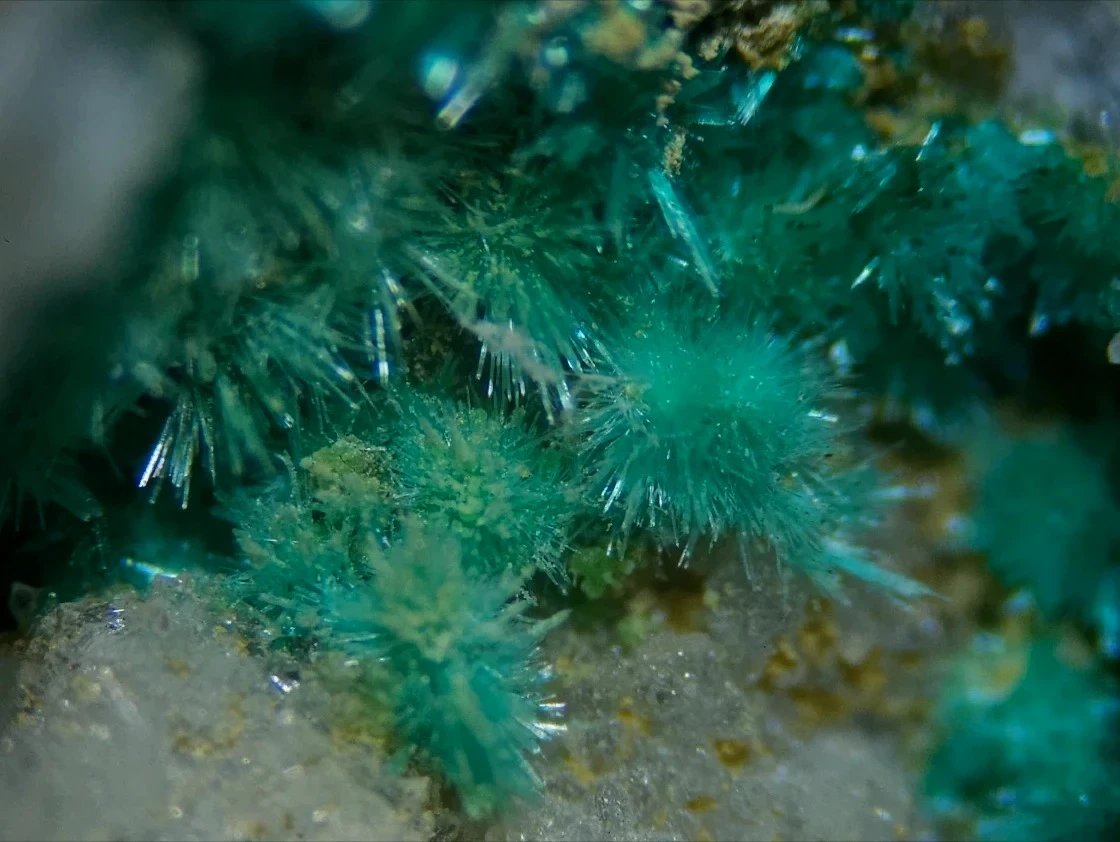
Mixite is a rare arsenate mineral, characterized by a variable color from light green to blue-green, often forming radial aggregates.
Properties
- Mohs hardness
- 3-4
- Luster
- Dull, brilliant
- Streak
- Pale bluish green
- Density
- 3.79
- Cleavage
- Brak
- Fracture
- Nierówny
- Transparency
- Transparent,Translucent
- Crystal system
- Hexagonal
Diagnostic features
## Identification Mixite can be identified by its characteristic radial, fibrous, or acicular aggregates and its color ranging from light green to blue-green. The luster is usually dull to vitreous. Low hardness (3-4 on the Mohs scale) is also a diagnostic feature. ## Distinguishing from Similar Minerals Mixite can be confused with other green copper minerals, such as malachite or azurite, but its radial structure and lack of reaction with acids (unlike malachite) help in differentiation. Other copper arsenates can also form similar shapes, so precise identification often requires laboratory analysis. ## Crystal Forms Mixite most commonly occurs as radial, fibrous, or acicular aggregates. Crystals are rare, usually small, with an acicular or columnar habit.
Geological environment
## Genesis Mixite is a secondary mineral, forming in the oxidation zones of copper and bismuth ore deposits. It forms as a result of the weathering of primary minerals containing these elements, in the presence of arsenate-rich solutions. ## Mineral Associations Mixite often co-occurs with other secondary minerals of the oxidation zone, such as azurite, malachite, native bismuth, bismuthinite, erythrite, annabergite, scorodite, and quartz. ## Localities Known localities of mixite include the Mixe mine in Saxony (Germany), where it was discovered. Other important localities are Tsumeb in Namibia, Broken Hill in Australia, Tintic in Utah (USA), and some deposits in the Czech Republic and Slovakia.
Rarity
Uncommon
For collectors
## Quality Criteria The most prized mixite specimens are those with intense, vivid color (especially blue-green or emerald green), well-formed, radial aggregates with a distinct structure. The size of the specimen and the absence of mechanical damage also affect its collector's value. Purity and aesthetic form are key. ## Popular Localities The most sought-after specimens come from historical localities such as the Mixe mine in Germany and Tsumeb in Namibia, known for their well-formed and aesthetic mixite forms.
Care and storage
## Cleaning Mixite is a relatively soft mineral, therefore it requires gentle cleaning. It is best to use a soft brush or paintbrush to remove dust. For heavier soiling, lukewarm distilled water with a small amount of mild soap can be used, then rinse thoroughly and dry with a soft cloth. ## What to Avoid Avoid using aggressive chemical agents that can damage the mineral's surface or alter its color. Mixite is sensitive to high temperatures and prolonged exposure to sunlight, which can lead to fading. Due to the water content in its structure, sudden temperature changes and excessive humidity should be avoided. ## Storage Mixite specimens are best stored in closed display cases or boxes, away from direct sunlight and heat sources. Maintaining stable temperature and humidity is recommended. A soft substrate, such as cotton or foam, will help prevent mechanical damage.