Millerite
Chemical formula: NiS
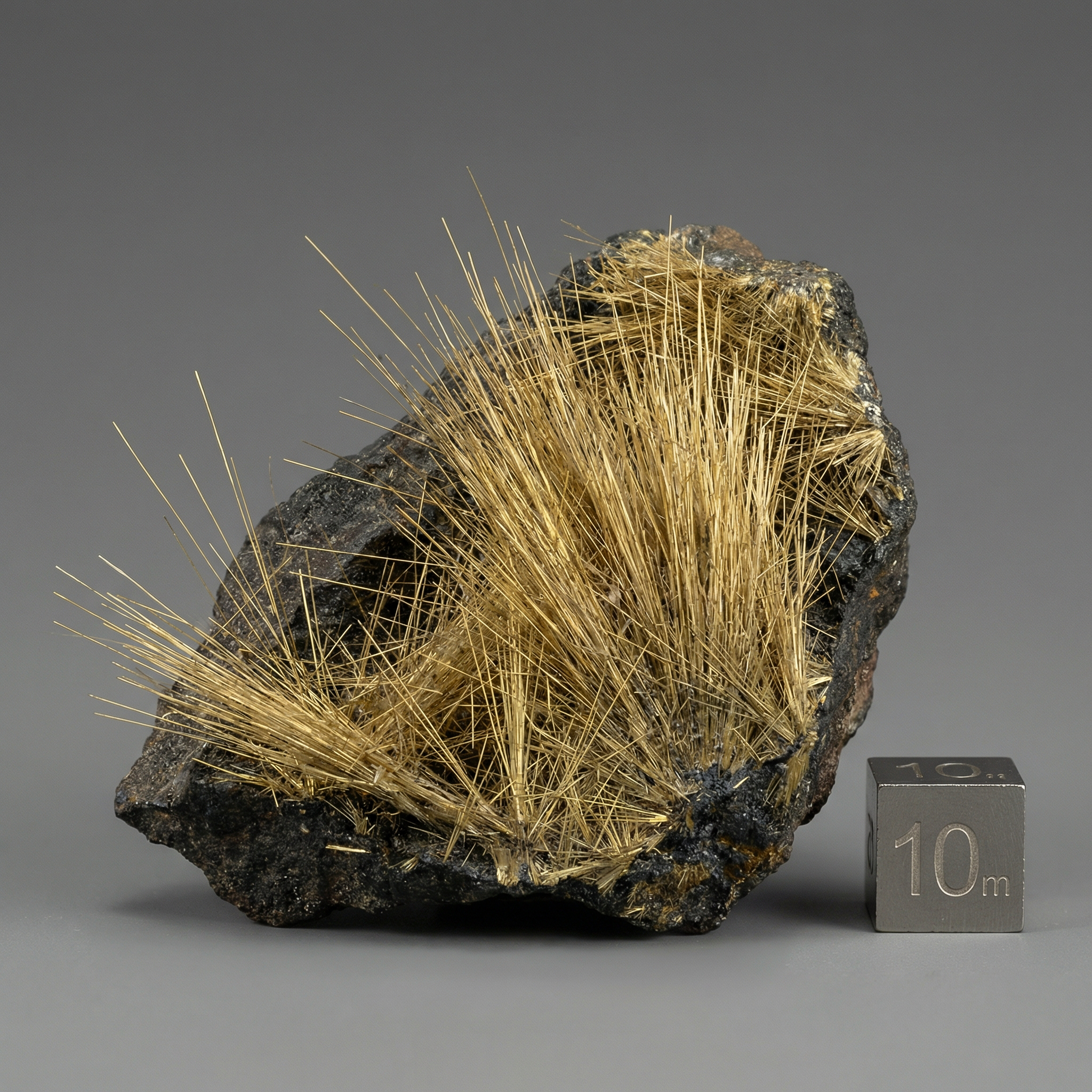
Millerite is a nickel sulfide that often forms characteristic acicular or capillary crystals of a brass-yellow color, sometimes with an iridescent tarnish.
Properties
- Mohs hardness
- 3-3.5
- Luster
- Metallic
- Streak
- Greenish black
- Density
- 5.3
- Cleavage
- Perfect on <mi>{10_11} and {01_12}</mi>.
- Fracture
- Nierówny
- Transparency
- Opaque
- Crystal system
- Trigonal
Diagnostic features
## Identification Millerite can be identified by its characteristic capillary or acicular crystal habit and pale brass-yellow color. Its metallic luster and greenish-black streak are also important diagnostic features. ## Distinguishing from Similar Minerals Millerite can be confused with other sulfides of similar color, such as chalcopyrite or pyrite. However, its unique capillary habit and lower hardness distinguish it from these minerals. Chalcopyrite has a more yellow color and often forms massive aggregates, while pyrite crystallizes in isometric forms and is much harder. ## Crystal Forms Millerite most commonly occurs as very thin, acicular or capillary crystals. These crystals often form radiating, tangled, or felted aggregates; columnar crystals are less common.
Geological environment
## Genesis Millerite forms in low-temperature, hydrothermal veins, often in association with other sulfides. It can also occur as a product of alteration of other nickel minerals in ultramafic rocks and serpentinites, as well as in sedimentary carbonate rocks. ## Mineral Associations Millerite often co-occurs with minerals such as pyrite, chalcopyrite, pentlandite, calcite, dolomite, barite, and quartz. ## Localities Known millerite localities include Gap Mine in Pennsylvania (USA), Sterling Mine in New Jersey (USA), Sudbury in Ontario (Canada), Freiberg in Saxony (Germany), Kambalda in Australia, and Rudňany in Slovakia.
Rarity
Very Common
For collectors
## Quality Criteria The most prized millerite specimens are those that exhibit well-formed, long, and thin crystals, forming aesthetic, radiating or dense aggregates. The intensity and uniformity of the pale brass-yellow color and the absence of mechanical damage to the delicate crystals are also important. Specimens with a distinct iridescent tarnish may also be sought after. ## Popular Localities Particularly valued millerite specimens come from the Gap Mine in Pennsylvania (USA), where beautiful, capillary aggregates have been found. Other important localities include Sudbury in Canada and Freiberg in Germany.
Care and storage
## Cleaning Millerite is a relatively soft mineral, so it should be handled with care. For cleaning, it is best to use a soft brush to gently remove dust. For heavier soiling, lukewarm distilled water can be used, avoiding prolonged soaking. ## What to Avoid Avoid contact of millerite with acids and other aggressive chemicals, which can damage the mineral's surface or cause corrosion. Due to the possibility of iridescent tarnish formation, it is recommended to avoid excessive humidity and exposure to direct sunlight, which can accelerate oxidation processes. ## Storage Millerite specimens are best stored in enclosed display cases or boxes to protect them from dust and humidity changes. It is advisable for each specimen to have a separate space to prevent mechanical damage to the delicate crystals.