Metatorbernite
Chemical formula: Cu<sup>2+</sup>(U<sup>6+</sup>O<sub>2</sub>)<sub>2</sub>(PO<sub>4</sub>)<sub>2</sub>(H<sub>2</sub>O)<sub>4</sub>·4H<sub>2</sub>O
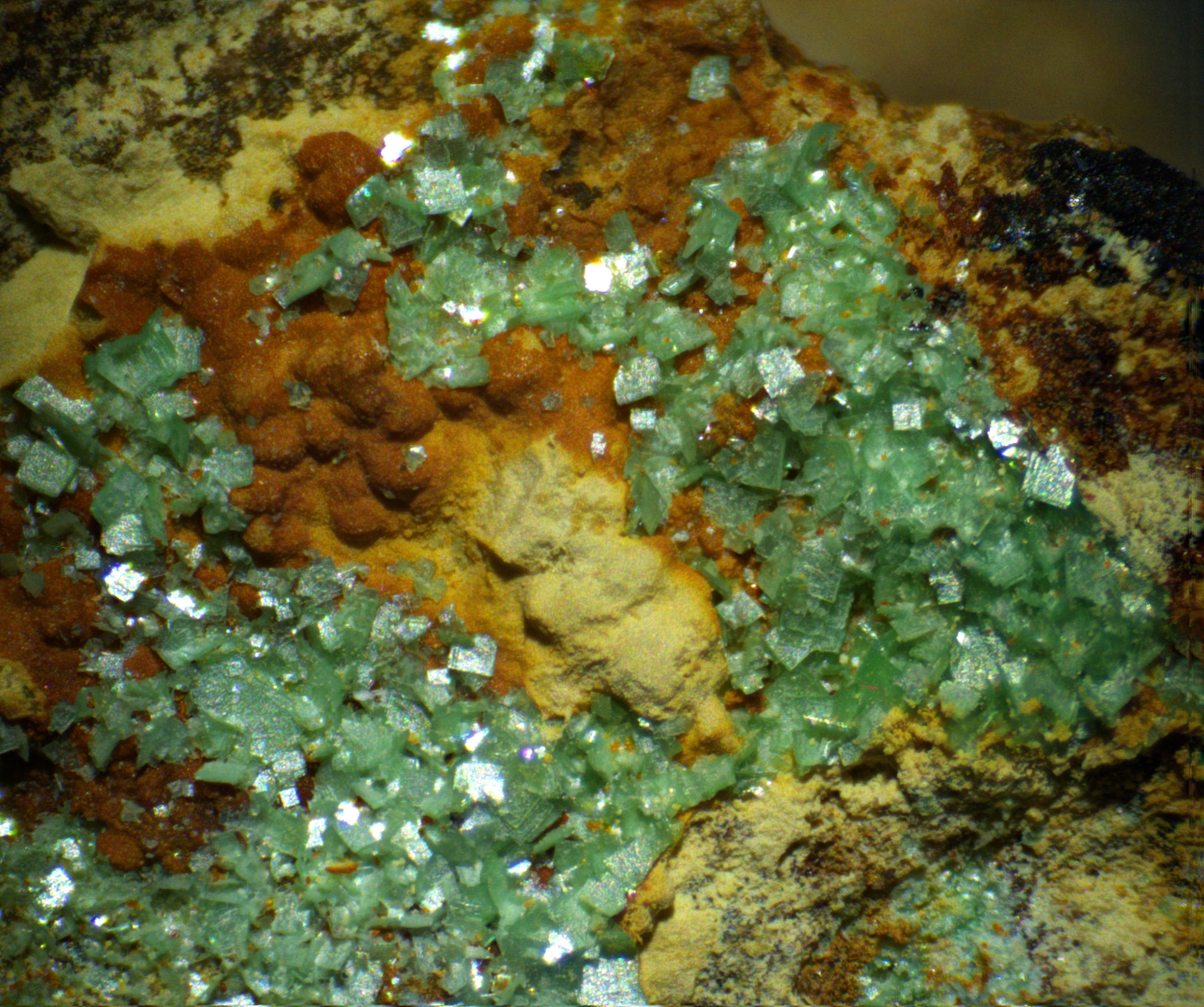
Metatorbernite is a rare uranyl copper phosphate mineral, a hydrated phosphate, often occurring as green, tabular crystals.
Properties
- Mohs hardness
- 2.5
- Luster
- Szklisty do perłowego
- Streak
- pale green
- Density
- 3.52
- Cleavage
- Perfect on {001} indistict on {010}
- Fracture
- Brak danych
- Transparency
- Transparent,Translucent
- Crystal system
- Tetragonal
Diagnostic features
## Identification Metatorbernite can be identified by its characteristic green color, tabular crystal habit, and perfect cleavage. It often occurs in scaly or radial aggregates. It is radioactive, which can be confirmed with a Geiger counter. ## Distinguishing from Similar Minerals Metatorbernite is often confused with torbernite, which has a similar appearance and chemical composition. The main difference is the degree of hydration – metatorbernite contains fewer water molecules than torbernite. Under laboratory conditions, they can be distinguished by thermal analysis or X-ray diffraction. Other green secondary minerals, such as autunite or uranophane, have different chemical compositions and often different crystal forms. ## Crystal Forms Metatorbernite most often forms tabular, pyramidal, or bipyramidal crystals. They often occur in scaly, radial, or earthy aggregates. Crystals are usually small but well-formed.
Geological environment
## Genesis Metatorbernite is a secondary mineral, forming in the oxidation zones of uranium deposits. It forms as a result of the weathering of primary uranium minerals, such as uraninite, in the presence of phosphates and copper. This process occurs in oxygen- and water-rich environments. ## Mineral Associations Metatorbernite often co-occurs with other uranium minerals, such as torbernite, autunite, uraninite, carnotite, as well as copper minerals, such as chalcopyrite, malachite, and azurite. It can also occur in association with quartz and calcite. ## Localities Known localities of metatorbernite include Erzgebirge in Germany, Cornwall in England, Jáchymov in the Czech Republic, Shinkolobwe in the Democratic Republic of Congo, as well as some localities in the United States (e.g., Utah, Colorado) and Australia.
Rarity
Common
For collectors
## Quality Criteria The most prized metatorbernite specimens are those with well-formed, distinct crystals of intense, uniform green color. Large, aesthetic crystal aggregates on matrix are also highly sought after. The transparency and luster of the crystals contribute to their collector appeal. Low radioactivity is also important, although in the case of metatorbernite, it is an inherent characteristic. ## Popular Localities The most prized metatorbernite specimens come from historical uranium deposits, such as Erzgebirge (Germany), Jáchymov (Czech Republic), and Shinkolobwe (Democratic Republic of Congo). Specimens from these localities are often well-formed and have intense color.
Care and storage
## Cleaning Metatorbernite is a radioactive and delicate mineral, so special care must be taken during cleaning. It is best to avoid direct contact with water, as this can lead to further hydration or dehydration, changing its structure. If dust removal is necessary, use a soft brush or compressed air. ## What to Avoid Avoid all chemical substances, including detergents and acids, which can damage the mineral's surface. Exposure to sunlight and high temperatures can lead to changes in crystal structure and color. Due to radioactivity, metatorbernite specimens should be stored in appropriate, ventilated containers, away from other minerals and organic materials that may be damaged by radiation. ## Storage Metatorbernite is best stored in airtight containers, away from moisture and heat sources. Due to its radioactivity, it is recommended to store it in a separate place, preferably in a lead container or a specially adapted display case, to minimize radiation exposure. It is also important to limit direct contact with the mineral and always use gloves when handling specimens.