Magnetite
Chemical formula: Fe<sup>2+</sup>Fe<sup>3+</sup><sub>2</sub>O<sub>4</sub>
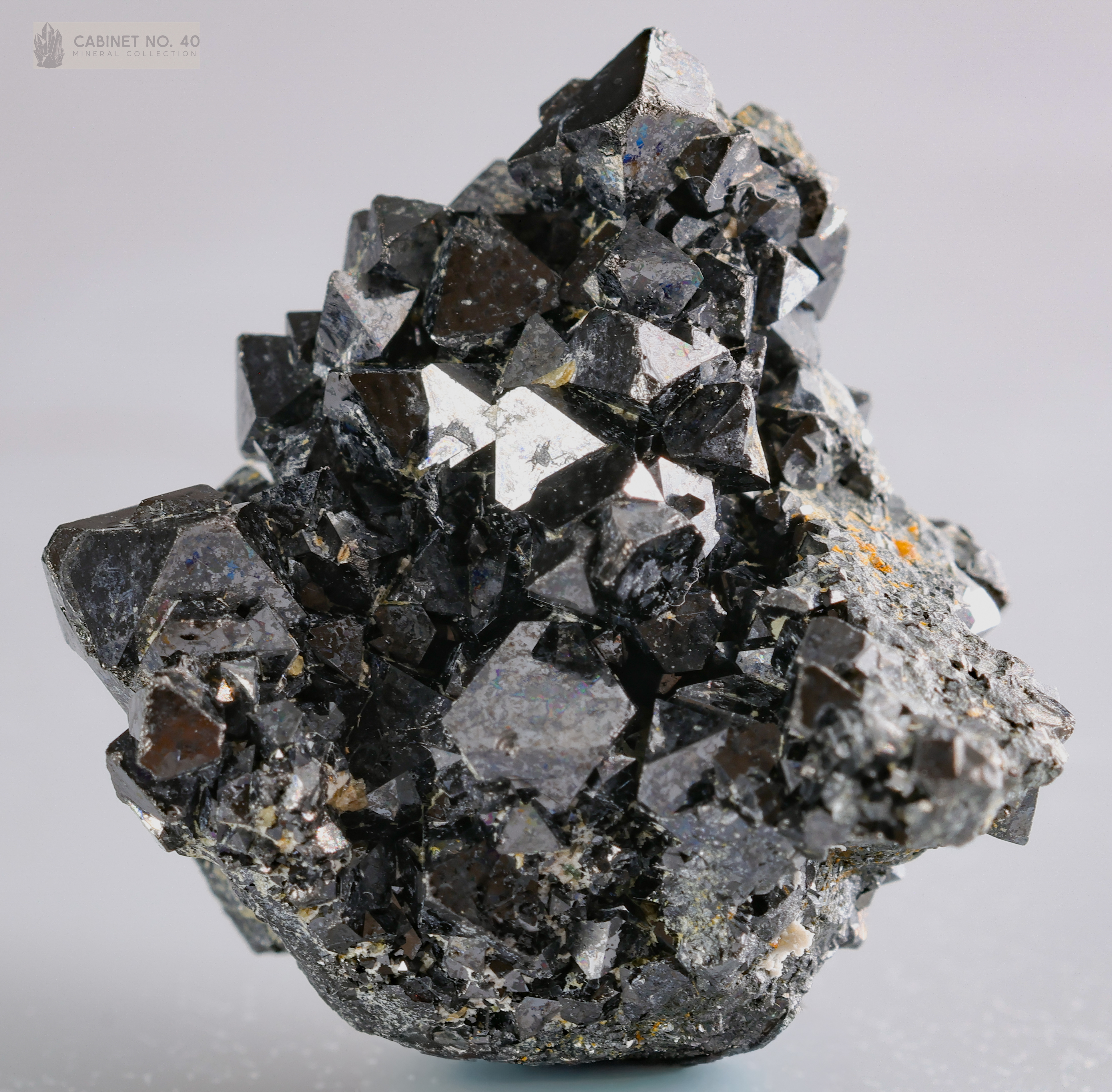
Magnetite is a common mineral from the oxide group, an iron oxide, characterized by strong magnetism.
Properties
- Mohs hardness
- 5.5-6.5
- Luster
- Metallic
- Streak
- Black
- Density
- 5.175
- Cleavage
- None
- Fracture
- Nierówny
- Transparency
- Opaque
- Crystal system
- Isometric
Diagnostic features
## Identification Magnetite is easily recognizable due to its strong magnetic properties – it attracts iron filings and reacts to a magnet. Additionally, its metallic luster and black streak are diagnostic features. It occurs in granular aggregates or as well-formed crystals. ## Distinguishing from similar minerals Magnetite can be confused with hematite or ilmenite, which are also black, metallic minerals. However, magnetite is distinguished by strong magnetism, while hematite is usually non-magnetic or weakly magnetic, and ilmenite is only weakly magnetic and has a brownish-red streak. ## Crystal forms Magnetite most commonly forms octahedral crystals, less often dodecahedral. It can also occur as granular aggregates or massive forms.
Geological environment
## Genesis Magnetite forms in a wide range of geological environments. It occurs in igneous rocks, both volcanic and intrusive, as an accessory component or in larger accumulations. It is also a common mineral in metamorphic rocks, such as skarns and schists, and in hydrothermal deposits. It can also form as a result of sedimentary processes, in the form of magnetite sands. ## Mineral associations Magnetite often co-occurs with other ore minerals, such as hematite, pyrite, chalcopyrite, as well as with rock-forming minerals like quartz, feldspars, pyroxenes, and amphiboles. ## Localities Known magnetite deposits are found worldwide. Important localities include Kiruna in Sweden, the Ural region in Russia, the United States (e.g., Adirondack Mountains), Brazil, India, China, and Australia.
Rarity
Very Common
For collectors
## Quality criteria The most prized magnetite specimens are those with well-formed, large, and lustrous crystals with a distinct octahedral habit. Crystal clarity, absence of mechanical damage, and contrast with the matrix also influence collector value. ## Popular localities High-quality collector specimens come from places such as Kiruna in Sweden, where large, well-formed crystals occur. Other valued localities include Russia, Brazil, and certain regions of the United States.
Care and storage
## Cleaning Magnetite can be cleaned gently using a soft brush or cloth. For heavier soiling, lukewarm water with a small amount of mild soap may be used, followed by thorough rinsing and drying. ## What to avoid Avoid using aggressive chemical agents that can damage the mineral's surface. Magnetite is sensitive to strong impacts, which can cause cracks. Prolonged exposure to high temperatures can affect its magnetic properties. ## Storage Magnetite should be stored in a dry place, away from sources of strong magnetic fields that could affect other specimens in the collection. It is best displayed in a closed cabinet to protect it from dust and mechanical damage.