Löllingite
Chemical formula: Fe<sup>3+</sup>(As<sub>2</sub>)<sup>3-</sup>
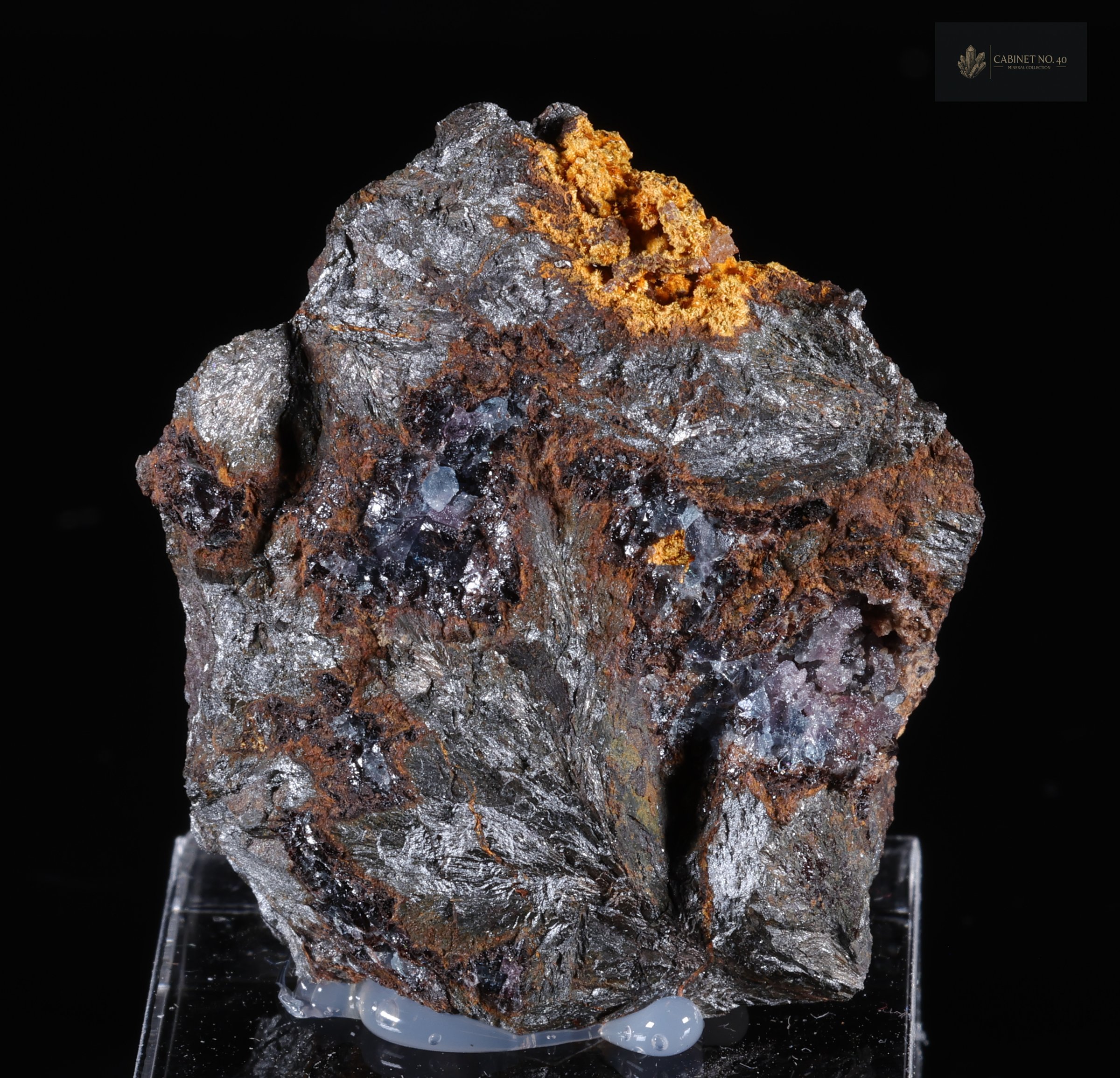
Löllingite is a mineral from the arsenide group, an iron arsenide, often forming crystals with a metallic luster.
Properties
- Mohs hardness
- 5-5.5
- Color
- Steel gray to silver white
- Luster
- Metallic
- Streak
- Greyish black
- Density
- 7.43
- Cleavage
- Distinct on {010}{101}
- Fracture
- Sub-Conchoidal
- Transparency
- Opaque
- Crystal system
- Orthorhombic
Diagnostic features
## Identification Löllingite can be identified by its silvery-white to steel-gray color, metallic luster, and relatively high density. Perfect cleavage, visible on fresh fractures, is also characteristic. The streak is black. ## Distinguishing from Similar Minerals Löllingite is sometimes confused with other arsenides, such as arsenopyrite (FeAsS) or safflorite ((Co,Fe)As₂). It differs from arsenopyrite by the absence of sulfur in its chemical composition and its perfect cleavage, whereas arsenopyrite has good cleavage. It differs from safflorite by the dominant iron in its composition, while safflorite is a cobalt arsenide. ## Crystal Forms Löllingite forms columnar, isometric, or tabular crystals. It often occurs as massive, granular, or radial aggregates. It can also form dendritic or reniform aggregates.
Geological environment
## Genesis Löllingite is a hydrothermal mineral, forming at medium and high temperatures in ore veins. It occurs in arsenic, cobalt, nickel, and silver deposits, often associated with mafic and ultramafic igneous rocks. ## Mineral Associations It often co-occurs with other arsenides and sulfosalts, such as arsenopyrite, safflorite, rammelsbergite, niccolite, cobaltite, bismuthinite, as well as with pyrite, chalcopyrite, quartz, and calcite. ## Localities Significant occurrences of löllingite are found in Lölling, Austria (type locality), in the Schneeberg and Freiberg areas in Germany, in Bou Azzer, Morocco, in Cobalt, Ontario, Canada, and also in some deposits in Sweden and the Czech Republic.
Rarity
Not very common
For collectors
## Quality Criteria The most prized löllingite specimens are well-formed crystals, especially those with distinct columnar or isometric habits, with preserved metallic luster. Crystal size, clarity, and absence of mechanical damage also affect collectible value. Specimens with interesting mineral associations are particularly sought after. ## Popular Localities Valued löllingite specimens come from type localities such as Lölling in Austria. Other important localities include Schneeberg in Germany, known for its well-formed crystals, and Bou Azzer in Morocco, where löllingite occurs in association with other rare cobalt and nickel minerals.
Care and storage
## Cleaning Löllingite is a relatively hard mineral, but its surface can oxidize. For cleaning, it is best to use a soft, dry cloth or brush to remove dust. If necessary, it can be gently wiped with a damp cloth and then immediately dried. ## What to Avoid Avoid using aggressive chemicals, acids, and bases, which can damage the mineral's surface or cause corrosion. Prolonged exposure to moisture can accelerate the oxidation process. Sudden temperature changes should also be avoided. ## Storage Löllingite should be stored in a dry place, away from direct sunlight and heat sources. An enclosed box or display case that protects against dust and humidity changes is ideal. Consider storing it in containers with a desiccant, especially in humid climates.