Leucite
Chemical formula: K(Si<sub>2</sub>Al)O<sub>6</sub>
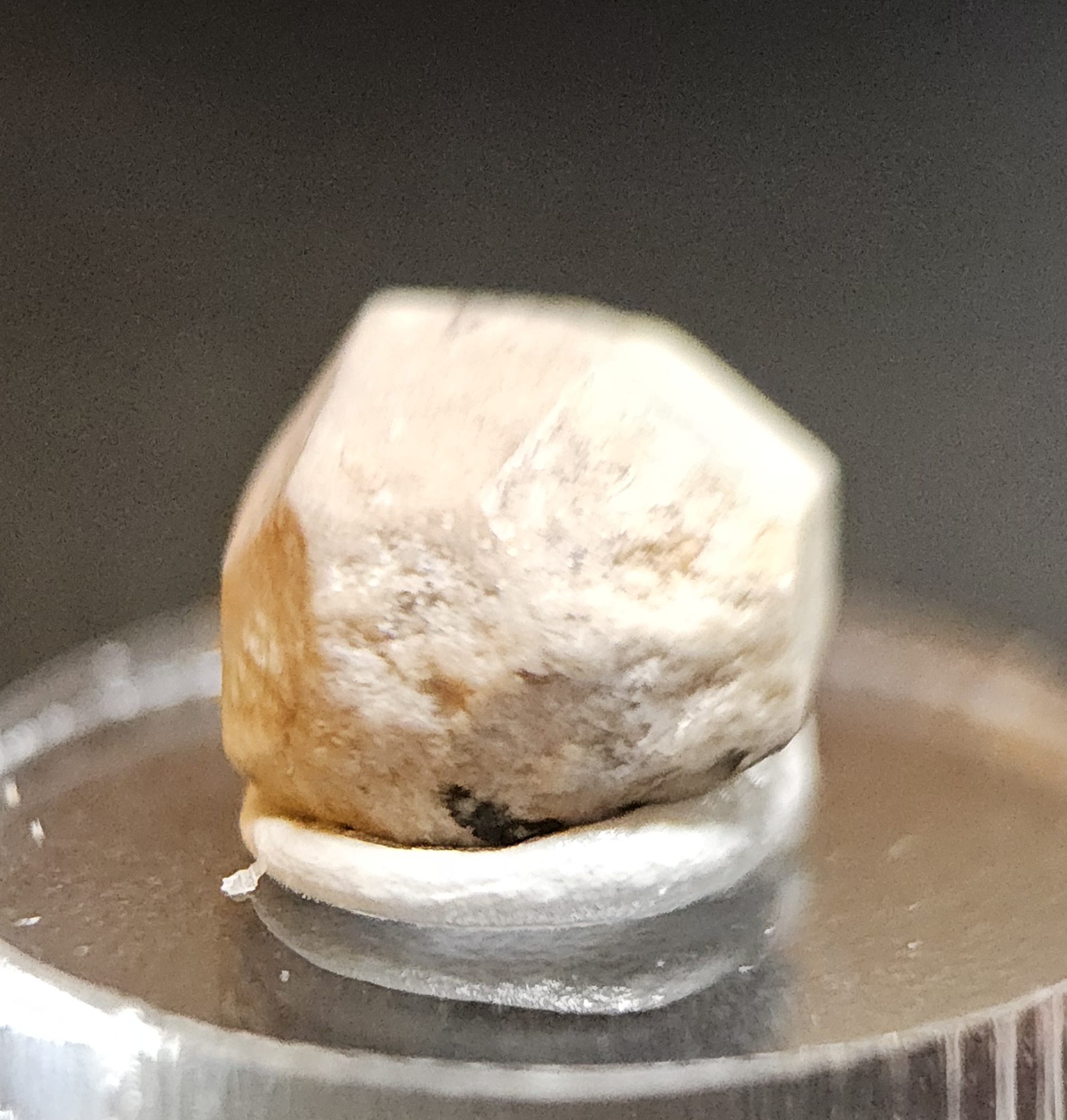
Leucite is a potassium and aluminum silicate, forming characteristic white or gray crystals with a shape resembling a trapezohedron, found in silica-poor volcanic rocks.
Properties
- Mohs hardness
- 5.5-6
- Color
- White, grey, cream, colorless
- Luster
- Vitreous
- Streak
- White
- Density
- 2.45
- Cleavage
- Very poor on {110}
- Fracture
- Conchoidal
- Transparency
- Transparent,Translucent
- Crystal system
- Tetragonal
Diagnostic features
## Identification The most important diagnostic feature of leucite is its characteristic crystal form – the deltoidal icositetrahedron (trapezohedron). Its occurrence in potassium-rich and silica-poor volcanic rocks (such as phonolites and leucitites) is also a strong indicator. A white streak and vitreous luster aid in identification. ## Distinguishing from Similar Minerals Leucite is sometimes confused with analcime, which forms crystals of very similar shape. However, analcime is a sodium zeolite, crystallizing under different geological conditions (often in gas vesicles in basalts) and has a slightly lower hardness. Garnets (mainly from the grossular group) can have a similar shape, but are much harder (above 6.5 on the Mohs scale) and denser, and also occur in other types of rocks, mainly metamorphic. ## Crystal Forms Leucite forms almost exclusively crystals in the shape of a deltoidal icositetrahedron. They can be sharp-edged and fully developed, occurring as phenocrysts in the host rock or, more rarely, as loose, individual crystals released from weathering rock.
Geological environment
## Genesis Leucite is an igneous mineral, crystallizing at high temperatures directly from potassium-rich and silica-undersaturated lava. It is a typical mineral of extrusive rocks, such as phonolites, leucitites, and leucite tephrites. Its presence precludes the co-occurrence of primary quartz, as leucite reacts with silica to form potassium feldspar. ## Mineral Associations This mineral often occurs in association with sanidine, nepheline, augite (clinopyroxene), olivine, and melilite. Depending on the location, various zeolites may also accompany it as products of secondary alterations. ## Localities The most classic and world-renowned localities for leucite are in Italy, in the volcanic complex of Vesuvius (Monte Somma) and in the Alban Hills (e.g., in the Roccamonfina area). Beautiful crystals also come from the Eifel volcanic region in Germany. In the United States, occurrences are known in the Leucite Hills in Wyoming. This mineral is also a rock-forming component of lavas from volcanoes in Africa, e.g., Nyiragongo in the Democratic Republic of Congo.
Rarity
Uncommon
For collectors
## Quality Criteria The most valued specimens by collectors are those with large, sharp-edged, and well-formed leucite crystals in the shape of a perfect trapezohedron. Crystals with a pure, white color, strongly contrasting with the dark host rock, are highly prized. Groups of crystals and loose, undamaged single crystals (so-called "floaters") are also attractive. ## Popular Localities The historical localities in Italy, especially in the Vesuvius region, are considered the source of the best, classic leucite specimens. Specimens from Germany (Eifel) and the USA (Wyoming) are also sought after by collectors and often feature excellent crystal development.
Care and storage
## Cleaning Leucite specimens can be safely cleaned with a soft brush and distilled water. Due to its brittleness, ultrasonic cleaners should be avoided, as they could cause internal fractures. ## What to Avoid The mineral is sensitive to acids, especially hydrochloric acid, so contact with chemicals should be avoided. It should not be subjected to sudden temperature changes. Although it is relatively hard, harder minerals (e.g., quartz) can scratch it. ## Storage Collector's specimens of leucite are best stored in separate boxes or display cases to avoid abrasions and scratches. They should be protected from dust and prolonged exposure to moisture.