Legrandite
Chemical formula: Zn<sup>2+</sup><sub>2</sub>As<sup>5+</sup>O<sub>4</sub>(OH)(H<sub>2</sub>O)
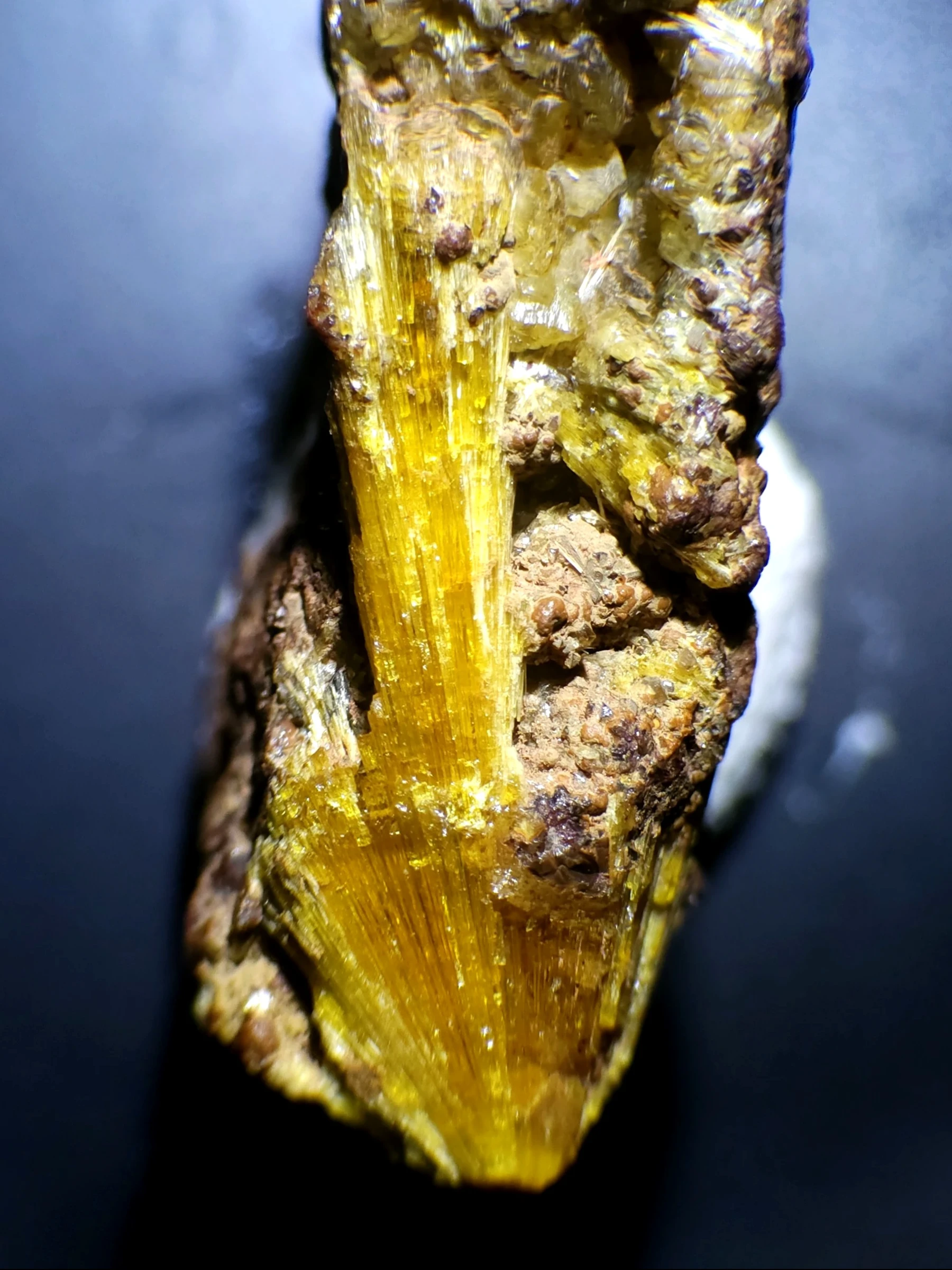
Legrandite is a rare zinc arsenate mineral, characterized by beautiful, often intensely yellow crystals, forming radial or fibrous aggregates.
Properties
- Mohs hardness
- 4.5
- Luster
- Vitreous
- Streak
- White
- Density
- 3.98
- Cleavage
- Fair to poor on {100}
- Fracture
- Nierówny
- Transparency
- Transparent,Translucent
- Crystal system
- Monoclinic
Diagnostic features
## Identification Legrandite can be identified by its characteristic color (from colorless to intensely yellow), vitreous luster, and crystal habit, which are often elongated, acicular, or prismatic and form radial aggregates. Its hardness of 4.5 on the Mohs scale also aids in identification. ## Distinguishing from Similar Minerals Legrandite can be confused with other zinc minerals or arsenates, such as adamite or scorodite, especially if they occur in similar colors. It differs from adamite by its chemical composition (adamite is a zinc arsenate without water and a hydroxyl group) and often a different crystal habit. It differs from scorodite by color (scorodite is usually green or brown) and chemical composition (scorodite is a hydrated iron arsenate). ## Crystal Forms Legrandite most often forms elongated, acicular, prismatic, or bladed crystals. They often occur as radial aggregates, sheaves, druses, or fibrous aggregates. Crystals are usually well-formed and embedded in a matrix.
Geological environment
## Genesis Legrandite is a secondary mineral, forming in the oxidation zones of zinc and arsenic deposits. It forms as a result of hydrothermal processes, where solutions rich in zinc and arsenic react with other minerals in an oxidizing environment. ## Mineral Associations Legrandite often co-occurs with other minerals of the oxidation zone, such as adamite, scorodite, mimetite, hemimorphite, smithsonite, aurichalcite, goethite, and iron and manganese minerals. ## Localities The most important and well-known localities for legrandite are the Flor de Peña mine in Mapimí, Durango, Mexico, where it was discovered and where many excellent specimens have been found. Other localities include Tsumeb in Namibia and several smaller occurrences in the United States and Europe.
Rarity
Very Rare
For collectors
## Quality Criteria The most prized legrandite specimens are those with well-formed, transparent, intensely yellow crystals, forming aesthetic aggregates on a matrix. The size of the crystals, their color, transparency, and lack of mechanical damage are crucial for collector value. Specimens with distinct radial aggregates are particularly sought after. ## Popular Localities The Flor de Peña mine in Mapimí, Durango, Mexico, is the most famous and valued source of high-quality legrandite. Specimens from Tsumeb in Namibia are also highly sought after, though rarer.
Care and storage
## Cleaning Legrandite is a relatively delicate mineral, so it should be cleaned carefully. It is best to use a soft brush or paintbrush to remove dust. For heavier soiling, lukewarm distilled water can be used, avoiding a strong stream that could damage the delicate crystals. After washing, gently dry the specimen with a soft cloth or allow it to air dry. ## What to Avoid Avoid using aggressive chemicals, such as acids or strong detergents, which can damage the mineral's surface or alter its color. Legrandite is sensitive to high temperatures and direct sunlight, which can cause color fading. It should also be protected from sudden temperature changes. ## Storage Legrandite should be stored in a dry place, away from direct sunlight and heat sources. It is ideally suited for storage in a closed display cabinet or box, which protects it from dust and mechanical damage. Due to its delicacy, it is best to store specimens separately to avoid scratches or chipping.