Kyanite
Chemical formula: Al<sub>2</sub>OSiO<sub>4</sub>
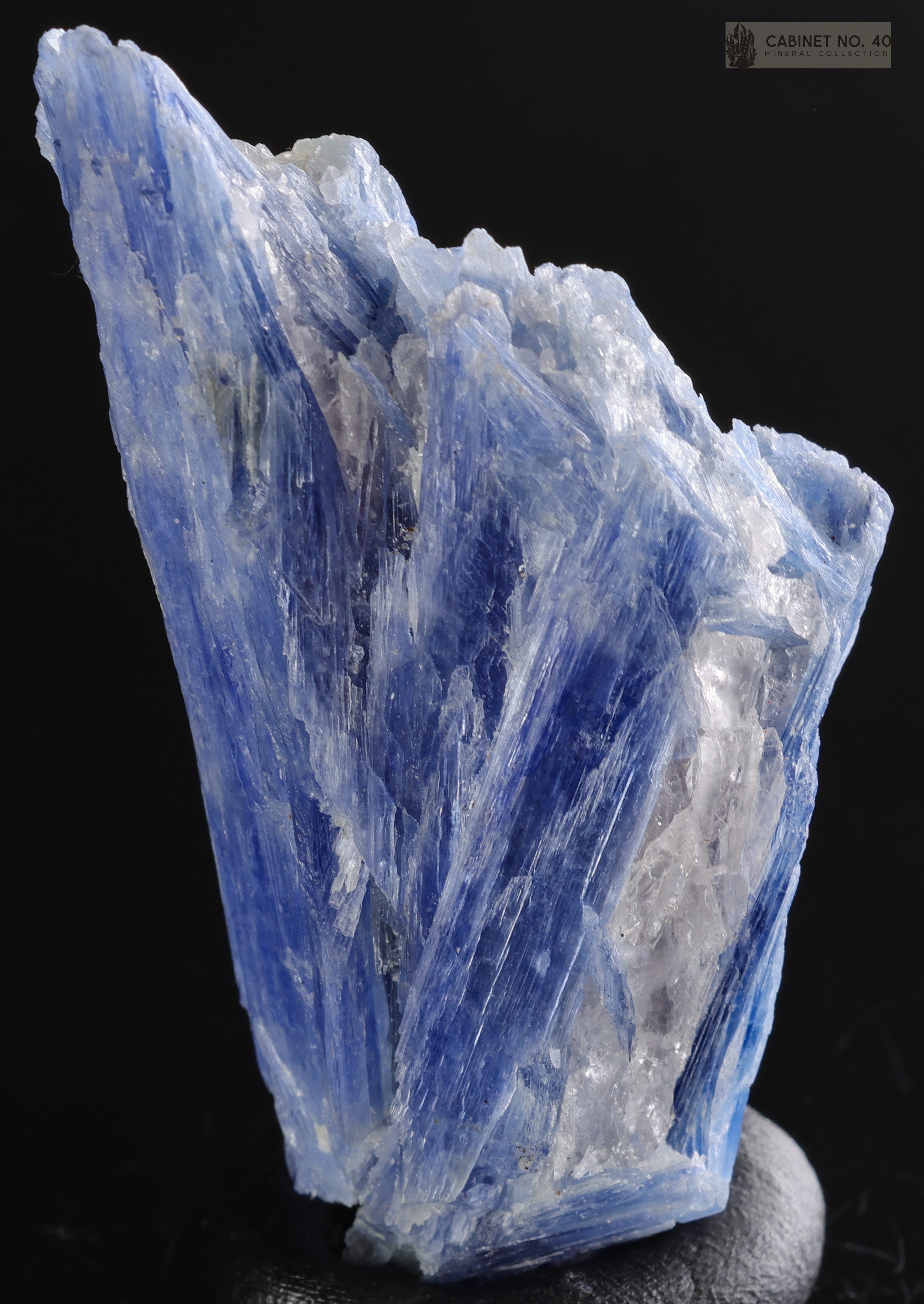
Kyanite is an aluminum silicate characterized by variable hardness, often occurring as elongated, bladed crystals.
Properties
- Mohs hardness
- 5.5-7
- Luster
- Vitreous
- Streak
- Colorless
- Density
- 3.53
- Cleavage
- Perfect on (100), good on (010)
- Fracture
- Brak danych
- Transparency
- Transparent,Translucent
- Crystal system
- Triclinic
Diagnostic features
## Identification Kyanite can be identified by its characteristic hardness anisotropy, elongated, often bladed crystals, and typical blue color. Its occurrence in metamorphic rocks is also an important diagnostic clue. ## Distinguishing from Similar Minerals Kyanite is sometimes confused with other blue minerals, such as sapphire or dumortierite. It differs from sapphire by its lower hardness and different crystal form. From dumortierite, which can also be fibrous, kyanite differs in hardness and chemical formula. ## Crystal Forms Kyanite most often forms elongated, bladed or columnar crystals, often with a flattened cross-section. They can occur individually, as radial aggregates, or as intergrown masses.
Geological environment
## Genesis Kyanite is a metamorphic mineral, forming under conditions of high pressure and moderate temperature. It occurs in metamorphic rocks such as gneisses, mica schists, eclogites, and granulites, often in association with other aluminosilicate minerals. ## Mineral Associations Kyanite often co-occurs with quartz, muscovite, biotite, garnet, staurolite, andalusite, and sillimanite. In some deposits, it may also be associated with corundum. ## Locations Significant kyanite deposits are found in Brazil (Minas Gerais), Nepal, India, Kenya, Switzerland, Austria, USA (North Carolina, Georgia, Pennsylvania), Russia (Urals), and Poland (Sudetes).
Rarity
Very Common
For collectors
## Quality Criteria The most prized kyanite specimens are those with an intense, uniform blue color, high transparency, and well-formed, undamaged crystals. Specimens with rare colors, such as green or orange, may also be sought after. Crystal size and the aesthetics of aggregates are important for collectible value. ## Popular Localities Particularly prized kyanite specimens come from Nepal, where crystals of exceptional blue color and transparency are found. Brazil is known for large crystals, and India supplies kyanite in various shades.
Care and storage
## Cleaning Kyanite can be cleaned gently using a soft brush and lukewarm water with a small amount of mild soap. After washing, rinse the specimen thoroughly with clean water and dry with a soft cloth. ## What to Avoid Avoid using aggressive chemical agents that can damage the mineral's surface. Due to its variable hardness, kyanite is susceptible to scratches, so it should be handled carefully. Also, avoid sudden temperature changes, which can lead to cracks. ## Storage Kyanite specimens are best stored separately from harder minerals to prevent scratches. An ideal storage location is a dry place with stable temperature, away from direct sunlight, which in the case of some varieties can affect color intensity.