Corkite
Chemical formula: Pb<sup>2+</sup>Fe<sup>3+</sup><sub>3</sub>(S<sup>6+</sup>O<sub>4</sub>)(PO<sub>4</sub>)(OH)<sub>6</sub>
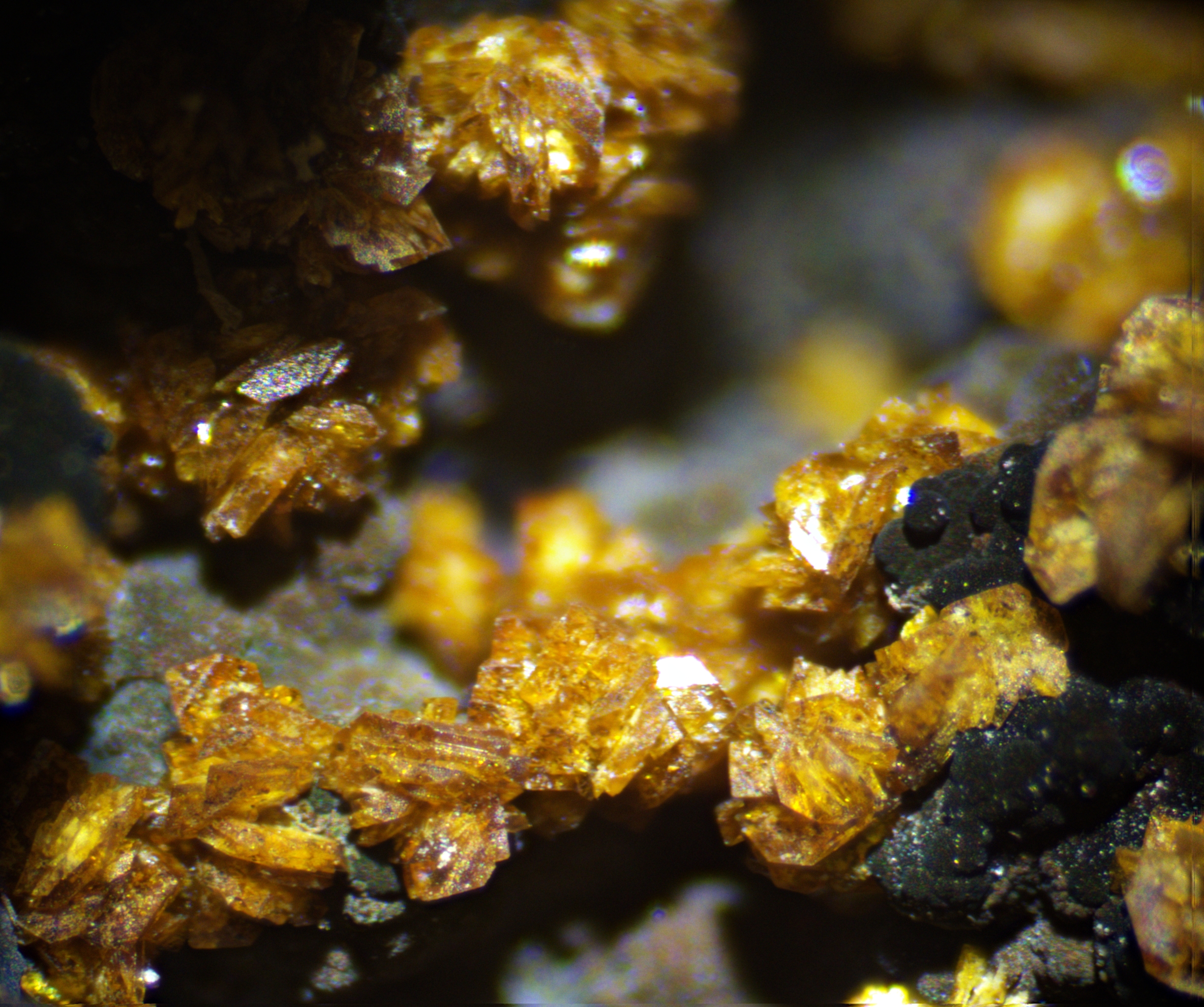
Corkite is a rare lead-iron mineral of the alunite-jarosite group, typically forming small, tabular crystals ranging in color from brown to greenish.
Properties
- Mohs hardness
- 3.5-4.5
- Luster
- Szklisty do jedwabistego
- Streak
- Biała
- Density
- 4.295
- Cleavage
- On {0001}, perfect.
- Fracture
- Nierówny
- Transparency
- Transparent,Translucent
- Crystal system
- Trigonal
Diagnostic features
## Identification Corkite can be identified by its characteristic color (from brown to greenish), tabular crystal habit, and perfect cleavage. Its association with other minerals of the oxidation zone, such as goethite or jarosite, can also indicate the presence of corkite. ## Distinguishing from Similar Minerals Corkite can be confused with other minerals of the alunite-jarosite group, such as jarosite or beudantite, due to similar habit and color. Differentiation usually requires chemical analysis or X-ray diffraction to confirm the presence of lead and phosphates in the structure. It is distinguished from jarosite by the presence of lead and phosphates, and from beudantite by the dominance of sulfate over arsenate. ## Crystal Forms Corkite most commonly forms small, tabular or platy crystals. They can occur individually or form aggregates, often with a rosette or radial habit. Crystals are usually small, often microscopic.
Geological environment
## Genesis Corkite is a secondary mineral, formed in the oxidation zones of lead and iron ore deposits. It forms as a result of weathering and transformation processes of primary minerals, in an environment rich in sulfates and phosphates. ## Mineral Associations Corkite often co-occurs with other secondary minerals, such as goethite, jarosite, cerussite, pyromorphite, and other iron and lead minerals. It can also be found in association with quartz or other silicate minerals, which form the matrix. ## Localities The most famous corkite localities include the Cork mine in Ireland, where the mineral was discovered. Other occurrences include mines in England (e.g., Devon), Germany (e.g., Black Forest), and the United States (e.g., Arizona).
Rarity
Uncommon
For collectors
## Quality Criteria The most prized corkite specimens are those with well-formed, distinct crystals of intense and uniform color. Large aggregates of crystals or specimens on an aesthetic matrix are also highly valued. The transparency of the crystals and the absence of mechanical damage contribute to their collectibility. ## Popular Localities The most sought-after corkite specimens come from historical localities, such as the Cork mine in Ireland, due to their historical significance and often good crystal quality. Other localities that yield interesting specimens include those in England and Germany.
Care and storage
## Cleaning Delicate corkite specimens can be cleaned with a soft brush to remove dust. For more stubborn dirt, distilled water can be used, but prolonged soaking should be avoided, especially if the mineral is embedded in a water-sensitive matrix. ## What to Avoid Avoid using aggressive chemical agents, such as acids or strong detergents, as they can damage the mineral's surface. Corkite is sensitive to temperature changes, so it should be protected from sudden fluctuations. Prolonged exposure to direct sunlight can lead to color fading. It is also important to avoid excessive humidity, which can promote specimen degradation. ## Storage Corkite is best stored in a dry place, away from direct sunlight and heat sources. Specimens can be placed in sealed containers or display cases to protect them from dust and mechanical damage. For delicate crystals, it is recommended to use a soft substrate, such as cotton or foam, to prevent breakage.