Sunstone
Chemical formula: (Na,Ca)Al₁₋₂Si₃₋₂O₈
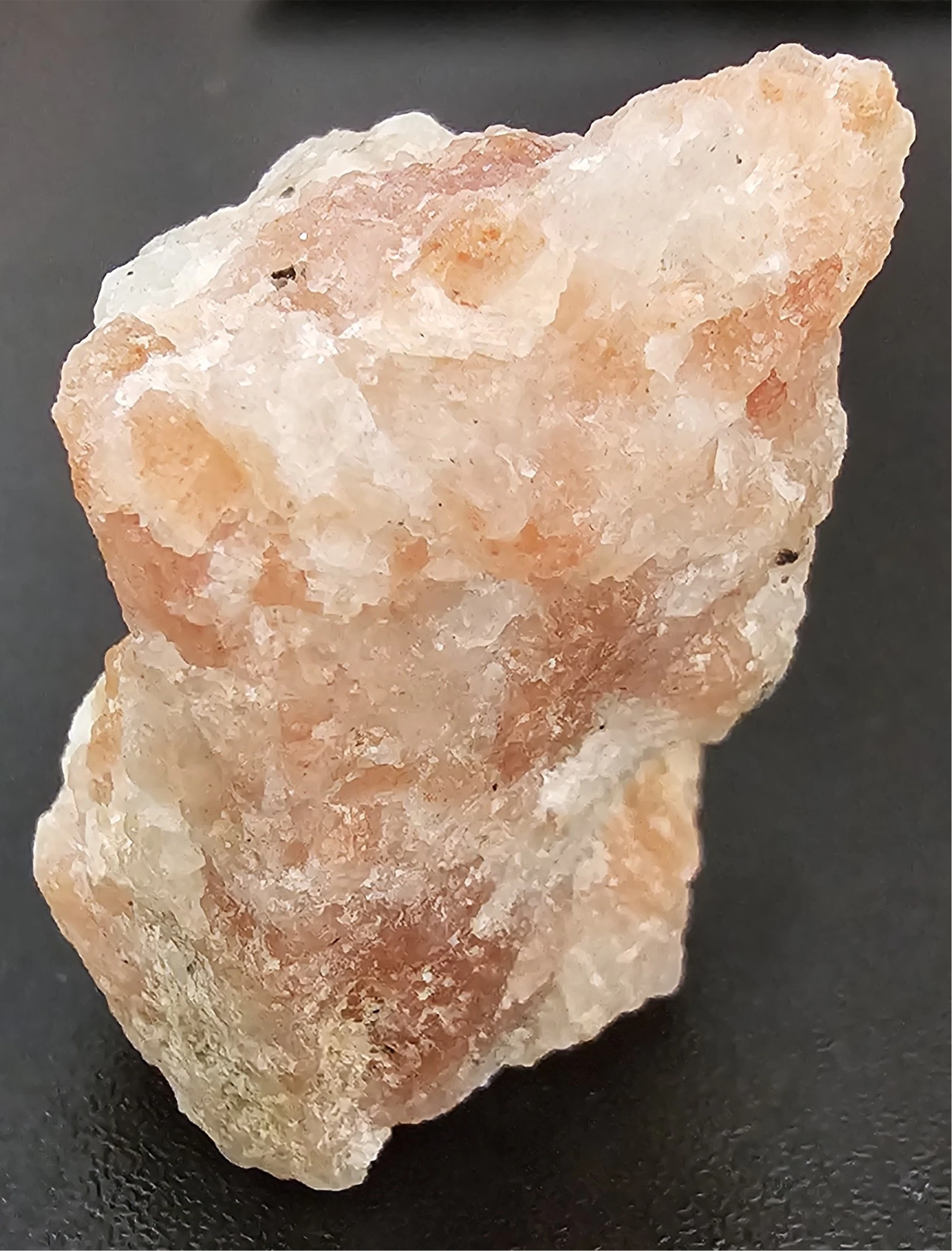
Sunstone is a variety of feldspar, most commonly oligoclase, characterized by a distinctive aventurescence effect, which is a shimmering caused by inclusions of hematite or goethite.
Properties
- Mohs hardness
- 6-6.5
- Luster
- Vitreous
- Streak
- White
- Density
- 2.62-2.67
- Cleavage
- Good on {001} and {010}
- Fracture
- Conchoidal to uneven
- Transparency
- Transparent to translucent
- Crystal system
- Triclinic
Diagnostic features
## Identification Sunstone is primarily identified by its characteristic shimmer (aventurescence), which results from light reflection off tiny inclusions. The color, usually in shades of orange, red, or green, is also a diagnostic feature. Observing inclusions under magnification can aid in identification. ## Distinguishing from Similar Minerals Sunstone can be confused with aventurine, which also exhibits aventurescence. The difference lies in the type of inclusions: in aventurine, these are typically small mica flakes (fuchsite), while in sunstone, hematite or goethite platelets dominate. Sunstone also has a higher hardness than aventurine. It can also be confused with artificial aventurine glass, which has more evenly distributed and often larger inclusions. ## Crystal Forms Sunstone typically occurs as massive aggregates or as a component of igneous rocks. Crystals are rare and usually have a tabular or prismatic habit.
Geological environment
## Genesis Sunstone primarily forms in igneous rocks, such as pegmatites and volcanic extrusive rocks. It also occurs in some metamorphic rocks. The inclusions responsible for the aventurescence effect crystallize during the formation of the mineral or are a result of secondary processes. ## Mineral Associations Sunstone often coexists with other feldspar minerals, quartz, biotite, muscovite, and hornblende, depending on the geological environment. ## Localities Significant deposits of sunstone are found in Norway (Tvedestrand), USA (Oregon, North Carolina), India (Orissa), Canada (Labrador), Tanzania, Russia, and Australia.
Rarity
Rare
For collectors
## Quality Criteria The most valued sunstone specimens are characterized by intense, uniform color, a distinct and evenly distributed aventurescence effect, and good transparency. Large sizes and the absence of visible cracks or inclusions other than those responsible for the shimmer also increase the specimen's value. Specimens with a dichroism effect are particularly sought after. ## Popular Localities Particularly prized sunstone specimens come from Oregon in the USA, where a variety with copper inclusions occurs, giving it a unique red and green color. Other important sources include Norway and India.
Care and storage
## Cleaning Sunstone can be cleaned gently using a soft cloth or brush and lukewarm water with mild soap. After washing, it should be thoroughly rinsed with clean water and dried. ## What to Avoid Avoid contact of sunstone with strong chemicals such as acids, alkalis, or solvents, which can damage its surface or alter its color. Ultrasonic or steam cleaning is also not recommended, as it can lead to damage or cracks, especially in specimens with numerous inclusions. Prolonged exposure to direct sunlight can, in some cases, affect color intensity. Protect the stone from sudden temperature changes. ## Storage Sunstone is best stored separately from other, harder minerals to avoid scratches. Ideally, wrap it in a soft cloth or place it in a separate pouch or box. Store in a place with stable temperature and humidity, away from direct sunlight.
External references
- https://www.mindat.org/min-10984.html
- https://pl.wikipedia.org/wiki/https%3A%2F%2Fpl.wikipedia.org%2Fwiki%2FKamie%25C5%2584_s%25C5%2582oneczny
- https://en.wikipedia.org/wiki/https%3A%2F%2Fen.wikipedia.org%2Fwiki%2FSunstone
- https://es.wikipedia.org/wiki/https%3A%2F%2Fes.wikipedia.org%2Fwiki%2FPiedra_del_Sol