Howlite
Chemical formula: Ca<sub>2</sub>B<sub>5</sub>SiO<sub>9</sub>(OH)<sub>5</sub>
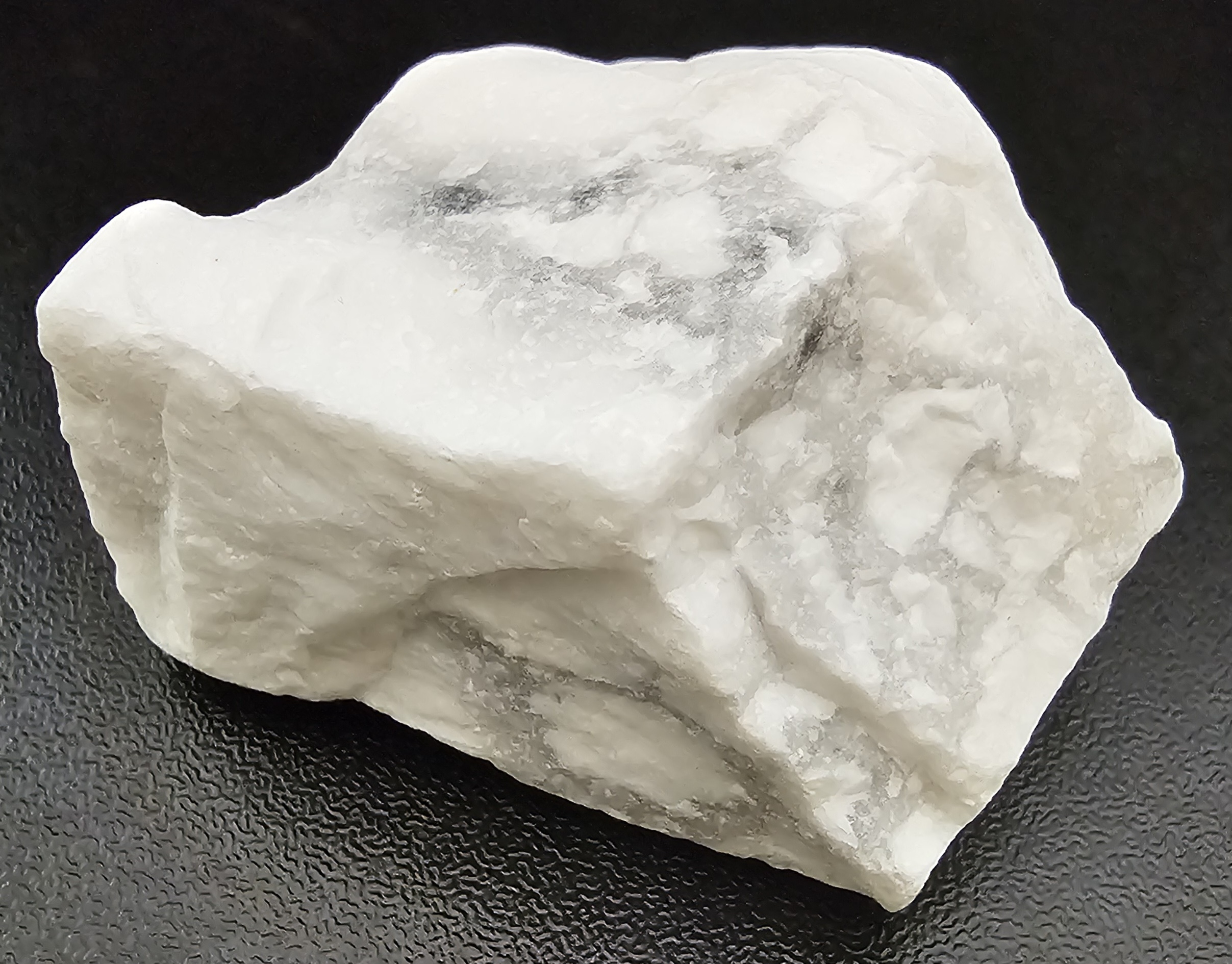
Howlite is a hydrated calcium borosilicate, valued in jewelry and sculpture for its characteristic white color with dark veins.
Properties
- Mohs hardness
- 6.5
- Luster
- Matowy do ziemistego, na przełamach szklisty
- Streak
- White
- Density
- 2.62
- Cleavage
- Brak
- Fracture
- Muszlowy do nierównego
- Transparency
- Transparent
- Crystal system
- Monoclinic
Diagnostic features
## Identification Howlite can be identified by its characteristic white or grayish-white color with dark, irregular veins that form a web-like pattern. Its dull, porcelain-like luster and relatively low hardness (6.5 on the Mohs scale) also aid in identification. It often occurs as nodular or cauliflower-like concretions. ## Distinguishing from Similar Minerals Howlite is sometimes confused with turquoise, magnesite, marble, or bone. It is distinguished from turquoise by the lack of natural blue coloration (though it is often dyed blue) and lower hardness. Magnesite has a similar appearance but is usually more compact and does not have such distinct veins. Marble is typically softer and has a different crystalline structure. Bone is lighter and has a different texture. ## Crystal Forms Howlite most commonly occurs as massive, opaque aggregates, often with a nodular or cauliflower-like shape. Less commonly, it forms small, tabular crystals, which are usually white and opaque. Aggregates can be granular or fibrous.
Geological environment
## Genesis Howlite forms in evaporitic environments, in sedimentary borate deposits, often in association with gypsum, anhydrite, and other borate minerals. It forms as a result of hydrothermal or metasomatic processes, where solutions rich in boron and calcium react with sediments. It occurs in sedimentary rocks, especially in desert and semi-desert areas where intense evaporation of mineral-rich waters takes place. ## Mineral Associations Howlite often co-occurs with other borate minerals such as ulexite, colemanite, borax, as well as with gypsum, anhydrite, calcite, and aragonite. It can also be found in association with opal and chalcedony. ## Localities The most important howlite deposits are found in the United States (California, Nevada), Canada (Nova Scotia), Turkey, Russia, and Germany. Significant amounts of howlite are also mined in Mexico.
Rarity
Rare
For collectors
## Quality Criteria The most prized howlite specimens are those with an intense white color and distinct, contrasting dark veins that form an aesthetic pattern. Large, well-formed concretions with interesting shapes are also highly sought after. Color purity and the absence of cracks or mechanical damage affect the specimen's value. Rare, well-formed howlite crystals are particularly valuable. ## Popular Localities The most prized howlite specimens usually come from California, USA, where large concretions of excellent quality are found. Other important sources include Nova Scotia, Canada, and some regions of Turkey.
Care and storage
## Cleaning Howlite is a porous mineral, so care should be taken during cleaning. It is best cleaned with a soft, damp cloth or a gentle brush using lukewarm water. Mild soap can be used, but the mineral should be thoroughly rinsed to remove any residue. ## What to Avoid Avoid using harsh chemicals such as acids, ammonia, or bleaches, as they can damage the mineral's surface or alter its color. Howlite is sensitive to high temperatures and prolonged exposure to direct sunlight, which can lead to fading. Due to its porosity, it can absorb liquids and substances, so contact with oils, perfumes, or cosmetics should be avoided. ## Storage Howlite should be stored separately from harder minerals to prevent scratching. It is best to wrap it in a soft cloth or place it in a separate pouch. Ideal storage conditions are a dry, cool place, away from direct sunlight and heat sources.