Hilairite
Chemical formula: Na<sub>2</sub>Zr<sup>4+</sup>Si<sub>3</sub>O<sub>9</sub>·3H<sub>2</sub>O
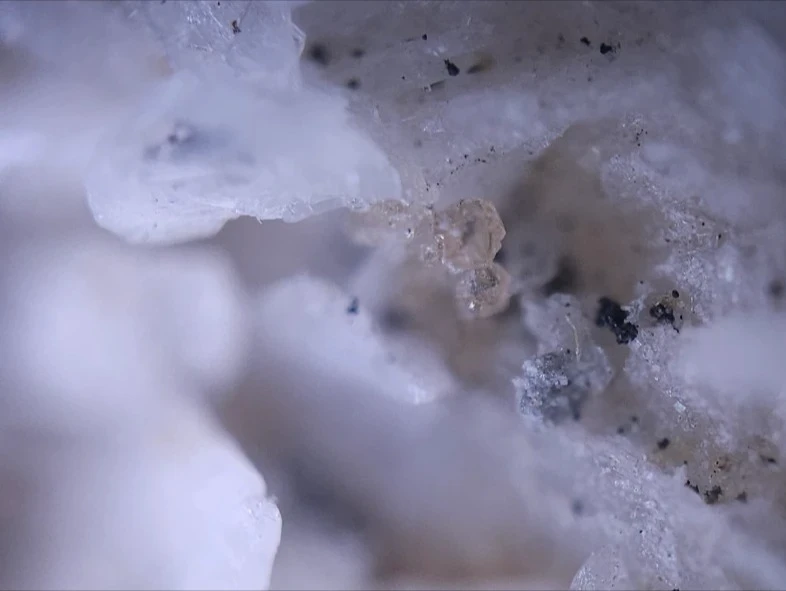
Hilairite is a rare sodium zirconium silicate mineral, characterized by variable color and a trigonal crystallographic system.
Properties
- Mohs hardness
- 4.5
- Luster
- Szklisty
- Streak
- Biała
- Density
- 2.724
- Cleavage
- Brak
- Fracture
- Nierówny
- Transparency
- Transparent,Translucent,Opaque
- Crystal system
- Trigonal
Diagnostic features
## Identification Hilairite can be identified by its trigonal crystal habit, variable color (often pink or brown), and vitreous luster. A Mohs hardness of 4.5 is also a diagnostic feature. For small crystals, identification may require laboratory tests, such as X-ray diffraction. ## Distinguishing from similar minerals Due to its color variability, hilairite can be confused with other silicate minerals of similar habit, such as eudialyte or catapleiite. It differs from eudialyte by its lower hardness and lack of distinct cleavage. Catapleiite usually has a different color and often occurs in larger crystals. Definitive distinction requires chemical analysis or X-ray diffraction. ## Crystal forms Hilairite typically forms isometric crystals with columnar or tabular habit, often with distinct trigonal faces. Aggregates can be massive, radial, or form crusts.
Geological environment
## Genesis Hilairite is a secondary mineral, formed in low-temperature, hydrothermal conditions, often in alkaline pegmatites and nepheline syenite rocks. It occurs in fissures and cavities of these rocks, where it crystallizes from solutions rich in sodium, zirconium, and silicon. ## Mineral associations Hilairite often co-occurs with other rare alkaline minerals, such as eudialyte, aegirine, nepheline, microcline, analcime, natrolite, quartz, fluorite, and various zeolites. ## Localities The most known and valued occurrences of hilairite are in Canada, at Mont Saint-Hilaire in Quebec, which is the type locality for this mineral. Other occurrences include Russia (Kola Peninsula) and Greenland.
Rarity
Rare
For collectors
## Quality criteria The most prized hilairite specimens are those that exhibit well-formed, distinct crystals with intense and uniform color, especially pink or red. The size of the crystals, their transparency, and the absence of mechanical damage also influence their collector's value. Specimens with aesthetic associations with other rare minerals are particularly sought after. ## Popular localities The most desirable hilairite specimens come from Mont Saint-Hilaire in Quebec, Canada, where the mineral was first discovered and where some of the best specimens in the world are still found.
Care and storage
## Cleaning Hilairite is a relatively soft mineral, so it should be cleaned gently. For removing dust and minor dirt, a soft brush or paintbrush is recommended. For heavier dirt, lukewarm distilled water with a small amount of mild soap can be used, followed by thorough rinsing and drying with a soft cloth. ## What to avoid Avoid using aggressive chemical agents, such as acids or strong detergents, which can damage the mineral's surface. Hilairite is sensitive to temperature changes, so it should not be exposed to sudden fluctuations or prolonged high temperatures. Prolonged exposure to direct sunlight can also affect the color change of some specimens. Due to the water content in its structure, avoid extremely low humidity environments, which can lead to dehydration and cracking. ## Storage Hilairite specimens are best stored in closed display cases or boxes, away from dust and direct light. It is advisable to keep each specimen separate from others to prevent scratching. Stable temperature and humidity conditions are crucial for maintaining the mineral in good condition.