Glaucophane
Chemical formula: ☐Na<sub>2</sub>(Mg<sub>3</sub>Al<sub>2</sub>)Si<sub>8</sub>O<sub>22</sub>(OH)<sub>2</sub>
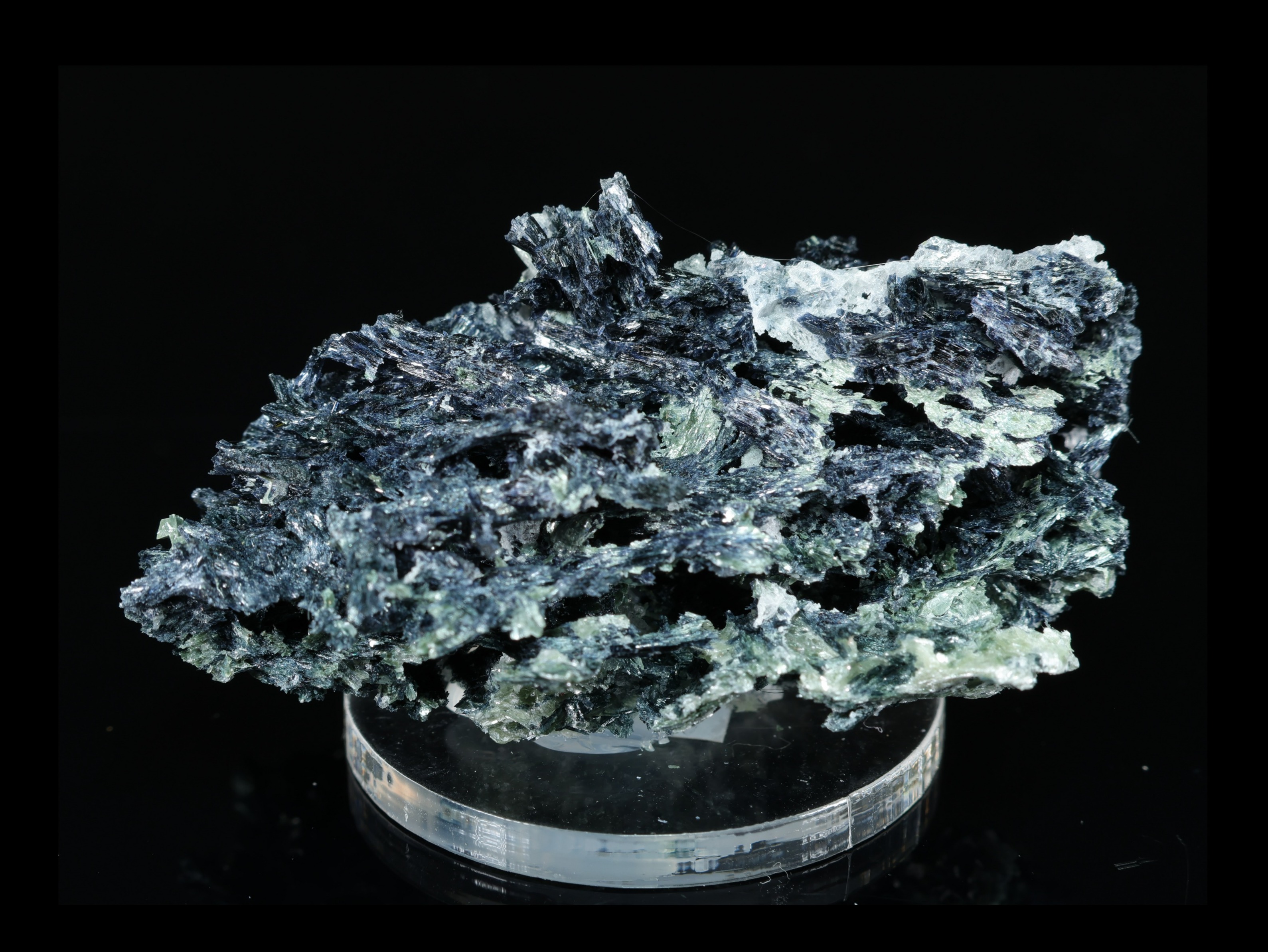
Glaucophane is a blue mineral from the amphibole group, characterized by a fibrous or columnar habit, forming under specific metamorphic conditions.
Properties
- Mohs hardness
- 5-6
- Luster
- Vitreous, to silky in fibrous varieties.
- Streak
- Pale grey to bluish-grey.
- Density
- 3.08
- Cleavage
- Perfect on {110}
- Fracture
- Nierówny
- Transparency
- Translucent
- Crystal system
- Monoclinic
Diagnostic features
## Identification Glaucophane can be identified by its characteristic blue color, fibrous or columnar habit, and perfect cleavage. Its occurrence in metamorphic rocks, especially in glaucophane schists, is also a strong diagnostic indicator. ## Distinguishing from Similar Minerals Glaucophane can be confused with other blue amphiboles, such as riebeckite or crossite. Differentiation often requires optical analysis under a polarizing microscope or X-ray diffraction studies, which allow for precise determination of chemical composition and crystal structure. The color of glaucophane is usually more lavender or grayish-blue compared to the more intense blue of some other amphiboles. ## Crystal Forms Glaucophane most commonly occurs as long, prismatic crystals that form fibrous or columnar aggregates. Single, well-formed crystals are less common. Aggregates can be compact or radial.
Geological environment
## Genesis Glaucophane is a metamorphic mineral, forming under conditions of high pressure and relatively low temperature, typical of the glaucophane schist facies. These conditions are characteristic of subduction zones, where an oceanic plate is drawn beneath another plate, leading to the metamorphism of oceanic crust rocks. ## Mineral Associations Glaucophane often co-occurs with minerals such as jadeite, lawsonite, epidote, garnets (especially almandine and spessartine), muscovite, chlorite, quartz, and albite. These associations are typical of metamorphic rocks of the glaucophane schist facies, such as glaucophane schists and eclogites. ## Localities Significant glaucophane deposits occur in various regions worldwide. The most well-known localities include California in the USA (especially in the Coast Ranges region), the Alps (e.g., in Italy and Switzerland), Greece (Syros island), Japan, and New Caledonia. In Poland, glaucophane is less common, but its occurrences are known in the Sudetes.
Rarity
Uncommon
For collectors
## Quality Criteria The most prized glaucophane specimens are those with intense, uniform blue color, well-formed crystals, or aesthetic, fibrous aggregates. Large, undamaged specimens with distinct crystallization are particularly sought after. The purity of the mineral and the absence of visible inclusions of other minerals also increase its collector's value. ## Popular Localities The most valued glaucophane specimens come from classic glaucophane schist facies localities, such as California (USA), the Alps (Italy, Switzerland), and Greece (Syros). Specimens from these locations often feature exceptional color and form.
Care and storage
## Cleaning Glaucophane can be cleaned gently using a soft brush and lukewarm water. For heavier dirt, distilled water can be used to avoid hard water deposits. ## What to Avoid Avoid using strong chemicals, acids, and bases, which can damage the mineral's surface. Prolonged exposure to direct sunlight may potentially affect the intensity of its color. The mineral is relatively hard, but it should be protected from impacts and scratches. ## Storage Glaucophane specimens are best stored in a dry place, away from dust and direct light. They can be displayed in closed cabinets, which protects them from dust accumulation and accidental damage. For delicate, fibrous specimens, it is advisable to provide additional protection against mechanical stress.