Galena
Chemical formula: PbS
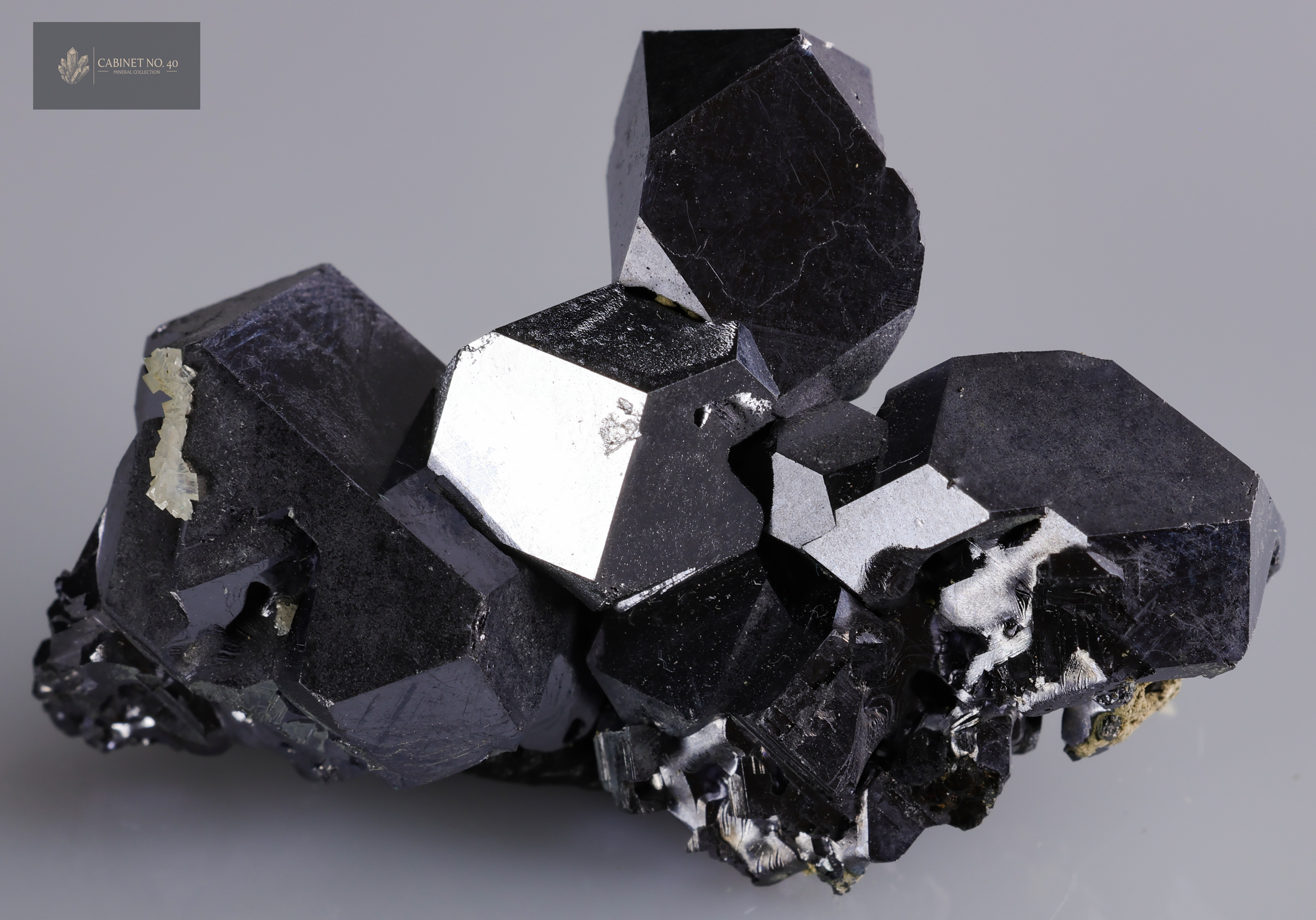
Galena is a common sulfide mineral with a metallic luster, being the main ore of lead, often forming cubes or octahedra.
Properties
- Mohs hardness
- 2.5
- Luster
- Metallic
- Streak
- Lead-grey
- Density
- 7.60
- Cleavage
- {001}
- Fracture
- Muszlowy do nierównego
- Transparency
- Opaque
- Crystal system
- Isometric
Diagnostic features
## Identification Galena can be identified by its characteristic lead-gray color, metallic luster, and high density. A key diagnostic feature is its perfect cleavage in three perpendicular directions, leading to the formation of cubes or stepped fractures. The streak of galena is lead-gray, which distinguishes it from many other minerals of similar appearance. ## Distinguishing from Similar Minerals Galena can be confused with other minerals with a metallic luster and dark color, such as argentite, tetrahedrite, or stibnite. It is distinguished from argentite (Ag₂S) by its distinct, perfect cleavage and higher density. Tetrahedrite (Cu₁₂Sb₄S₁₃) usually has a darker, black color and lacks cleavage. Stibnite (Sb₂S₃) forms elongated, acicular crystals and has a lower density. Pyrrhotite (Fe₁₋ₓS) has a brownish color and is magnetic, which distinguishes it from galena. ## Crystal Forms Galena most commonly occurs as cubes, octahedra, or combinations of these forms. It often forms massive, granular, or compact aggregates. Bladed or fibrous habits can also be found. Crystals often exhibit twinning, which further complicates their morphology.
Geological environment
## Genesis Galena forms in a wide range of geological environments, most commonly in medium- and low-temperature hydrothermal veins associated with magmatic intrusions. It also occurs in metasomatic deposits, where hydrothermal solutions react with carbonate rocks, forming MVT (Mississippi Valley Type) deposits. It can also form in sedimentary deposits as a result of diagenetic and epigenetic processes. ## Mineral Associations Galena often co-occurs with other sulfide minerals, such as sphalerite (ZnS), chalcopyrite (CuFeS₂), and pyrite (FeS₂). It is also frequently accompanied by ore minerals such as native silver, argentite, as well as gangue minerals such as quartz, calcite, barite, and fluorite. In oxidation zones, galena can alter into secondary minerals such as cerussite (PbCO₃) and anglesite (PbSO₄). ## Localities Known galena deposits occur worldwide. Important localities include: Broken Hill in Australia, Freiberg in Germany, Coeur d'Alene in the USA (Idaho), Sullivan in Canada (British Columbia), Madan in Bulgaria, and various regions of Mexico and Peru. In Poland, galena occurs in zinc and lead ore deposits in the Upper Silesian region and in the Świętokrzyskie Mountains.
Rarity
Common
For collectors
## Quality Criteria Collectors value galena specimens for well-formed, large, and undamaged crystals with a distinct metallic luster. Cubes and octahedra with sharp edges and smooth surfaces are particularly sought after. The attractiveness is also enhanced by the co-occurrence with other contrasting minerals, such as sphalerite, pyrite, or calcite, creating aesthetic compositions. The purity and absence of weathering coatings on the crystal surfaces also affect the value of the specimen. ## Popular Localities The most prized galena specimens come from localities such as: Madan in Bulgaria, where large, lustrous crystals are found; Joplin in the USA (Missouri), famous for excellent cubes; and Naica in Mexico, known for gigantic galena crystals often co-occurring with other minerals. Deposits in Broken Hill, Australia, also provide high-quality specimens.
Care and storage
## Cleaning Galena should be cleaned gently, using a soft brush or cotton cloth. Distilled water can be used, but prolonged soaking should be avoided, as galena can react with water containing dissolved gases, leading to surface oxidation. After washing, the specimen should be thoroughly dried. ## What to Avoid Avoid contact of galena with acids, strong bases, and other aggressive chemicals that can damage the mineral surface or cause corrosion. Due to its low hardness (2.5 on the Mohs scale), galena is susceptible to scratches, so it should be protected from contact with harder minerals and sharp objects. Rapid temperature changes and exposure to direct sunlight, which can accelerate oxidation processes, should also be avoided. ## Storage Galena is best stored in enclosed display cases or boxes, away from dust and moisture. It is advisable to place it on a soft pad to prevent mechanical damage. Due to its lead content, caution should be exercised when handling specimens, and hands should always be washed after contact with the mineral.