Francevillite
Chemical formula: Ba(U<sup>6+</sup>O<sub>2</sub>)<sub>2</sub>(V<sup>5+</sup>O<sub>4</sub>)<sub>2</sub>·5H<sub>2</sub>O
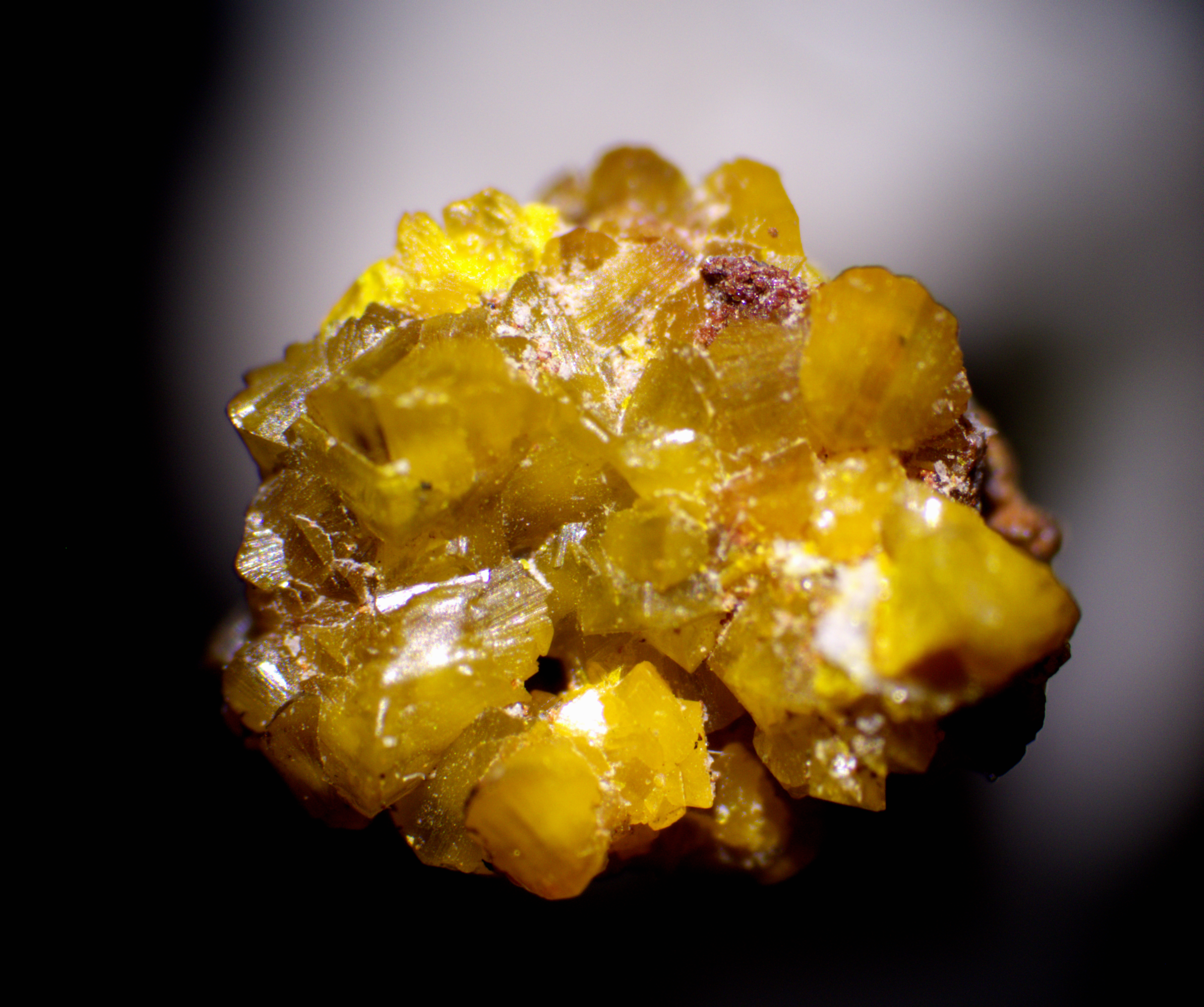
Francevillite is a rare uranyl and barium vanadate mineral, typically forming small, radial aggregates or crusts with an intense yellow coloration.
Properties
- Mohs hardness
- 3
- Luster
- Perłowy do jedwabistego
- Streak
- Light yellow
- Density
- 4.55
- Cleavage
- On {001}
- Fracture
- Nierówny
- Transparency
- Translucent
- Crystal system
- Orthorhombic
Diagnostic features
## Identification Francevillite can be identified by its characteristic lemon-yellow color, often forming radial or lamellar aggregates. An important diagnostic feature is its hardness (3 on the Mohs scale) and translucent nature. The streak is pale yellow. ## Distinguishing from Similar Minerals Francevillite can be confused with other secondary uranium minerals, such as carnotite or tyuyamunite, which also have a yellow coloration. It differs from carnotite by the presence of barium instead of potassium. Differences in chemical composition and crystallographic system are key for precise differentiation. ## Crystal Forms Francevillite crystals are typically tabular, often forming radial aggregates, crusts, or lamellar masses. These aggregates can be very fine, forming coatings on other minerals.
Geological environment
## Genesis Francevillite forms in the oxidation zones of uranium deposits as a secondary mineral. It is formed by hydrothermal processes or weathering, where uranium, barium, and vanadium are mobilized and recrystallize in the presence of water. ## Mineral Associations Francevillite often co-occurs with other uranium minerals, such as uraninite, carnotite, tyuyamunite, as well as vanadium and barium minerals. It can be found in association with silicate minerals and iron oxides. ## Localities The most known and type locality for francevillite is the Mounana uranium mine in Gabon, where it was discovered. Other occurrences include the Democratic Republic of Congo, United States (Colorado, Utah), Australia, and Germany.
Rarity
Rare
For collectors
## Quality Criteria The most prized francevillite specimens are those with intense, uniform color, well-formed crystals, and aesthetic, radial aggregates. The size of the specimen, its purity, and the absence of mechanical damage also affect its collector's value. Specimens on matrix are particularly sought after. ## Popular Localities The most sought-after francevillite specimens come from its discovery site - the Mounana mine in Gabon. They are valued for their typical color and mode of occurrence.
Care and storage
## Cleaning Francevillite is a relatively soft and delicate mineral. To clean specimens, use only a soft brush or a delicate paintbrush to remove dust. For heavier soiling, the specimen can be carefully rinsed with distilled water, avoiding prolonged soaking. ## What to Avoid Avoid using any chemical cleaning agents, which can damage the mineral's surface or alter its color. Francevillite is sensitive to high temperatures and direct sunlight, which can lead to dehydration and color change. Due to its uranium content, direct skin contact should be avoided, and the specimen should not be stored near radiation-sensitive materials. ## Storage Francevillite specimens are best stored in enclosed display cases or boxes, away from sources of light and heat. It is important to ensure stable environmental conditions to avoid changes in temperature and humidity. Due to its delicacy, each specimen should be stored separately to prevent mechanical damage.