Ferrosaponite
Chemical formula: Ca<sub>0.3</sub>(Fe<sup>2+</sup>,Mg,Fe<sup>3+</sup>)<sub>3</sub>(Si,Al)<sub>4</sub>O<sub>10</sub>(OH)<sub>2</sub>·4H<sub>2</sub>O
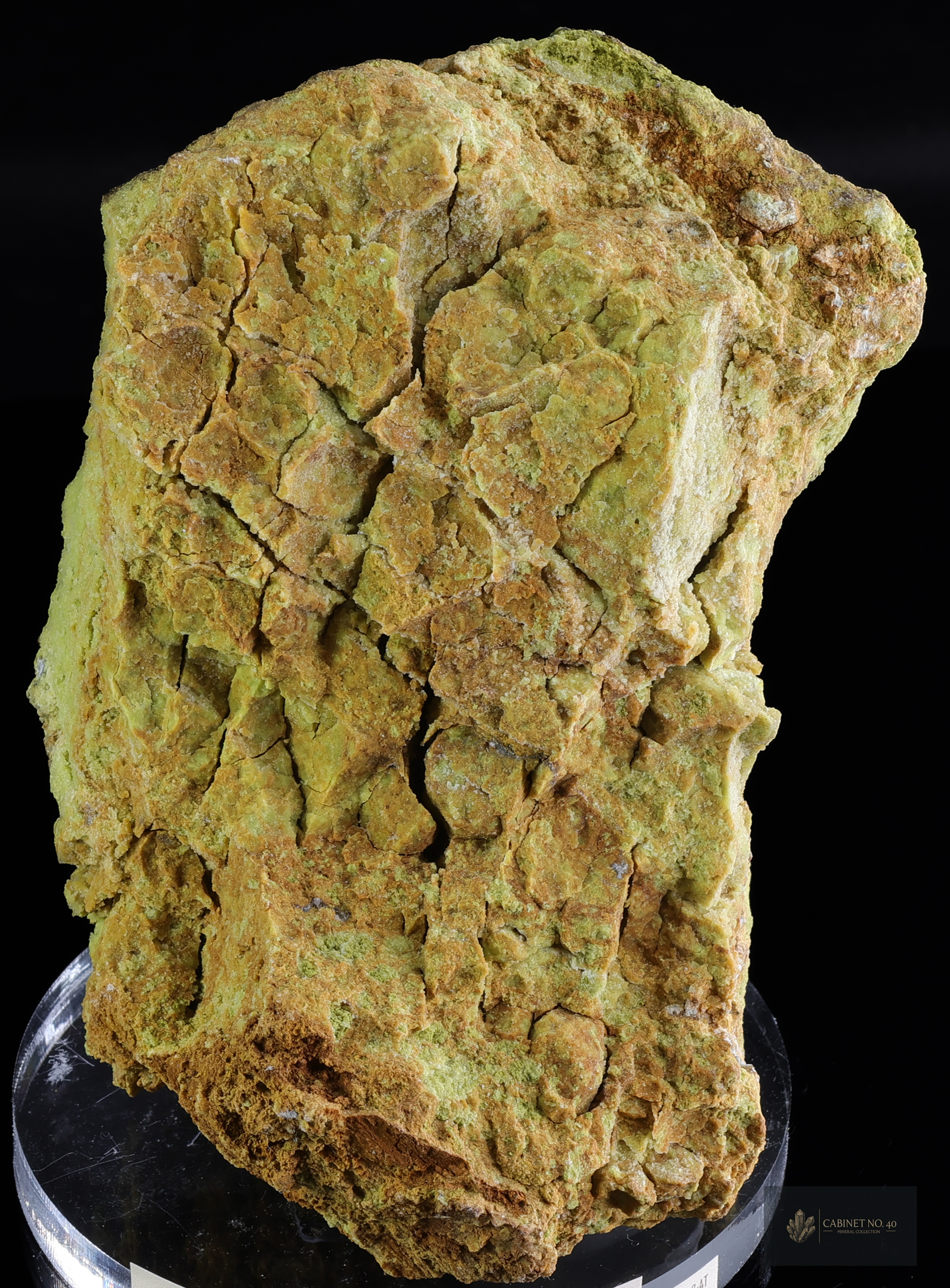
Ferrosaponite is a rare clay mineral of the smectite group, a magnesium-iron silicate, characterized by its dark green color and low hardness.
Properties
- Mohs hardness
- 2
- Streak
- green
- Density
- 2.49
- Cleavage
- (001)
- Transparency
- Translucent
- Crystal system
- Monoclinic
Diagnostic features
## Identification Ferrosaponite can be identified by its dark green color, low hardness (2 on the Mohs scale), and earthy or compact habit. The green streak is also characteristic. This mineral often occurs as fine-grained aggregates. ## Distinguishing from similar minerals Ferrosaponite can be confused with other clay minerals, such as saponite or chlorites. It is distinguished from saponite by the dominant presence of iron in its chemical composition, which often manifests as a darker color. It can be distinguished from chlorites based on its lower hardness and different optical and crystallographic properties, although in the case of compact aggregates, this may require specialized studies. ## Crystal forms Ferrosaponite typically does not form well-developed crystals visible to the naked eye. It occurs mainly as microcrystalline aggregates, compact masses, or earthy accumulations. Sometimes it can form pseudomorphs after other minerals.
Geological environment
## Genesis Ferrosaponite forms under low-temperature hydrothermal conditions, often as a result of alteration of ultramafic rocks, such as basalts, peridotites, or serpentinites. It can also form in sedimentary environments where clay minerals undergo transformations in the presence of iron- and magnesium-rich solutions. ## Mineral associations Ferrosaponite often co-occurs with other clay minerals, such as saponite, chlorites, montmorillonite, as well as with quartz, calcite, and minerals from the serpentine group. ## Localities Ferrosaponite is a rare mineral, and its occurrences are scattered. Known localities include some areas in the United States, Canada, Russia, and Europe, where it occurs in altered volcanic and sedimentary rocks.
Rarity
Very Rare
For collectors
## Quality criteria The most prized ferrosaponite specimens are those with an intense, uniform dark green color, without visible impurities. Specimens with well-preserved texture, forming interesting aggregate shapes, are also more desirable. The size of the specimen is important, but due to its rarity, even smaller, well-formed samples are valuable. ## Popular localities Due to the rarity of ferrosaponite, there are not many popular localities that supply specimens in large quantities. Specimens usually come from single, specific geological locations where conditions favored its formation.
Care and storage
## Cleaning Ferrosaponite is a soft mineral, therefore it requires gentle cleaning. It is best to use a soft brush or paintbrush to remove loose dust. For heavier soiling, lukewarm distilled water can be used to gently rinse the specimen. Avoid vigorous scrubbing to prevent damage to the mineral's surface. ## What to avoid Avoid using any chemical cleaning agents, which can react with the mineral and permanently damage it. Ferrosaponite is sensitive to high temperatures and direct sunlight, which can lead to changes in color or structure. Due to the water content in its structure, prolonged exposure to moisture should also be avoided, as it can affect the mineral's stability. ## Storage Ferrosaponite should be stored in a dry place, away from direct sunlight and heat sources. It is best to place the specimen in a closed display case or box to protect it from dust and humidity changes. A soft substrate, such as cotton or foam, can prevent mechanical damage.