Ferberite
Chemical formula: Fe<sup>2+</sup>W<sup>6+</sup>O<sub>4</sub>
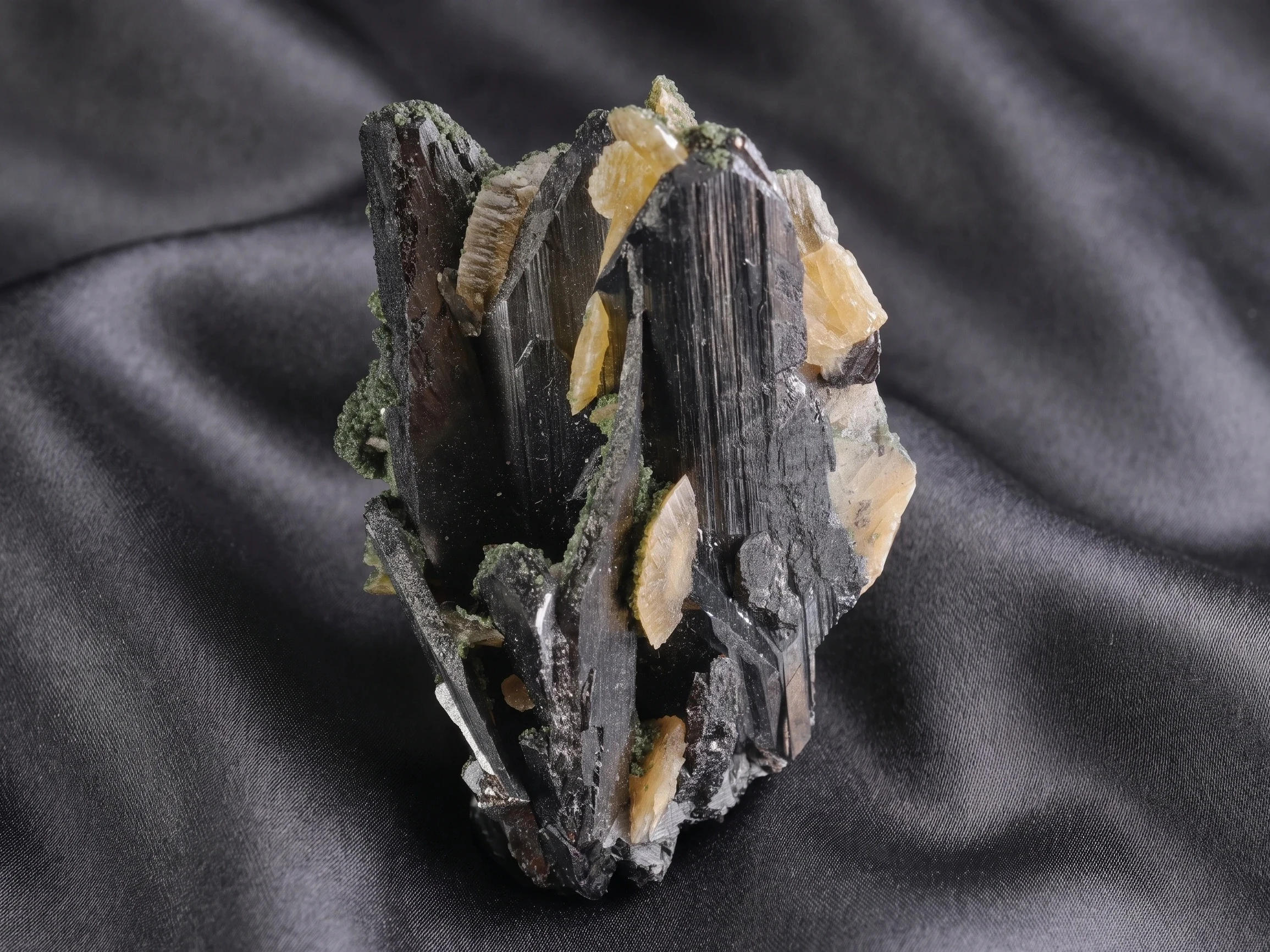
Ferberite is a mineral from the tungstate group, an iron-rich end-member of the wolframite series, characterized by its dark color and high density.
Properties
- Mohs hardness
- 4-4.5
- Luster
- Metaliczny
- Streak
- Brownish black to black
- Density
- 7.58
- Cleavage
- Perfect on {010}
- Fracture
- Nierówny
- Transparency
- Opaque
- Crystal system
- Monoclinic
Diagnostic features
## Identification Ferberite can be identified by its black color, metallic luster, and high density. Its characteristic streak, which is brownish-black to black, is also helpful. The crystal habit, often prismatic or tabular, also aids in identification. ## Distinguishing from Similar Minerals Ferberite can be confused with other minerals of similar color and luster, such as scheelite, wolframite, or even some varieties of hematite. It is distinguished from scheelite by the absence of fluorescence and significantly higher density. It is distinguished from wolframite by the dominance of iron in its chemical composition, which is difficult to assess without specialized analysis. Hematite typically has a red streak, which differentiates it from ferberite. ## Crystal Forms Ferberite most commonly occurs as prismatic or tabular crystals, often with distinct striations on their faces. It also forms granular, massive, or radial aggregates.
Geological environment
## Genesis Ferberite primarily forms in high-temperature hydrothermal veins associated with granitic intrusions. It often occurs in greisens and in contact-metasomatic zones. It can also form in pegmatites. ## Mineral Associations Ferberite co-occurs with other tungsten minerals, such as scheelite, as well as with quartz, fluorite, muscovite, topaz, cassiterite, arsenopyrite, pyrite, and chalcopyrite. ## Localities Important ferberite deposits are found in Spain (Panasqueira), Portugal (Panasqueira), Bolivia (Llallagua), China (Jiangxi), Russia (Urals), and the United States (Colorado).
Rarity
Common
For collectors
## Quality Criteria The most prized ferberite specimens are well-formed, large crystals with a distinct habit and an intense, uniform black color. The cleanliness of the crystal surfaces and the absence of mechanical damage also contribute to their collector's value. Specimens with aesthetic associations with other minerals, such as quartz or fluorite, are particularly sought after. ## Popular Localities Particularly valued ferberite specimens come from Panasqueira in Portugal and Spain, where large, well-formed crystals are found. Other important localities include Bolivia, known for its rich wolframite deposits, and China, a major producer of tungsten.
Care and storage
## Cleaning Ferberite is a relatively hard mineral, but delicate due to its cleavage. For cleaning specimens, use a soft brush and lukewarm water. A mild detergent can be used, but after cleaning, the specimen should be thoroughly rinsed with distilled water to remove any residue. ## What to Avoid Avoid using strong acids and bases, which can damage the mineral's surface. High temperatures and sudden temperature changes can also negatively affect the specimen. Due to its cleavage, ferberite is susceptible to impacts and falls, which can cause crystals to cleave. Prolonged exposure to direct sunlight is not recommended, although it does not directly affect the color of ferberite. ## Storage Ferberite specimens are best stored in enclosed display cases or boxes to protect them from dust and mechanical damage. Due to their high density, larger specimens should be stably positioned. It is advisable to place them in display cases with controlled humidity to prevent potential reactions with the environment.