Eudialyte
Chemical formula: Na<sub>15</sub>Ca<sub>6</sub>Fe<sup>2+</sup><sub>3</sub>Zr<sup>4+</sup><sub>3</sub>Si(Si<sub>25</sub>O<sub>73</sub>)(O,OH,H<sub>2</sub>O)<sub>3</sub>(Cl,OH)<sub>2</sub>
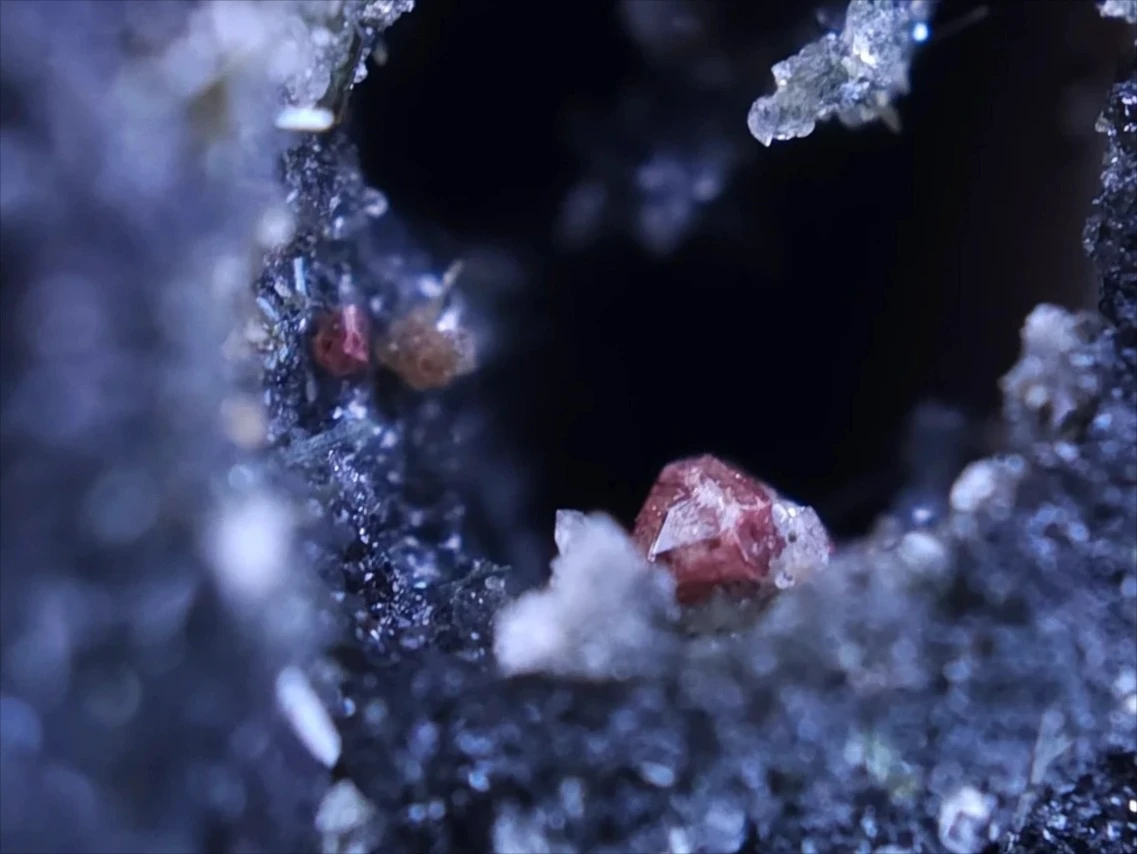
Eudialyte is a rare zirconium sodium silicate, prized for its intense colors ranging from red to pink, often found in igneous rocks.
Properties
- Mohs hardness
- 5-6
- Luster
- Vitreous.
- Streak
- White to pale pink
- Density
- 2.74
- Cleavage
- Distinct on {0001}, imperfect on <mi>{10_10} and {10_14} {11_20}</mi>.
- Fracture
- Brak danych
- Transparency
- Translucent
- Crystal system
- Trigonal
Diagnostic features
## Identification Eudialyte can be identified by its characteristic, often intense color (from red to pink, orange, brown, less commonly green or purple), vitreous luster, and translucent nature. It often occurs as granular aggregates in igneous rocks. The streak of eudialyte is white to pale pink. ## Distinguishing from Similar Minerals Eudialyte can be confused with other red or pink minerals, such as garnets, tourmalines, or rhodonite. It differs from garnets by its lower hardness and different crystallization habit. From tourmalines and rhodonite, it differs in chemical composition and often a different crystal habit. Key factors for identification include hardness, streak, and occurrence environment. ## Crystal Forms Eudialyte most often occurs as irregular grains and granular aggregates. Less frequently, it forms well-developed, tabular or prismatic trigonal crystals. Eudialyte aggregates are often embedded in the host rock.
Geological environment
## Genesis Eudialyte is an igneous mineral, forming in the final stages of crystallization of alkaline igneous rocks, such as nepheline syenites and phonolites. It occurs in pegmatites and hydrothermal veins associated with these rocks. Its presence indicates an environment rich in sodium, zirconium, and rare earth elements. ## Mineral Associations Eudialyte often co-occurs with other alkaline minerals, such as nepheline, aegirine, arfvedsonite, microcline, albite, as well as with zircon, titanite, and various minerals from the pyroxene and amphibole groups. It can also be found in association with rare earth element-bearing minerals. ## Localities The most important eudialyte deposits are located on the Kola Peninsula in Russia (Khibiny and Lovozero massifs), where it occurs in large quantities in nepheline syenites. Other significant localities include Greenland (Ilimaussaq complex), Canada (Mont Saint-Hilaire in Quebec), Norway, Sweden, United States (Arkansas), and Brazil.
Rarity
Uncommon
For collectors
## Quality Criteria The most valued eudialyte specimens are those with intense, uniform color, especially carmine or cherry red. The purity of the mineral, absence of cracks, and inclusions of other minerals that could detract from its aesthetics are also important. Well-formed crystals are rare and highly sought after, but even granular aggregates with beautiful color are attractive to collectors. Specimen size also matters, with larger, well-colored fragments being more expensive. ## Popular Localities The most prized eudialyte specimens come from the Kola Peninsula in Russia, especially from the Khibiny and Lovozero massifs. Specimens from Greenland (Ilimaussaq) are also highly valued for their quality and often accompanying other rare minerals.
Care and storage
## Cleaning Eudialyte is a mineral of moderate hardness, so it should be handled gently. For cleaning, it is best to use a soft cloth or brush and lukewarm water. Mild soap can be used, but the mineral should be thoroughly rinsed to remove any detergent residue. ## What to Avoid Avoid using aggressive chemical agents, such as acids, which can damage the mineral's surface due to its solubility. Eudialyte is sensitive to high temperatures and sudden thermal changes, which can lead to cracks. Prolonged exposure to direct sunlight can cause some colors to fade. It is also important to avoid ultrasonic and steam cleaning methods. ## Storage Eudialyte is best stored in a separate box or soft pouch to prevent scratching by harder minerals. An ideal storage location is dry, cool, away from direct sunlight and heat sources. When displayed, ensure stable conditions that protect against dust and mechanical damage.