Ellingsenite
Chemical formula: Na<sub>5</sub>Ca<sub>6</sub>Si<sub>18</sub>O<sub>38</sub>(OH)<sub>13</sub>·6H<sub>2</sub>O
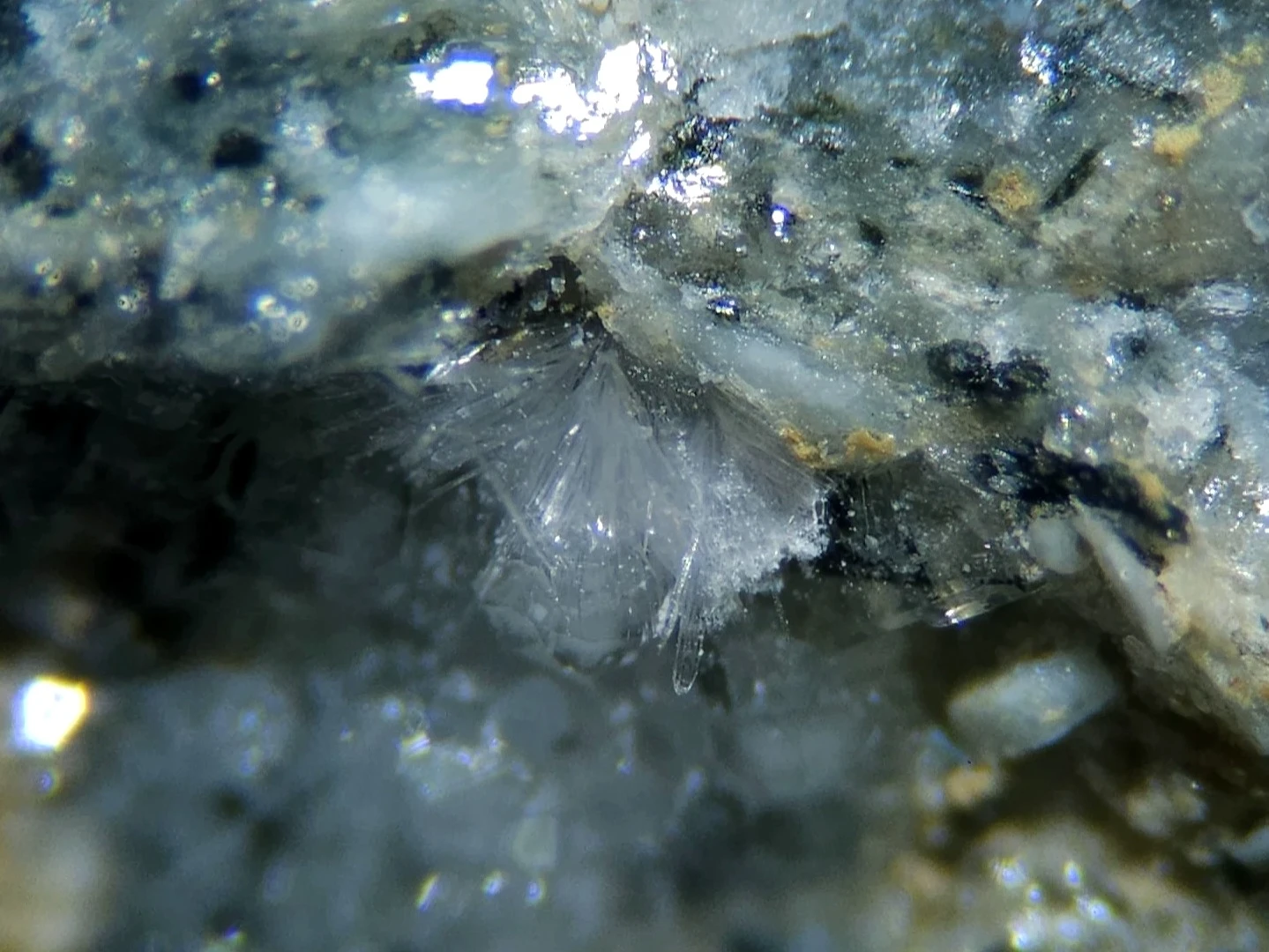
Ellingsenite is a rare sodium and calcium silicate mineral, characterized by the presence of hydroxyl groups and water in its structure.
Properties
- Mohs hardness
- 4
- Luster
- Szklisty do tłustego
- Streak
- White
- Density
- 2.32
- Cleavage
- on (001)
- Fracture
- Nierówny
- Transparency
- Transparent
- Crystal system
- Triclinic
Diagnostic features
## Identification Identifying ellingsenite in the field is difficult due to its small size and inconspicuous appearance. In a collection, identification usually requires specialized tests, such as X-ray diffraction, to confirm its structure and chemical composition. Features such as a hardness of 4, white streak, and transparency can be helpful but are not sufficient for definitive identification. ## Distinguishing from Similar Minerals Ellingsenite can be confused with other colorless or white silicate minerals, especially those occurring as small crystals. Key differences lie in the chemical composition and crystal structure, which require laboratory analysis for differentiation. ## Crystal Forms Ellingsenite crystallizes in the trigonal system. Crystals are usually small, with a platy or prismatic habit, often forming aggregates. Cleavage is visible on the (001) plane.
Geological environment
## Genesis Ellingsenite is a secondary mineral, forming in hydrothermal environments, often in fractures and cavities in igneous or metamorphic rocks. Its formation is associated with low-temperature alteration processes, where solutions rich in sodium and and calcium react with silicates. ## Mineral Associations Ellingsenite often co-occurs with other silicate minerals, such as zeolites, calcite, and other secondary minerals formed under similar hydrothermal conditions. ## Localities One of the main and best-known localities for ellingsenite is Langesundsfjorden in Norway, where it was discovered and where its best-formed specimens occur.
Rarity
Extremely Rare
For collectors
## Quality Criteria The most prized ellingsenite specimens are those characterized by well-formed, transparent crystals with a distinct habit. Larger crystal sizes, though rare, increase collector value. The purity of the specimen, free from contaminants and mechanical damage, is also important. ## Popular Localities The most sought-after ellingsenite specimens come from Langesundsfjorden in Norway, which is the type locality for this mineral. Specimens from this locality are valued for their authenticity and often better crystal development.
Care and storage
## Cleaning Ellingsenite, due to its hardness and the presence of water in its structure, requires delicate cleaning. It is recommended to use a soft brush and lukewarm distilled water. Avoid strong rubbing, which could damage the delicate crystals. ## What to Avoid Avoid contact with acids and strong bases, which can chemically react with the mineral. High temperatures and sudden temperature changes can lead to cracking. Prolonged exposure to direct sunlight may adversely affect the mineral's stability. It is also important to avoid excessive humidity, which could promote degradation. ## Storage Ellingsenite specimens are best stored in closed containers, away from dust and contaminants. Ideal conditions include stable temperature and moderate humidity. Display cases protecting against external factors are best for exhibition.