Ellenbergerite
Chemical formula: Mg<sub>6</sub>(Mg,Ti<sup>4+</sup>,Zr<sup>4+</sup>,☐)<sub>2</sub>(Al,Mg)<sub>6</sub>Si<sub>8</sub>O<sub>28</sub>(OH)<sub>10</sub>
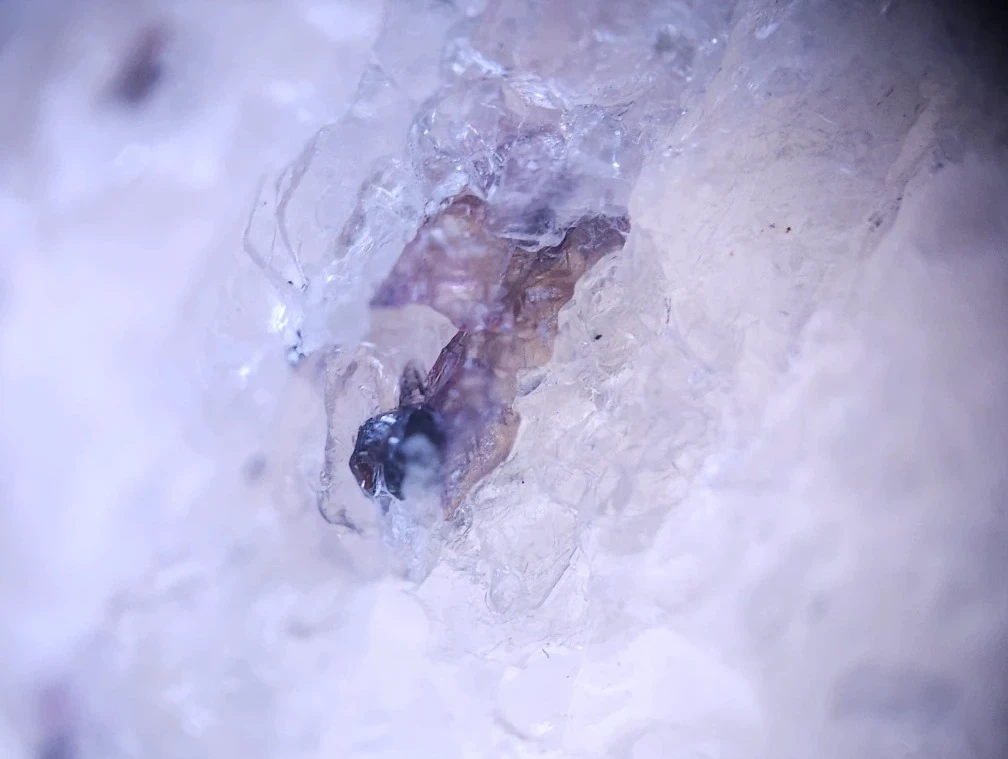
Ellenbergerite is a rare magnesium, titanium, and aluminum silicate, characterized by hexagonal crystals and often occurring in shades of purple.
Properties
- Mohs hardness
- 6.5
- Luster
- Szklisty
- Streak
- Biała
- Density
- 3.15
- Cleavage
- Brak
- Fracture
- Nierówny
- Transparency
- Transparent
- Crystal system
- Hexagonal
Diagnostic features
## Identification Ellenbergerite can be identified by its characteristic hexagonal crystal form, purple or lilac color, and a hardness of 6.5 on the Mohs scale. Its transparency is also a diagnostic feature. ## Distinguishing from Similar Minerals Due to its rarity and unique composition, ellenbergerite is not often confused with other minerals. However, its purple color may be superficially similar to some varieties of quartz (amethyst) or fluorite, but it differs from them in hardness, crystallographic system, and lack of distinct cleavage. ## Crystal Forms Ellenbergerite most commonly occurs as well-formed, columnar or acicular crystals with a hexagonal habit. Aggregates are rare; it usually forms single, isolated crystals embedded in the host rock.
Geological environment
## Genesis Ellenbergerite is a high-pressure mineral, forming under conditions of high-pressure, low-temperature metamorphism. It occurs in metamorphic rocks, such as glaucophane schists and eclogites, which have undergone subduction to significant depths in the Earth's crust. ## Mineral Associations Ellenbergerite often co-occurs with minerals such as glaucophane, garnet, rutile, titanite, chlorite, muscovite, and quartz. These associations are typical of high-pressure environments. ## Localities The most well-known occurrences of ellenbergerite are in the Alps, in the Piedmont region of Italy, particularly around the Dora Maira Massif. It is also known from several other localities worldwide, but in much smaller quantities.
Rarity
Extremely Rare
For collectors
## Quality Criteria The most prized ellenbergerite specimens are those with well-formed, transparent crystals of intense, uniform purple or lilac color. The size of the crystals, their clarity, and the absence of mechanical damage also affect their collectible value. Specimens with visible smoky or pink cores may also be sought after due to their uniqueness. ## Popular Localities The most sought-after ellenbergerite specimens come from the Dora Maira Massif in the Italian Alps, where the first and most spectacular crystals of this mineral were discovered.
Care and storage
## Cleaning Ellenbergerite can be cleaned gently using a soft brush and lukewarm water. For heavier dirt, a solution of mild soap can be used, followed by thorough rinsing with clean water. ## What to Avoid Avoid using aggressive chemicals such as acids or strong detergents, which can damage the mineral's surface. Prolonged exposure to direct sunlight may potentially affect color intensity. It is also important to avoid sudden temperature changes, which can lead to cracks. ## Storage Ellenbergerite is best stored in a dry place, away from dust and direct light. It is ideal to place the specimen in a closed display case or a box lined with soft material to prevent scratches and mechanical damage. Avoid storing it with minerals of greater hardness that could scratch it.