Demantoid Garnet
Chemical formula: Ca₃Fe₂(SiO₄)₃
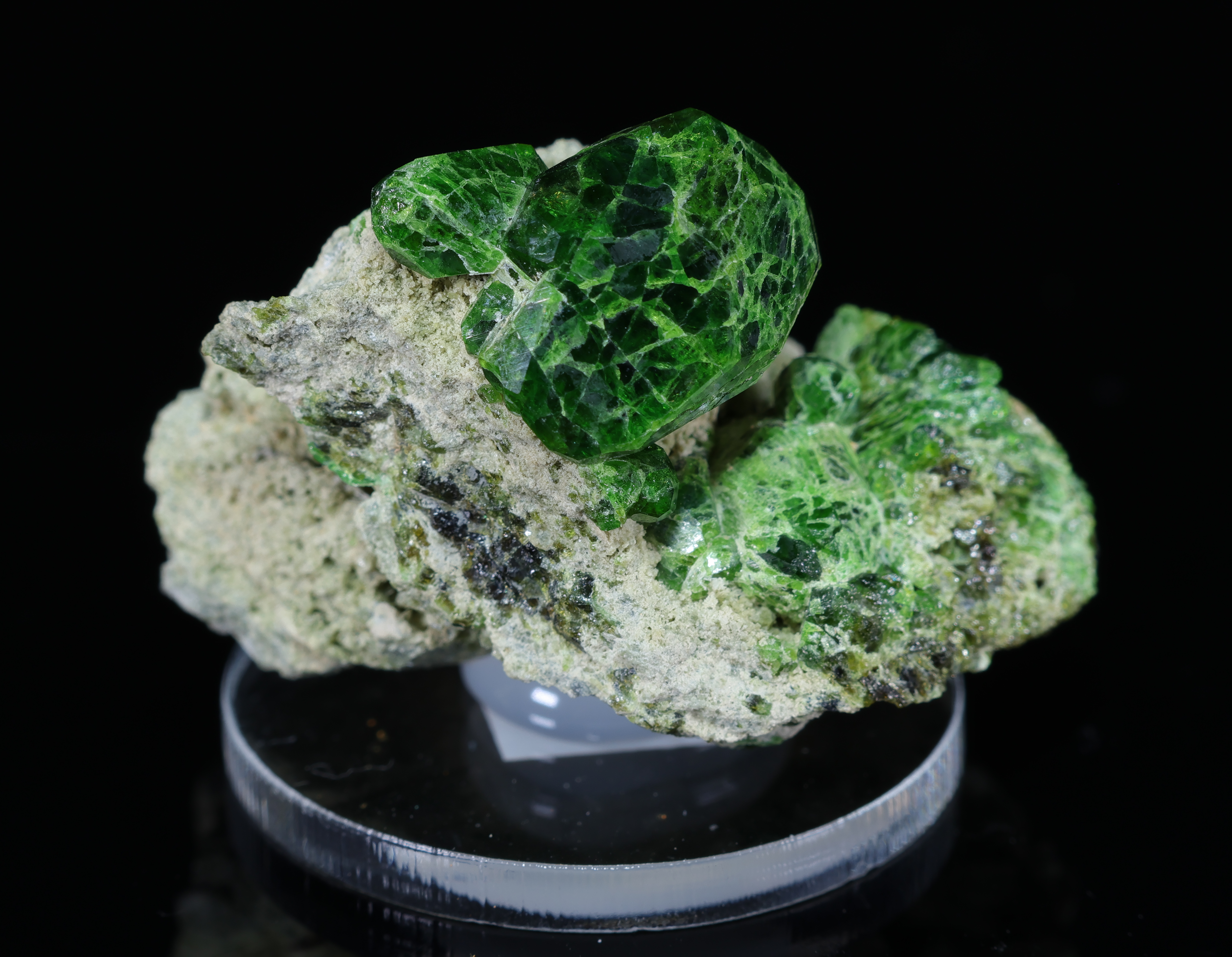
Demantoid is a rare, emerald-green variety of andradite garnet, prized for its exceptional brilliance and light dispersion.
Properties
- Mohs hardness
- 6.5-7
- Luster
- Szklisty do diamentowego
- Streak
- Biała
- Density
- 3.85-3.90
- Cleavage
- Brak
- Fracture
- Muszlowy do nierównego
- Transparency
- Przezroczysty do przeświecającego
- Crystal system
- Regularny
Diagnostic features
## Identification Demantoid can be identified by its intense, emerald-green color, exceptional luster, and strong light dispersion, which gives it a "fire" similar to diamond. Characteristic inclusions for demantoid are "horsetail" inclusions (byssolite), which are fibrous inclusions arranged radially. Their presence is a strong diagnostic feature. ## Distinguishing from Similar Minerals Demantoid can be confused with other green gemstones, such as emerald, tsavorite (a variety of grossular garnet), or peridot. It differs from emerald by its lack of cleavage and higher dispersion. It differs from tsavorite and peridot by the presence of "horsetail" inclusions and higher dispersion. A hardness test (6.5-7 on the Mohs scale) can also aid in identification. ## Crystal Forms Demantoid typically forms well-developed crystals with a rhombic dodecahedral or trapezohedral habit. It can also occur as grains or small aggregates.
Geological environment
## Genesis Demantoid forms in metamorphic and metasomatic rocks, especially in serpentinites and skarns, which are products of the alteration of ultramafic rocks. It requires specific geochemical conditions, including the presence of chromium, which is responsible for its green color. ## Mineral Associations Demantoid often co-occurs with other minerals typical of serpentinite and skarn rocks, such as serpentine, chlorite, magnetite, diopside, calcite, and other garnets. ## Localities The most famous and historically important demantoid deposits are located in Russia, in the Ural Mountains (Nizhny Tagil region). Other significant localities include Namibia (deposits in the Erongo region), Madagascar, Italy (Val Malenco), and Iran.
Rarity
Rare
For collectors
## Quality Criteria The most prized demantoid specimens are those with an intense, emerald-green color, high transparency, and strong "fire." Crystals with a well-developed habit and distinct "horsetail" inclusions are particularly sought after by collectors. The larger and cleaner the stone, the higher its value. ## Market Prices The prices of demantoids are highly varied and depend on many factors, such as color, clarity, size, the presence of "horsetail" inclusions, and origin. Small, poorly colored stones can cost tens of dollars per carat, while large, high-quality specimens with intense green and distinct inclusions can fetch prices from several hundred to several thousand dollars per carat, or even more for exceptional pieces. ## Popular Localities The most prized demantoid specimens come from the Russian deposits in the Urals, which are historically known for producing stones of exceptional color and "horsetail" inclusions. Demantoids from Namibia are also highly regarded for their good quality and often larger sizes.
Care and storage
## Cleaning Demantoid can be cleaned gently with warm water and mild soap. Use a soft brush to remove dirt from hard-to-reach areas. After washing, the stone should be thoroughly rinsed with clean water and dried with a soft cloth. ## What to Avoid Avoid cleaning demantoid in ultrasonic cleaners, as vibrations can damage the stone, especially if it has inclusions. Also, do not expose it to sudden temperature changes, strong impacts, or contact with aggressive chemicals such as acids or bleaches, which can dull its surface or damage the setting. Prolonged exposure to intense sunlight is also not recommended. ## Storage Demantoids should be stored separately from other gemstones and jewelry, preferably in a soft pouch or a separate compartment in a jewelry box, to prevent scratching. Due to its hardness, other harder minerals can scratch it, and demantoid can scratch minerals of lower hardness.