Demantoid
Chemical formula: Ca₃Fe³⁺₂(SiO₄)₃
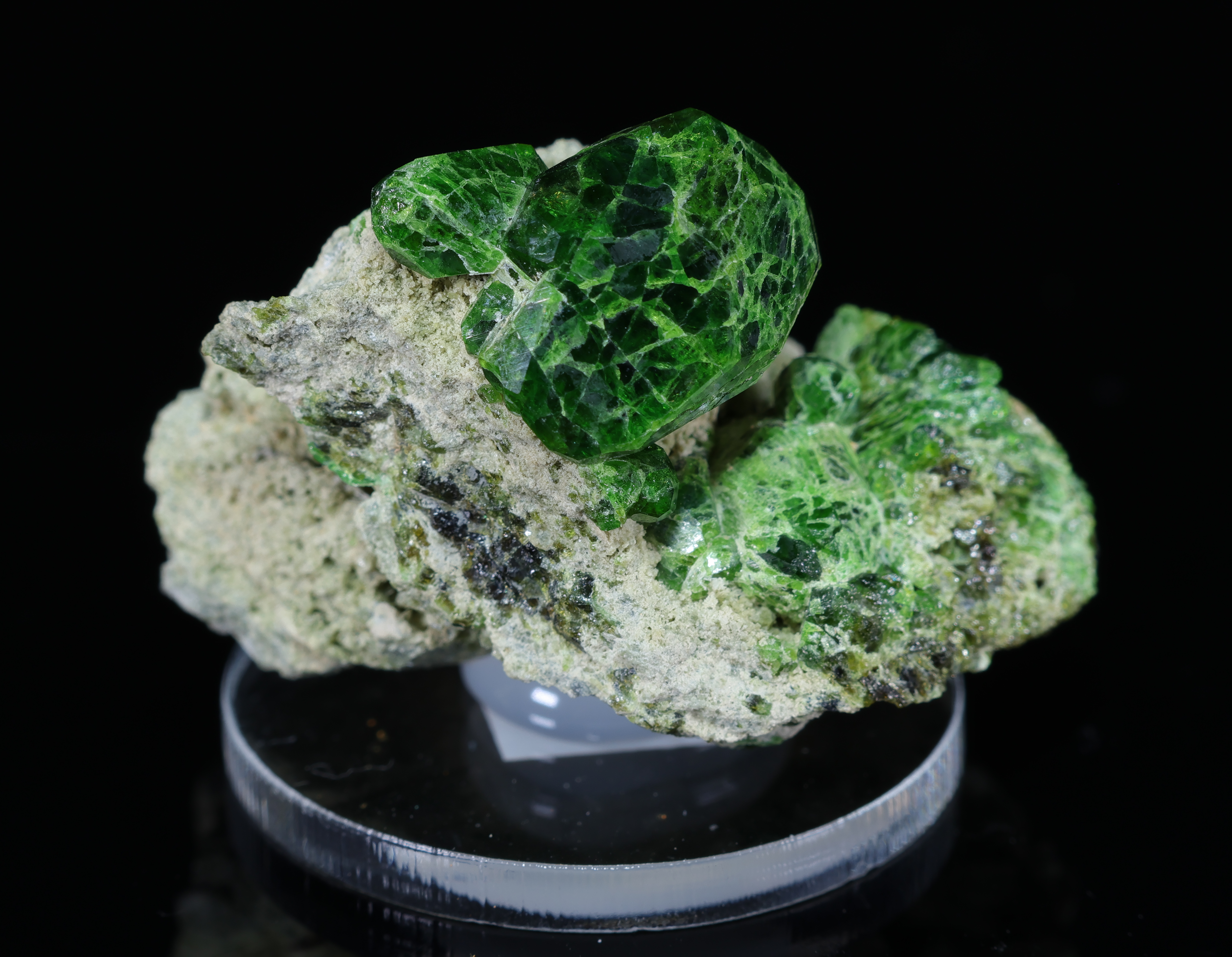
Demantoid is a green variety of andradite garnet, prized for its exceptional brilliance and light dispersion.
Properties
- Mohs hardness
- 6.5-7
- Luster
- Szklisty
- Streak
- Biała
- Density
- 0
- Cleavage
- Brak
- Fracture
- Muszlowy
- Transparency
- Przezroczysty do przeświecającego
- Crystal system
- Regularny
Diagnostic features
## Identification Demantoid can be identified by its characteristic green color, high luster, and strong dispersion, which gives it a "fiery" appearance. The presence of byssolite inclusions, resembling a "horsetail," is a strong diagnostic indicator for demantoids from Russian deposits. ## Distinguishing from Similar Minerals Demantoid can be confused with other green gemstones, such as emerald, tsavorite (another variety of garnet), peridot, or tourmaline. It differs from emerald by its lack of cleavage and higher dispersion. From tsavorite, which is also a garnet, it differs by its higher dispersion and often the presence of "horsetail" inclusions. Peridot has lower hardness and a different color. Tourmaline usually has stronger pleochroism. ## Crystal Forms Demantoids typically occur as well-formed crystals with a rhombic dodecahedral or deltoidal icositetrahedral habit. They also often form granular aggregates.
Geological environment
## Genesis Demantoid forms in metamorphic rocks, mainly in serpentinites and other ultramafic rocks, where it is associated with metasomatic processes. It also occurs in alluvial secondary deposits, where it is resistant to weathering. ## Mineral Associations Demantoid often co-occurs with chromite, diopside, chlorite, serpentine, and magnetite. ## Localities The most famous demantoid deposits are located in Russia, in the Ural Mountains (Nizhny Tagil, Karkodino region). Other important localities include Namibia (Erongo Region), Italy (Val Malenco), Iran, and Pakistan.
Rarity
Rare
For collectors
## Quality Criteria The most important quality criteria for demantoid are the intensity and purity of color, transparency, absence of visible inclusions, and the quality of the cut. High dispersion and "fire" are also highly valued. "Horsetail" inclusions can increase the value of the stone if they are aesthetically arranged and do not negatively affect transparency. ## Popular Localities The most prized demantoid specimens come from Russian deposits in the Urals, especially those with characteristic byssolite inclusions. Demantoids from Namibia are also highly regarded due to their good quality and color.
Care and storage
## Cleaning Demantoid can be cleaned with warm water and mild soap, using a soft brush. After washing, the stone should be thoroughly rinsed with clean water and dried with a soft cloth. ## What to Avoid Avoid cleaning demantoid in ultrasonic cleaners, especially if the stone has inclusions or fractures, as this can lead to damage. Also, avoid contact with strong chemicals and sudden temperature changes. Prolonged exposure to direct sunlight is not recommended, although demantoid is color stable. ## Storage Demantoids should be stored separately from other, harder gemstones to prevent scratching. It is best to wrap them in a soft cloth or place them in separate compartments in a jewelry box.