Delafossite
Chemical formula: Cu<sup>1+</sup>Fe<sup>3+</sup>O<sub>2</sub>
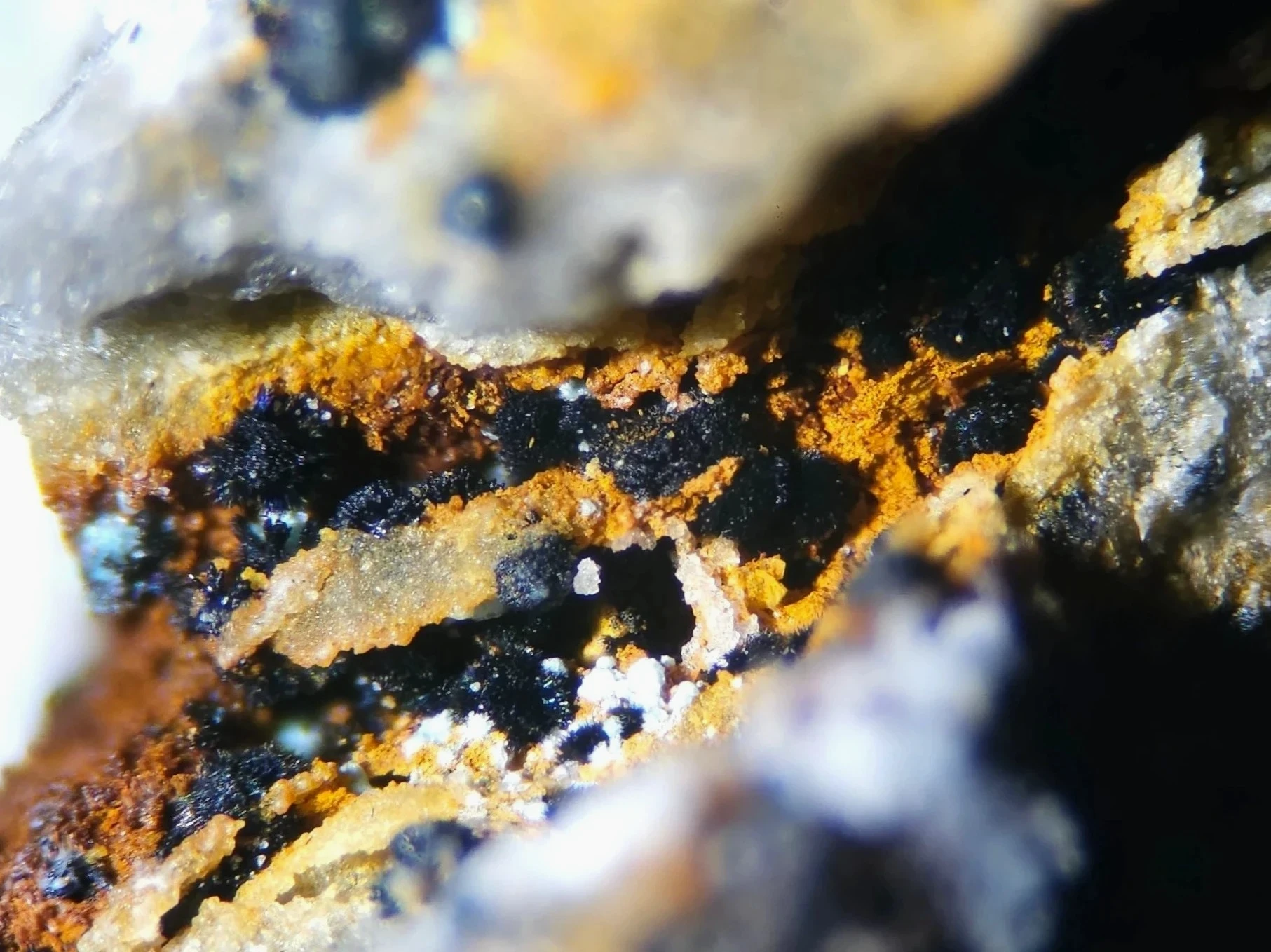
Delafossite is a rare copper iron oxide, characterized by its black color and metallic luster.
Properties
- Mohs hardness
- 5.5
- Luster
- Metallic
- Streak
- Black
- Density
- 5.41
- Cleavage
- imperfect <mi>{10_11}</mi>
- Fracture
- Nierówny
- Transparency
- Opaque
- Crystal system
- Trigonal
Diagnostic features
## Identification Delafossite can be identified by its black color, metallic luster, and black streak. In microscopic examinations, the characteristic brownish-white color in reflected light is diagnostic. ## Distinguishing from Similar Minerals Delafossite can be confused with other black minerals with a metallic luster, such as hematite or magnetite. It is distinguished from hematite by its black streak (hematite has a red streak), and from magnetite by its lack of magnetic properties. ## Crystal Forms Delafossite crystallizes in the trigonal system. It most often forms small, tabular or isometric crystals, frequently in the form of compact or granular aggregates.
Geological environment
## Genesis Delafossite is a secondary mineral, forming in the oxidation zones of copper deposits, often in association with other copper and iron oxides. It can also occur in metamorphic rocks. ## Mineral Associations Delafossite often co-occurs with cuprite, tenorite, hematite, magnetite, and other copper and iron minerals. ## Localities Known localities of delafossite include Russia (Urals), the United States (Arizona, Michigan), Chile, and some regions of Africa.
Rarity
Uncommon
For collectors
## Quality Criteria The most prized delafossite specimens are those that exhibit well-formed crystals with a distinct metallic luster and intense black color. The size of the crystals and their aesthetic arrangement in aggregates also influence their collector's value. ## Popular Localities Specimens of high collector's value come from localities known for well-formed crystals, such as some mines in Arizona, USA.
Care and storage
## Cleaning Delafossite can be mechanically cleaned using a soft brush to remove loose dust and contaminants. If necessary, distilled water can be used, and the surface gently wiped with a soft cloth. ## What to Avoid Aggressive chemical agents should be avoided, as they can damage the mineral's surface. Prolonged exposure to strong sunlight is not recommended, although the mineral is chemically stable. Sudden temperature changes should also be avoided. ## Storage Delafossite specimens are best stored in a dry place, away from dust and direct sunlight. Enclosed display cases or boxes with soft lining are ideal for protecting against mechanical damage.