Datolite
Chemical formula: CaB(SiO<sub>4</sub>)(OH)
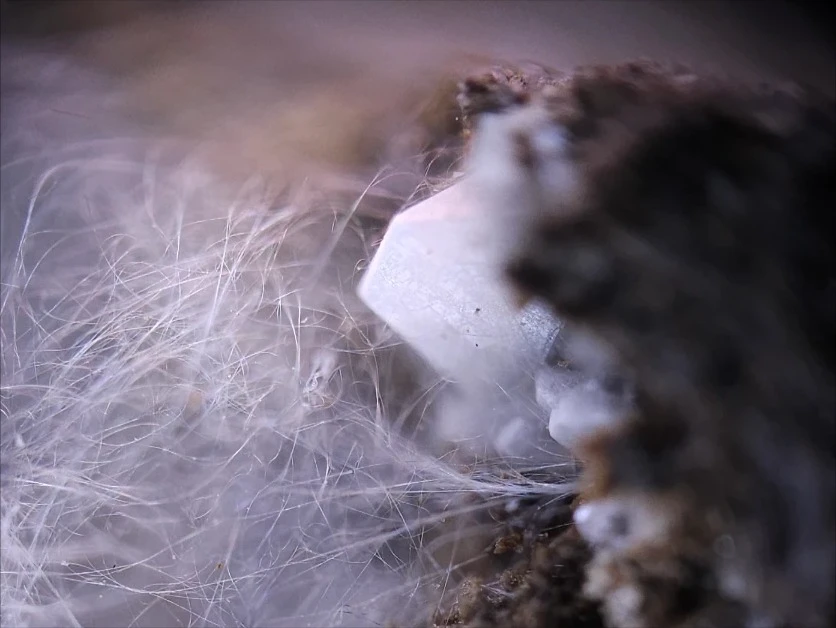
Datolite is a calcium borosilicate, typically forming short-prismatic or tabular crystals, often with a vitreous luster.
Properties
- Mohs hardness
- 5-5.5
- Luster
- Vitreous
- Streak
- White
- Density
- 2.96
- Cleavage
- Brak
- Fracture
- Muszlowy do nierównego
- Transparency
- Transparent,Translucent,Opaque
- Crystal system
- Monoclinic
Diagnostic features
## Identification Datolite can be identified by its characteristic, often richly sculpted crystals with a vitreous luster. Its hardness (5-5.5 on the Mohs scale) and white streak are also helpful in identification. Its occurrence in association with zeolites, prehnite, or calcite also indicates this mineral. ## Distinguishing from Similar Minerals Datolite can be confused with some zeolites, such as stilbite or heulandite, due to similar environments of occurrence and sometimes similar habit. However, it differs in hardness and lack of distinct cleavage. It is distinguished from quartz by its lower hardness and different crystallization form. ## Crystal Forms Datolite most often forms short-prismatic, tabular, or isometric crystals. Massive, granular, radial, or botryoidal aggregates are also common.
Geological environment
## Genesis Datolite typically forms in low-temperature, hydrothermal veins and fissures, often in volcanic rocks such as basalts and andesites. It also occurs in skarns, where it forms as a result of metasomatic contact processes. It can also be found in serpentinites and some metamorphic rocks. ## Mineral Associations Datolite often co-occurs with zeolites (e.g., stilbite, heulandite), prehnite, calcite, epidote, chlorite, quartz, and also with native copper minerals. ## Localities Known datolite localities are found in many places around the world. In the USA, they occur in New Jersey (Paterson) and also in Michigan. In Europe, datolite is found in Italy (Val di Fassa), Norway (Arendal), and Russia (Dalnegorsk). Other important localities include Japan and Mexico.
Rarity
Common
For collectors
## Quality Criteria The most prized datolite specimens are well-formed, transparent crystals with intense color and a distinct vitreous luster. Large, undamaged crystals, especially those with rare inclusions or in aesthetic associations with other minerals, are particularly sought after. Clarity and absence of internal cracks also affect the value of the specimen. ## Popular Localities Particularly valued datolite specimens come from Dalnegorsk, Russia, where large, transparent crystals are found. Other popular locations include Paterson, New Jersey (USA), known for white and greenish crystals, and Val di Fassa, Italy.
Care and storage
## Cleaning Datolite is a mineral of moderate hardness, so a soft brush and lukewarm water should be used for cleaning. For heavier soiling, a mild soap can be used, followed by thorough rinsing of the specimen with distilled water. ## What to Avoid Avoid using aggressive chemical agents that can damage the mineral's surface. Datolite is not sensitive to sunlight; however, prolonged exposure to intense UV radiation can, in some cases, lead to slight color changes. It is also important to avoid sudden temperature changes, which can cause cracks. ## Storage Datolite specimens are best stored in a dry place, away from dust and contaminants. They can be displayed in enclosed showcases, which protects them from dirt accumulation and mechanical damage. For delicate specimens, it is advisable to protect them with a soft material.