Danburite
Chemical formula: CaB<sub>2</sub>Si<sub>2</sub>O<sub>8</sub>
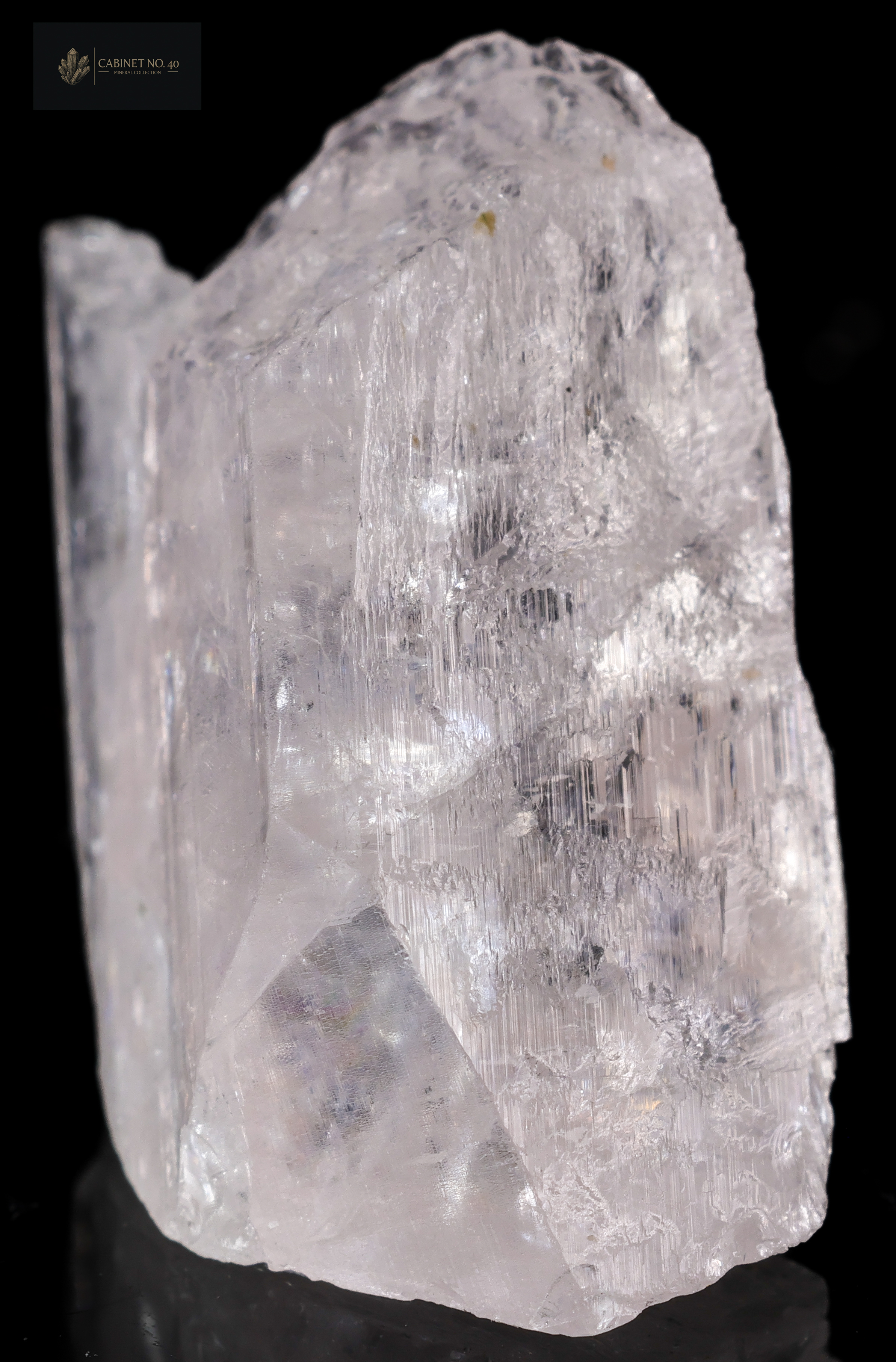
Danburite is a rare calcium boron silicate mineral, prized for its hardness and transparency, often found in well-formed crystals.
Properties
- Mohs hardness
- 7-7.5
- Luster
- Vitreous, Greasy
- Streak
- White
- Density
- 2.93
- Cleavage
- Indistinct on {001}
- Fracture
- Muszlowy
- Transparency
- Transparent,Translucent
- Crystal system
- Orthorhombic
Diagnostic features
## Identification Danburite can be identified by its prismatic crystal habit, often terminated by pyramids, and by its Mohs hardness of 7-7.5. Its characteristic colors – colorless, pale yellow, or yellowish-brown – as well as its vitreous or greasy luster, are also distinctive. To confirm identification, a hardness test can be performed, and the indistinct cleavage can be observed. ## Distinguishing from Similar Minerals Danburite is sometimes confused with topaz, quartz, and even zircon due to similar appearance and hardness. It differs from topaz by the lack of distinct cleavage. It is distinguished from quartz by its higher density and different crystallization form. Zircon has a much higher density and often exhibits stronger light dispersion. ## Crystal Forms Danburite most commonly forms well-developed, prismatic crystals with a rhombic cross-section. They are often terminated by pyramidal or flat faces. Danburite aggregates are rarer, usually occurring as single, isolated crystals or intergrowths of several crystals.
Geological environment
## Genesis Danburite forms in hydrothermal environments, often in altered carbonate rocks, such as marbles, and in pegmatites. It also occurs in skarns, where it is a product of contact metasomatism, i.e., the alteration of rocks by hot solutions originating from magmatic intrusions. ## Mineral Associations Danburite often co-occurs with minerals such as calcite, quartz, orthoclase, tourmaline, garnet, as well as other boron and silicate minerals typical of pegmatitic and skarn environments. ## Localities The most famous danburite localities are in Danbury, Connecticut (USA), where it was discovered. Other important localities include Charcas, Mexico, where large and clear crystals have been found, and Dalnegorsk, Russia, which also yields high-quality specimens. Smaller danburite deposits have also been reported in Japan, Myanmar, and Madagascar.
Rarity
Uncommon
For collectors
## Quality Criteria The most prized danburite specimens are those characterized by high transparency, lack of inclusions, and intense, uniform color (if colored). Well-formed, complete crystals with distinct faces and terminations are particularly sought after. Size also matters, with larger, clear crystals fetching higher prices. ## Popular Localities The most prized danburite specimens come from Mexico (Charcas) and Russia (Dalnegorsk), where crystals of exceptional clarity and size have been discovered. Specimens from the type locality in Danbury, USA, also have historical and collector's value, although they are usually smaller and less perfect.
Care and storage
## Cleaning Danburite can be cleaned gently using a soft brush and lukewarm water with a small amount of mild soap. After washing, rinse the mineral thoroughly with clean water and dry it with a soft cloth to avoid water spots. ## What to Avoid Avoid contact of danburite with strong acids and bases, which can damage its surface. The mineral is resistant to typical temperature changes, but sudden thermal shocks can lead to cracks. Prolonged exposure to direct sunlight should not negatively affect its color, but it is always recommended to store minerals away from intense light to preserve their original appearance. ## Storage Danburite is best stored in separate, soft pouches or in boxes with soft lining to prevent scratching by harder minerals. Due to its hardness, it can scratch other, less hard specimens in a collection. Ideal storage conditions are stable temperature and low humidity.