Red Beryl
Chemical formula: Be₃Al₂Si₆O₁₈
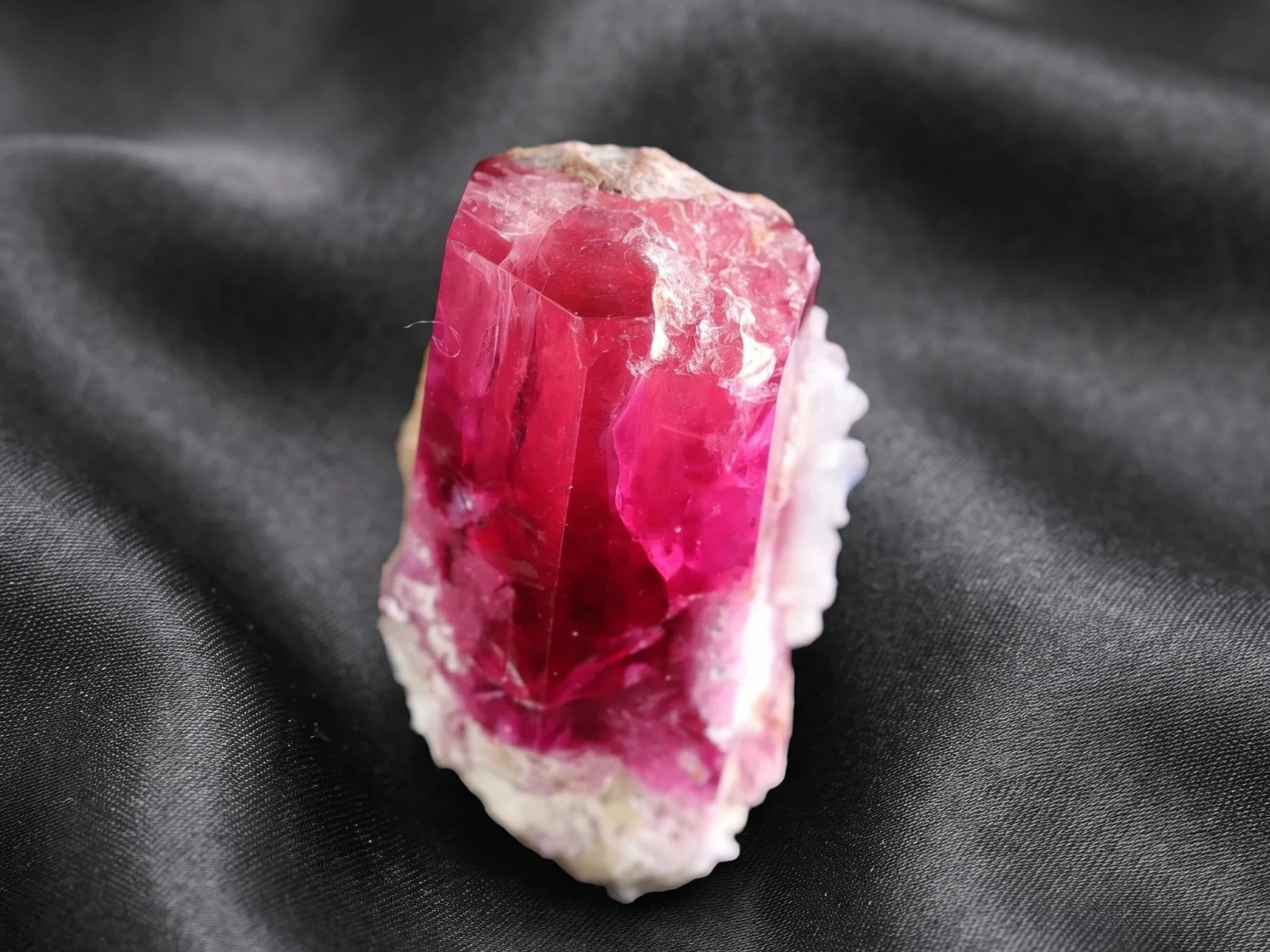
Red beryl, also known as bixbite, is an extremely rare, red variety of beryl, prized for its intense color and exceptional clarity.
Properties
- Mohs hardness
- 7.5-8
- Luster
- Vitreous
- Streak
- White
- Density
- 0
- Cleavage
- {0001}
- Fracture
- Muszlowy do nierównego
- Transparency
- Transparent,Translucent
- Crystal system
- Hexagonal
Diagnostic features
## Identification Red beryl can be identified by its characteristic, intense red color, vitreous luster, and hexagonal crystal habit. Its hardness (7.5-8 on the Mohs scale) is also a diagnostic feature. Transparency and white streak are also important to note. ## Distinguishing from Similar Minerals Red beryl can be confused with ruby, spinel, or garnet. It is distinguished from ruby by its crystallographic system (ruby is trigonal, red beryl is hexagonal) and often by its shade of red. Spinel has an isometric crystallographic system and a different hardness. Garnets also have a different crystallographic system and often a different luster. Hardness testing and observation of crystal habit are key to distinguishing these minerals. ## Crystal Forms Red beryl typically occurs as hexagonal prisms, often terminated by flat faces. Crystals are usually small, with a columnar or tabular habit, rarely reaching larger sizes. It can also form fine granular aggregates.
Geological environment
## Genesis Red beryl forms under specific hydrothermal conditions associated with volcanic activity. It occurs in rhyolites, in fissures and rock cavities, where solutions rich in beryllium and manganese crystallize. Its formation requires the presence of manganese, which is responsible for the red color. ## Mineral Associations Red beryl often co-occurs with topaz, quartz, hematite, bixbyite (another manganese mineral), and sanidine. ## Localities The most important and practically only known occurrences of red beryl are in the Wah Wah Mountains in Utah, USA, especially in the Ruby-Violet Claim area. Other, less significant occurrences have also been reported in New Mexico.
Rarity
Very Rare
For collectors
## Quality Criteria The most important quality criteria for red beryl are the intensity and purity of the color, transparency, and the absence of visible inclusions and fractures. Larger, well-formed crystals with a deep, uniform red color are the most prized. Optical clarity and precise cutting also affect the value of the stone. ## Market Prices Red beryl is one of the most expensive gemstones in the world. Prices per carat can range from several thousand to tens of thousands of dollars, depending on the quality, size, and color of the stone. Very rare specimens of exceptional clarity and intense color can fetch even higher prices. ## Popular Localities The most prized specimens of red beryl come from the Wah Wah Mountains in Utah, USA, especially from the Ruby-Violet Claim mine. This is practically the only source of gem-quality stones.
Care and storage
## Cleaning Red beryl can be cleaned gently using a soft brush and lukewarm water with mild soap. After washing, rinse the stone thoroughly with clean water and dry with a soft cloth. Ultrasonic cleaners can also be used, but with caution, especially for stones with inclusions or fractures. ## What to Avoid Avoid contact of red beryl with strong chemicals, such as acids or bases, which can damage its surface. The stone is sensitive to sudden temperature changes, which can lead to fractures. Prolonged exposure to direct sunlight can in some cases affect the intensity of the color, although this is rare. Also avoid impacts and scratches, despite its high hardness. ## Storage Red beryl should be stored separately from other gemstones and minerals to prevent mutual scratching. It is best to store it in a soft pouch, a fabric-lined box, or a special jewelry box. Ideal conditions include stable temperature and moderate humidity.