Charoite
Chemical formula: (K,Sr,Ba,Mn<sup>2+</sup>)<sub>15-16</sub>(Ca,Na)<sub>32</sub>Si<sub>70</sub>(O,OH)<sub>180</sub>(OH,F)<sub>4</sub>·nH<sub>2</sub>O
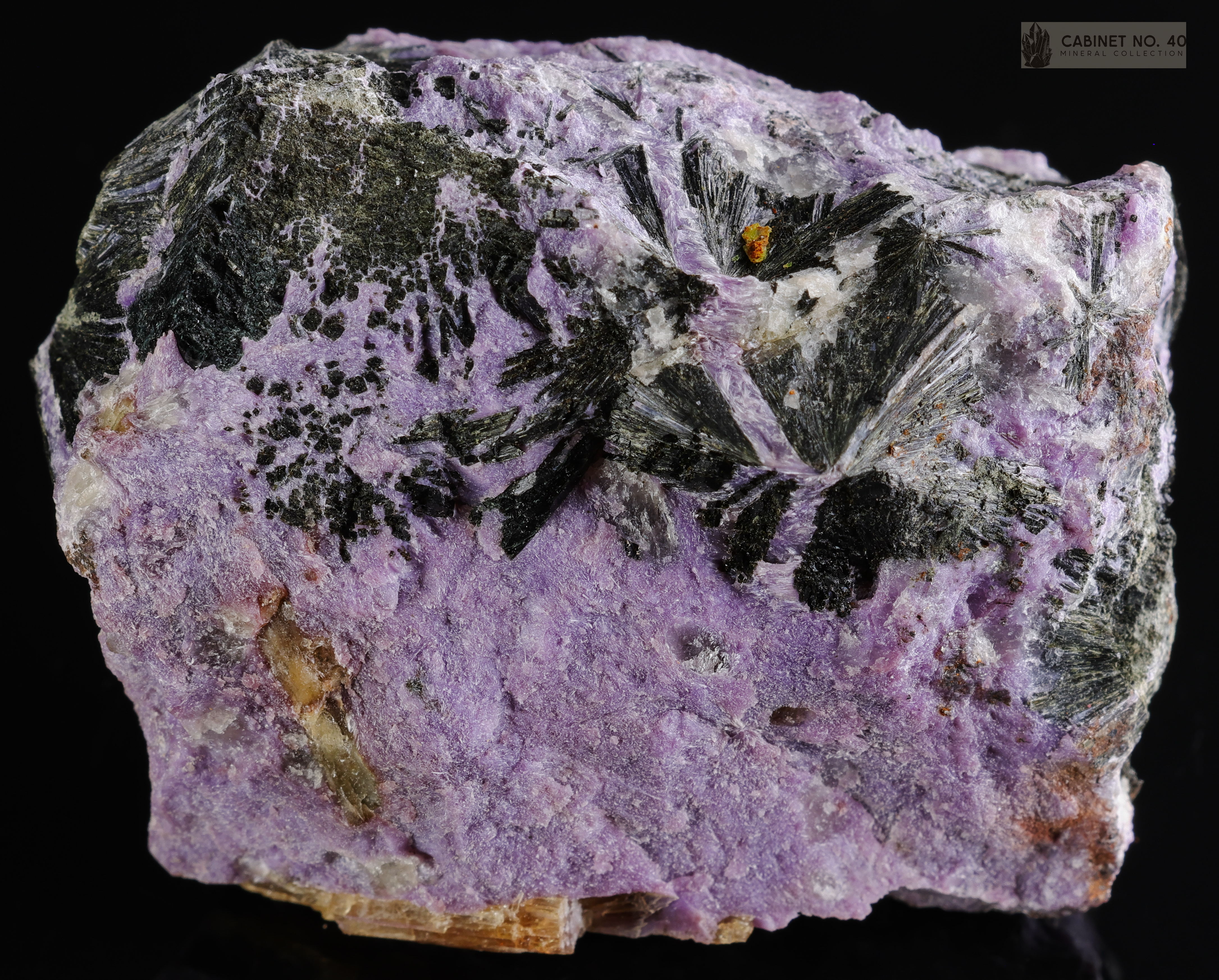
Charoite is a rare silicate mineral with a characteristic purple color, often occurring with a fibrous structure and dark inclusions.
Properties
- Mohs hardness
- 5-6
- Luster
- Szklisty, perłowy lub jedwabisty
- Density
- 2.54
- Cleavage
- Good in three directions.
- Transparency
- Translucent
- Crystal system
- Monoclinic
Diagnostic features
## Identification Charoite is relatively easy to identify due to its characteristic purple color and often fibrous structure, which forms swirling patterns. It is often accompanied by dark, acicular aegirine crystals and light inclusions of other minerals, which further aids identification. ## Distinguishing from similar minerals Due to its unique appearance, charoite is rarely confused with other minerals. Sometimes it can be mistaken for amethyst, but charoite usually has a more complex fibrous structure and often occurs in combination with other minerals, which is not observed in amethyst. Sugilite is also purple, but usually has a more uniform color and a different crystal structure. ## Crystal Forms Charoite occurs mainly in the form of massive, fibrous aggregates, often with a radial or fan-like arrangement of fibers. It rarely forms well-developed, single crystals.
Geological environment
## Genesis Charoite forms in metasomatic deposits, in alkaline rocks, as a result of hydrothermal processes, where solutions rich in potassium, strontium, barium, and other elements react with carbonate rocks. This process leads to the formation of a unique rock, called charoitite, which consists mainly of charoite but also contains other minerals such as aegirine, tinaksite, microcline, and quartz. ## Mineral Associations Charoite often co-occurs with aegirine, tinaksite, microcline, quartz, and other rare alkaline minerals such as cancrinite and fedorite. ## Localities The only known significant deposit of charoite in the world is the Murun Massif area in the Sakha Republic (Yakutia) in Eastern Siberia, Russia, in the Chara River basin.
Rarity
Very Rare
For collectors
## Quality Criteria The most prized charoite specimens are characterized by an intense, uniform purple color, distinct and attractive fibrous patterns, and the absence of cracks and inclusions of other minerals that could disrupt the aesthetics. Large sizes and polished surfaces that enhance the patterns also increase collectible value. ## Popular Localities All prized charoite specimens come from the only known deposit in the Murun Massif in Russia.
Care and storage
## Cleaning Charoite can be cleaned gently using a soft cloth or brush and lukewarm water with a small amount of mild soap. After washing, it should be thoroughly rinsed with clean water and dried. ## What to avoid Avoid using aggressive chemicals, such as acids or strong detergents, which can damage the mineral's surface. Charoite is sensitive to high temperatures and prolonged exposure to sunlight, which can lead to color fading. It should also be protected from sudden temperature changes. ## Storage Charoite should be stored in a place where it will not be scratched by harder minerals. It is best to wrap it in a soft cloth or place it in a separate box. Exposure should be in a shaded area, away from heat sources and humidity.