Cinnabar
Chemical formula: HgS
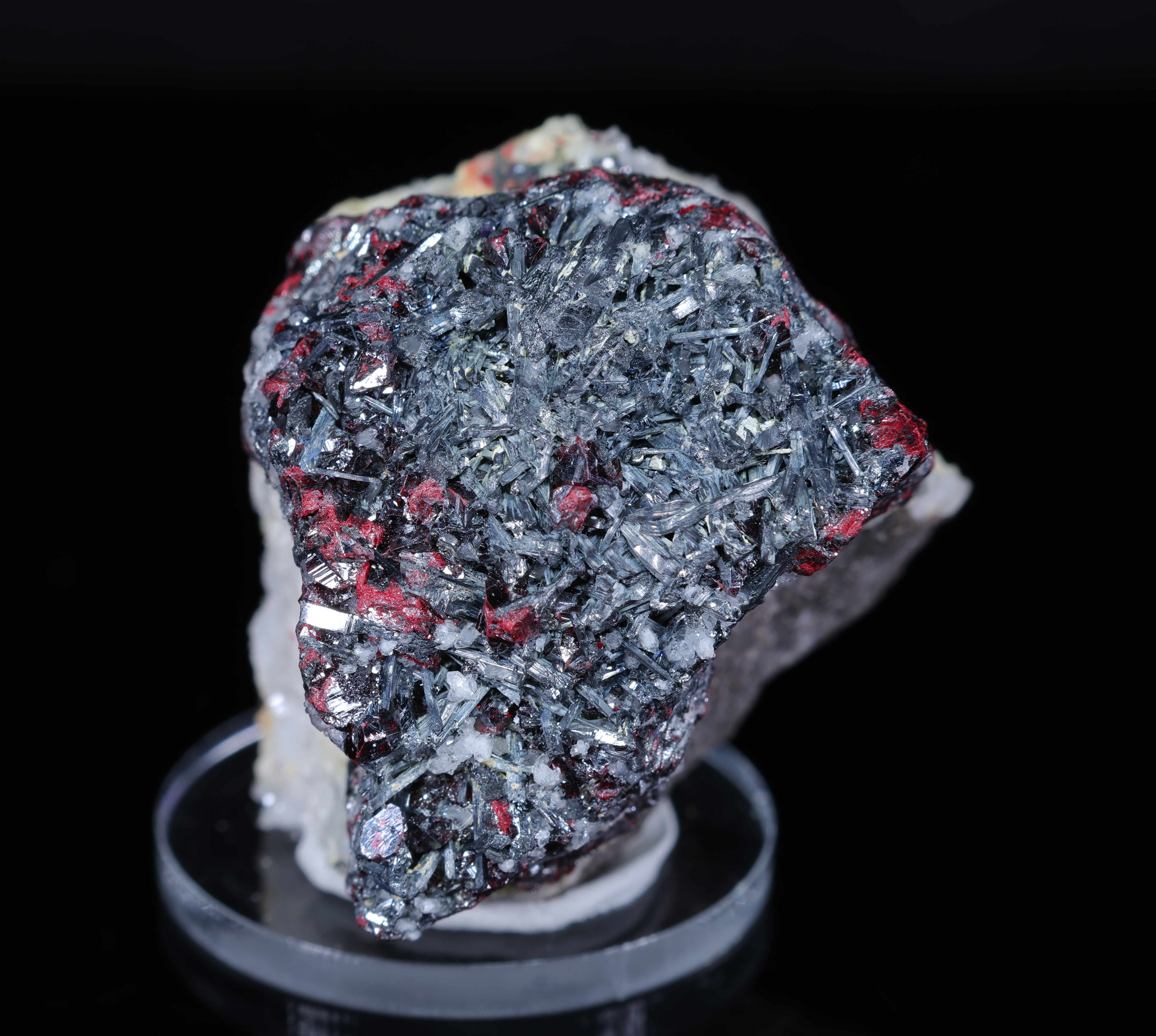
Cinnabar is a sulfide mineral, specifically mercury(II) sulfide, characterized by its intense red color and high density.
Properties
- Mohs hardness
- 2-2.5
- Luster
- Adamantine splendent in dark-colored crystalline variteties or earthy to dull in friable varieties
- Streak
- Red-brown to scarlet
- Density
- 8.176
- Cleavage
- Perfect <mi>{10_10}</mi>
- Fracture
- Nierówny do muszlowego
- Transparency
- Transparent,Translucent
- Crystal system
- Trigonal
Diagnostic features
## Identification Cinnabar can be identified by its characteristic, intense red color, high density, and low hardness. It often occurs as coatings or compact masses. The streak of cinnabar is reddish-brown to scarlet, which is an important diagnostic feature. Crystals, though rare, have a typical prismatic or rhombohedral habit. ## Distinguishing from Similar Minerals Cinnabar can be confused with other red minerals, such as realgar, cuprite, or hematite. It is distinguished from realgar (AsS) by the absence of an orange streak and higher density. It differs from cuprite (Cu₂O) by its streak (cuprite has a red streak) and lack of metallic luster. Hematite (Fe₂O₃) has a much higher hardness and a reddish-brown streak, but its density is lower. The most important distinguishing features of cinnabar are its very high density and characteristic streak. ## Crystal Forms Cinnabar forms crystals in the trigonal system, most commonly with a prismatic or rhombohedral habit. Twinning is common. However, granular, compact, earthy aggregates, crusts, and coatings are more typical. Radiating or fibrous aggregates are less common.
Geological environment
## Genesis Cinnabar forms in low-temperature, hydrothermal veins and metasomatic zones, often associated with volcanic activity and hot springs. It forms under conditions of low pressure and relatively low temperature, usually near the Earth's surface. It occurs in sedimentary rocks such as limestones, sandstones, and shales, where mercury is transported by hydrothermal solutions and precipitates as a sulfide. ## Mineral Associations Cinnabar often co-occurs with other mercury minerals, such as native mercury, metacinnabar, as well as with minerals like pyrite, marcasite, stibnite, realgar, orpiment, calcite, quartz, and chalcedony. In some deposits, it is also accompanied by barite and fluorite. ## Localities The most important cinnabar deposits in the world are in Almadén, Spain, where it has been mined since Roman times. Other significant localities include Idrija, Slovenia; Monte Amiata, Italy; Huancavelica, Peru; as well as deposits in California and Nevada in the USA (e.g., New Almadén, Sulphur Bank), in China (e.g., Hunan, Guizhou), and in Kyrgyzstan.
Rarity
Very Common
For collectors
## Quality Criteria The most prized cinnabar specimens are those with well-formed, large, and intensely red crystals. High transparency and strong adamantine luster are also desirable. Specimens with distinct twinning or in association with other attractive minerals, such as quartz or calcite, are particularly valuable. Purity of color and absence of impurities also contribute to collector appeal. ## Popular Localities The most sought-after cinnabar specimens come from historical deposits in Almadén (Spain) and Idrija (Slovenia), as well as from China, especially from Hunan and Guizhou provinces, where beautiful, large crystals are found. Specimens from Peru (Huancavelica) are also highly regarded by collectors.
Care and storage
## Cleaning Cinnabar is a soft and brittle mineral, so it should be handled with care. For cleaning, it is best to use a soft, dry brush to remove dust. For heavier soiling, the specimen can be gently wiped with a damp cloth moistened with distilled water, then immediately dried. ## What to Avoid Avoid using any chemical agents, including detergents, acids, or solvents, as they can damage the mineral's surface or cause a reaction. Cinnabar is sensitive to high temperatures, which can lead to its decomposition and the release of toxic mercury. Prolonged exposure to sunlight can cause the mineral to darken. Due to its mercury content, direct skin contact and inhalation of dust should be avoided. ## Storage Cinnabar should be stored in a closed display case or an airtight container, away from direct sunlight and heat sources. It is important to ensure stable temperature conditions and avoid sudden changes. Due to its toxicity, cinnabar specimens should be stored out of reach of children and pets. Ideal storage is in a dry place at a moderate temperature.