Cuprosklodowskite
Chemical formula: Cu<sup>2+</sup>(U<sup>6+</sup>O<sub>2</sub>)<sub>2</sub>(SiO<sub>3</sub>OH)<sub>2</sub>·6H<sub>2</sub>O
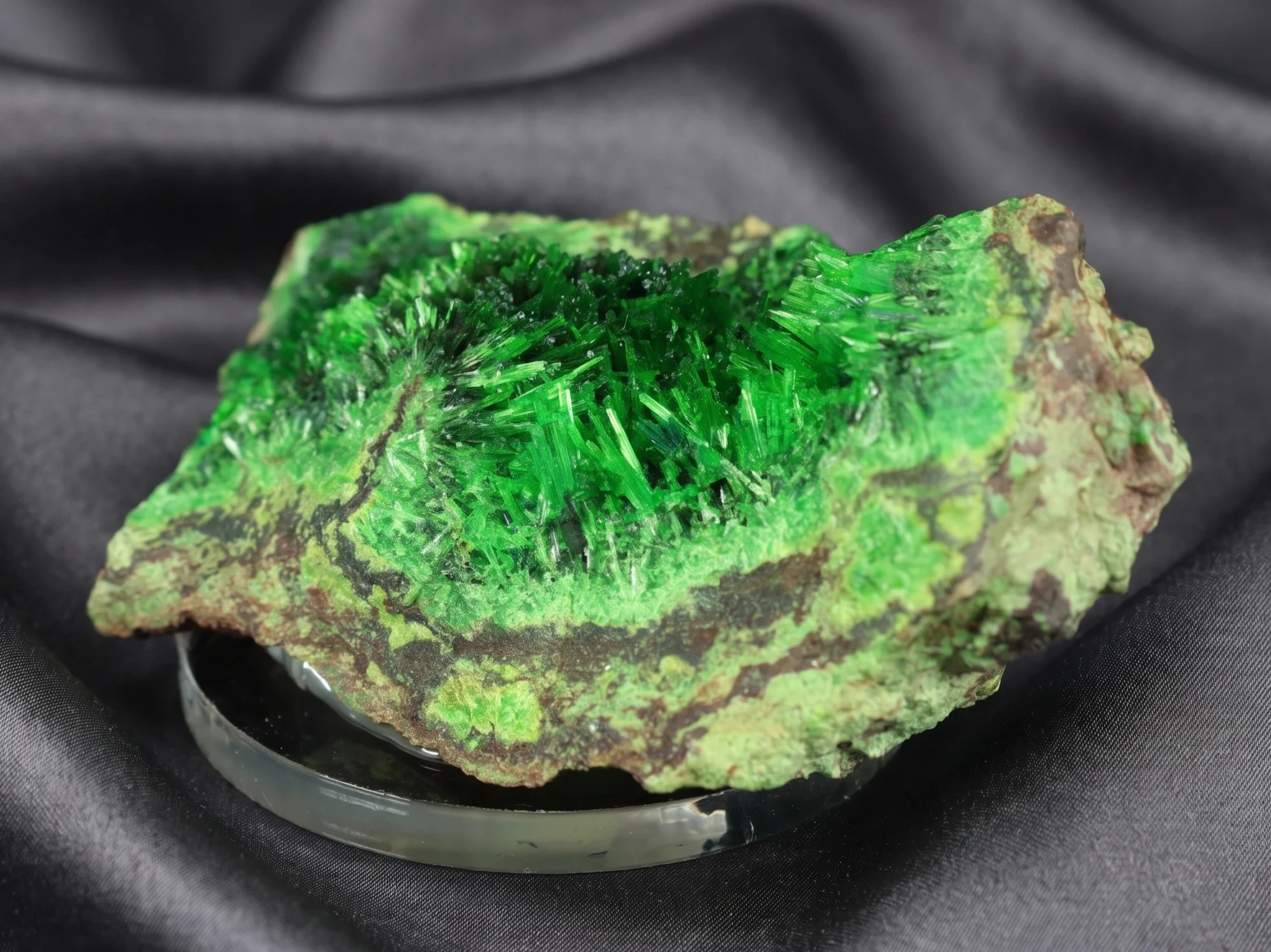
Cuprosklodowskite is a rare uranyl, copper, and silicate mineral, characterized by its intense green-yellow color and radioactivity.
Properties
- Mohs hardness
- 4
- Luster
- Szklisty do jedwabistego
- Streak
- Brak danych
- Density
- 3.85
- Cleavage
- {100}
- Fracture
- Nierówny
- Transparency
- Transparent,Translucent
- Crystal system
- Triclinic
Diagnostic features
## Identification Cuprosklodowskite can be identified by its characteristic green-yellow color, acicular or fibrous crystal habit, and its radial or spherical aggregates. A key diagnostic feature is its strong radioactivity, which can be confirmed with a Geiger counter. Its occurrence in the oxidation zones of uranium deposits is also an important clue. ## Differentiation from Similar Minerals Cuprosklodowskite can be confused with other secondary uranium minerals, such as sklodowskite, uranophane, or autunite. It differs from sklodowskite by the presence of copper, which gives it a more greenish hue. Uranophane usually has a more yellow color and a different crystal habit. Autunite typically forms flat, tabular crystals, in contrast to the acicular forms of cuprosklodowskite. Final differentiation often requires laboratory analyses, such as X-ray diffraction. ## Crystal Forms Cuprosklodowskite most commonly occurs as very fine, acicular or fibrous crystals. These crystals often form radial aggregates, spherical aggregates, or coatings. Single, well-formed crystals, which are usually elongated and prismatic, are less common.
Geological environment
## Genesis Cuprosklodowskite is a secondary mineral, forming in the oxidation zones of uranium deposits. It forms as a result of the weathering of primary uranium minerals, in the presence of solutions containing copper and silica. This process occurs under surface or shallow subsurface conditions, where oxygen and water interact with the deposits. ## Mineral Associations Cuprosklodowskite often co-occurs with other secondary uranium minerals, such as uranophane, sklodowskite, torbernite, autunite, as well as copper minerals like chrysocolla or malachite. It can also be found in association with quartz and calcite. ## Localities The most important occurrences of cuprosklodowskite are in the Democratic Republic of Congo, especially in the Shinkolobwe and Musonoi mines. Other known localities include Jáchymov in the Czech Republic, the Moab area in Utah, USA, and some locations in Australia.
Rarity
Rare
For collectors
## Quality Criteria The most prized cuprosklodowskite specimens are characterized by an intense, vibrant green-yellow color, well-formed, dense aggregates of acicular crystals, and a lack of mechanical damage. The size of the specimen is important, but due to the fine habit of the mineral, even small, aesthetic clusters are sought after. The aesthetics of the matrix on which the mineral is embedded are also important. ## Popular Localities The most sought-after cuprosklodowskite specimens come from the Democratic Republic of Congo, especially from the historic Shinkolobwe and Musonoi mines, which are famous for their well-formed and intensely colored crystals. Specimens from these localities are particularly valued by uranium mineral collectors.
Care and storage
## Cleaning Cuprosklodowskite is a radioactive and delicate mineral. Cleaning should be kept to a minimum. If dust removal is necessary, a soft brush can be used. Avoid using water, especially running water, as this can damage delicate crystals and cause leaching of components. ## What to Avoid Absolutely avoid contact with acids, bases, and other chemicals that can destroy the mineral. High temperatures and direct, prolonged exposure to sunlight can lead to changes in color or structure. Due to radioactivity, specimens should be stored in a way that minimizes exposure, preferably in sealed containers. ## Storage Cuprosklodowskite specimens should be stored in closed, preferably lead-lined or other shielding containers, to minimize radiation exposure. It is important to store them away from other minerals, especially those sensitive to radiation. Ideal conditions include stable temperature and low humidity. Specimens should be handled with caution, preferably with gloves, and inhalation of dust should be avoided.