Connellite
Chemical formula: Cu<sup>2+</sup><sub>36</sub>(S<sup>6+</sup>O<sub>4</sub>)(OH)<sub>62</sub>Cl<sub>8</sub>·6H<sub>2</sub>O
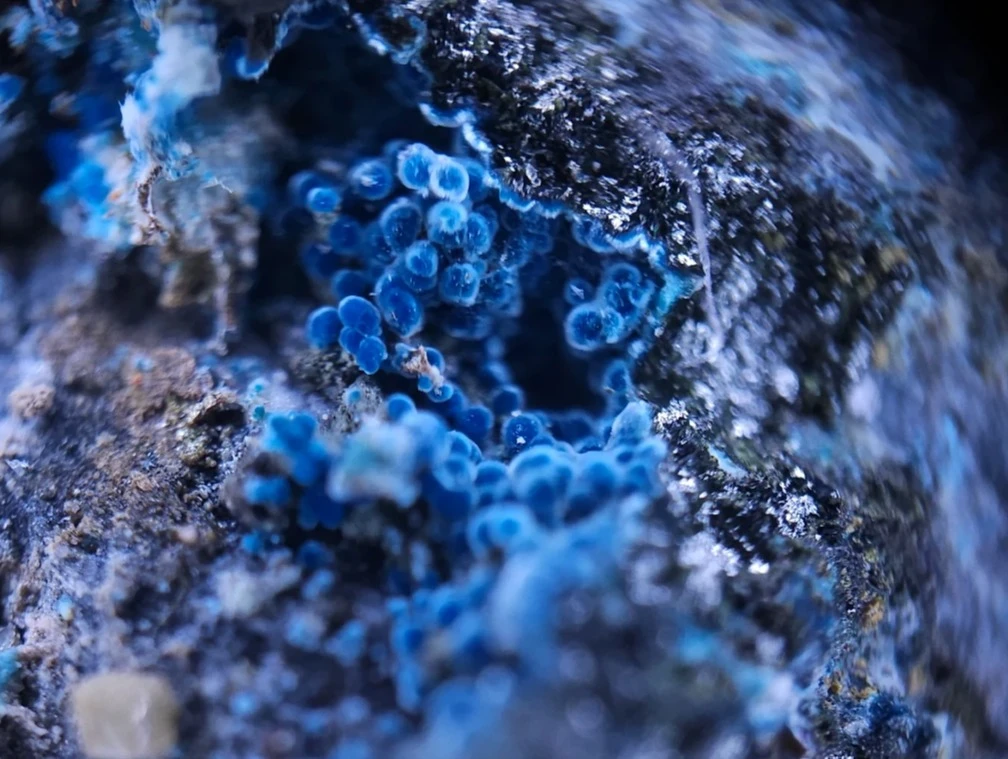
Connellite is a rare, secondary copper mineral, characterized by its intense blue color and occurrence in the oxidation zones of copper deposits.
Properties
- Mohs hardness
- 3
- Luster
- Vitreous
- Streak
- Pale green-blue
- Density
- 3.36
- Cleavage
- Brak
- Fracture
- Nierówny
- Transparency
- Transparent
- Crystal system
- Hexagonal
Diagnostic features
## Identification Connellite can be identified primarily by its characteristic, intense blue color and the habit of acicular or columnar crystals, often forming radial aggregates. Its low hardness (3 on the Mohs scale) and vitreous luster are also helpful. ## Distinguishing from Similar Minerals Connellite is sometimes confused with other blue copper minerals, such as azurite or chalcanthite. It differs from azurite by its lighter shade of blue and lack of reaction with hydrochloric acid (azurite reacts strongly). From chalcanthite, which is water-soluble, connellite differs by the absence of this characteristic. An important diagnostic feature is also its streak, which is light, blue-green. ## Crystal Forms Connellite most commonly occurs as small, acicular or columnar crystals, which often form radial aggregates, fibrous aggregates, or coatings on other minerals.
Geological environment
## Genesis Connellite is a secondary mineral that forms in the oxidation zones of copper deposits. It is formed by weathering and hydrothermal processes, where solutions rich in copper, sulfates, chlorides, and hydroxides react with each other in the presence of water. ## Mineral Associations Connellite often co-occurs with other secondary copper minerals, such as azurite, malachite, cuprite, chalcanthite, brochantite, and with chlorine-bearing minerals like atacamite. It can also be found in association with quartz and calcite. ## Localities Connellite is a rare mineral but has been found in several locations worldwide. Known occurrences include mines in Cornwall, England, where it was first discovered. Other localities include Arizona in the USA, Chile, Namibia, Australia, and some deposits in Europe.
Rarity
Uncommon
For collectors
## Quality Criteria The most prized connellite specimens are those characterized by an intense, vivid blue color, well-formed, distinct crystals, and an aesthetically pleasing arrangement in radial aggregates. The size of the crystals, although usually small, also affects the attractiveness of the specimen. Purity and lack of mechanical damage are crucial. ## Popular Localities The most sought-after specimens come from historical localities in Cornwall, England, where the mineral was discovered. Other valued localities include deposits in Arizona, USA, known for well-formed crystals, and Chile.
Care and storage
## Cleaning Connellite is a relatively soft mineral, so it requires gentle cleaning. It is best to use a soft brush or paintbrush to remove dust. For heavier soiling, lukewarm distilled water can be used, but prolonged soaking should be avoided. ## What to Avoid Avoid using any chemical agents, including detergents, as they can damage the mineral's surface or alter its color. Connellite is sensitive to acids. It should not be exposed to direct sunlight for extended periods, as this may lead to color fading. It is also important to avoid sudden temperature changes and excessive humidity. ## Storage Connellite specimens are best stored in enclosed display cases or boxes, away from dust and light. Due to its softness, contact with harder minerals that could scratch it should be avoided. Storage in a dry and stable environment is ideal.