Chalcopyrite
Chemical formula: Cu<sup>1+</sup>Fe<sup>3+</sup>S<sup>2-</sup><sub>2</sub>
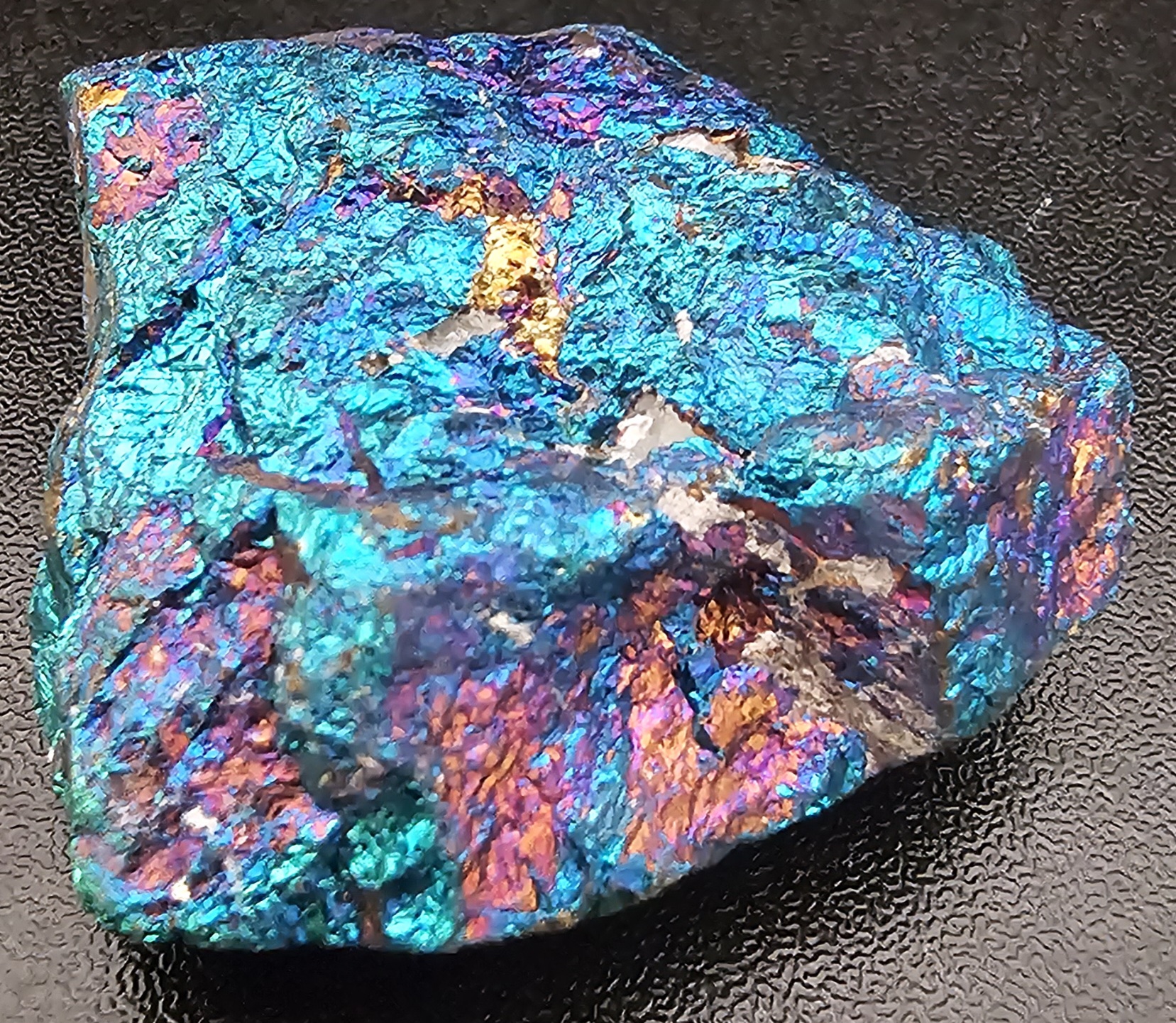
Chalcopyrite is a mineral from the copper and iron sulfide group, characterized by its brass-yellow color and often occurring iridescent tarnish.
Properties
- Mohs hardness
- 3.5-4
- Luster
- Metallic
- Streak
- Greenish black
- Density
- 4.1
- Cleavage
- Indistinct on {011}, sometimes distinct.
- Fracture
- Nierówny
- Transparency
- Opaque
- Crystal system
- Tetragonal
Diagnostic features
## Identification Chalcopyrite can be identified by its characteristic brass-yellow color, metallic luster, and often occurring iridescent tarnish. The streak of chalcopyrite is greenish-black, which distinguishes it from pyrite, whose streak is blackish-green. This mineral is relatively soft and can be scratched with a steel tool. ## Distinguishing from Similar Minerals Chalcopyrite is sometimes confused with pyrite (FeS₂) due to similar color and luster. However, it differs in hardness (pyrite is harder, 6-6.5 on the Mohs scale) and streak (pyrite has a blackish-green streak, chalcopyrite a greenish-black streak). Another distinguishing feature is brittleness – chalcopyrite is more brittle than pyrite. It is distinguished from gold by its brittleness, lower density, and streak. ## Crystal Forms Chalcopyrite crystallizes in the tetragonal system. It often forms crystals with a tetrahedral habit, though dodecahedral forms can also occur. It also appears as massive, granular, reniform, or botryoidal aggregates.
Geological environment
## Genesis Chalcopyrite forms in various geological environments. It is common in hydrothermal veins, where it crystallizes from hot solutions rich in copper, iron, and sulfur. It also occurs in skarn deposits, volcanogenic massive sulfide (VMS) deposits, and porphyry copper deposits. It can also form in igneous rocks, especially in gabbros and diorites. ## Mineral Associations Chalcopyrite often co-occurs with other sulfide minerals, such as pyrite, sphalerite, galena, bornite, as well as with quartz, calcite, and fluorite. In the oxidation zones of copper deposits, it may be associated with malachite, azurite, and cuprite. ## Locations Important chalcopyrite deposits are found worldwide. Significant locations include: Butte in Montana (USA), Rio Tinto in Spain, Tsumeb in Namibia, Bingham Canyon in Utah (USA), Chuquicamata in Chile, KGHM Polska Miedź in Poland (e.g., Lubin, Polkowice-Sieroszowice), and numerous deposits in Canada, Russia, and Australia.
Rarity
Very Common
For collectors
## Quality Criteria The most prized chalcopyrite specimens are those with well-formed crystals, preferably with a distinct tetrahedral habit. The intensity and beauty of the iridescent tarnish, which gives the mineral an attractive appearance, are also important. The purity of the specimen, absence of mechanical damage, and appropriate size also influence its collectible value. ## Popular Localities Specimens valued by collectors come from many places around the world. Among them, deposits in Peru (e.g., Huanzala) stand out, where large and well-formed crystals are found. Other known localities include mines in Mexico, the USA (e.g., Arizona), and Europe, where specimens with interesting forms and colors occur.
Care and storage
## Cleaning Chalcopyrite can be cleaned gently, using a soft brush or cotton cloth. For heavier soiling, lukewarm water with a small amount of mild soap can be used, followed by thoroughly rinsing the specimen with clean water and drying it. ## What to Avoid Avoid using aggressive chemicals, such as acids or strong detergents, which can damage the mineral's surface or its tarnish. Chalcopyrite is susceptible to oxidation, so prolonged exposure to moisture and air can lead to dulling and color changes. Also avoid prolonged exposure to direct sunlight, which can affect the intensity of the tarnish. ## Storage Chalcopyrite is best stored in a dry place, away from direct sunlight and sources of moisture. It is advisable to place the specimen in a closed display case or box to protect it from dust and humidity changes. Special containers with moisture-absorbing material can also be used to prevent oxidation.