Buttgenbachite
Chemical formula: Cu<sup>2+</sup><sub>36</sub>(N<sup>5+</sup>O<sub>3</sub>)<sub>2</sub>Cl<sub>6</sub>(OH)<sub>64</sub>·nH<sub>2</sub>O
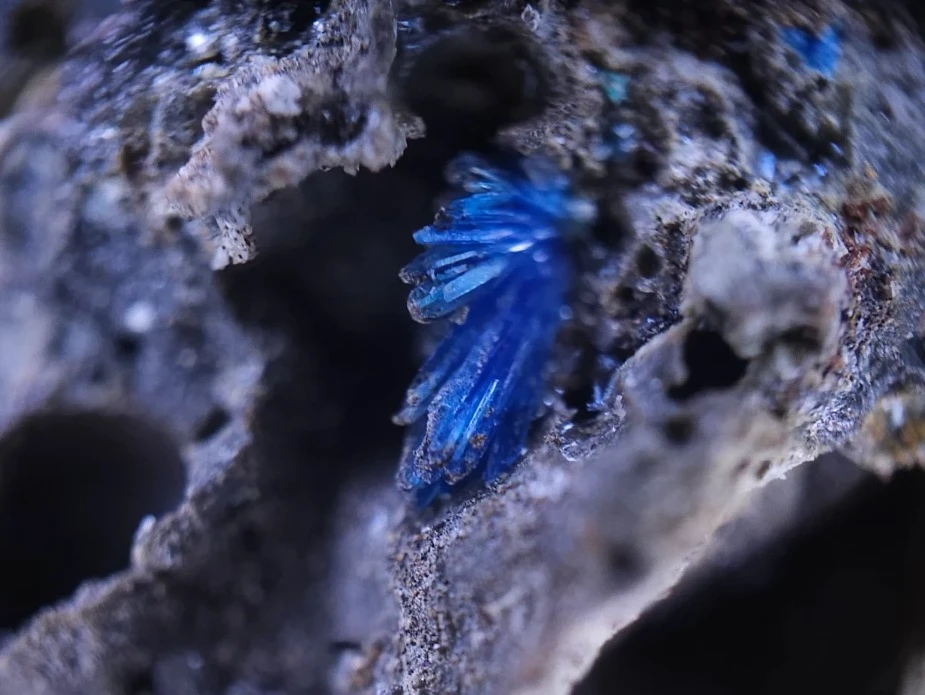
Buttgenbachite is a rare, secondary copper mineral, characterized by its intense blue color and hexagonal crystal system.
Properties
- Mohs hardness
- 3
- Luster
- Vitreous
- Streak
- Light blue
- Density
- 0
- Cleavage
- Brak
- Fracture
- Nierówny
- Transparency
- Translucent
- Crystal system
- Hexagonal
Diagnostic features
## Identification Buttgenbachite can be identified by its characteristic, intense blue color, vitreous luster, and typical acicular or columnar crystal habit. Radial or fibrous aggregates are also diagnostic. A light blue streak is an additional helpful identification feature. ## Distinguishing from Similar Minerals Buttgenbachite can be confused with other blue copper minerals, such as azurite or chalcanthite. It is distinguished from azurite by its hexagonal crystal system (azurite is monoclinic) and a lighter, bluer streak. Chalcanthite is much softer and water-soluble, allowing for easy differentiation. ## Crystal Forms Buttgenbachite forms hexagonal crystals with an acicular or columnar habit. They often occur as radial aggregates, fibrous masses, or crusts.
Geological environment
## Genesis Buttgenbachite is a secondary mineral, forming in the oxidation zones of copper deposits. It forms as a result of the reaction of copper-rich solutions with chlorides and nitrates, often in the presence of groundwater. ## Mineral Associations Buttgenbachite often co-occurs with other secondary copper minerals, such as azurite, malachite, cuprite, tenorite, as well as with minerals containing chlorides and nitrates. ## Localities The most important localities for buttgenbachite are in the Democratic Republic of Congo, especially in the Katanga region, where it was discovered. Other occurrences include Arizona in the USA and Chile.
Rarity
Very Rare
For collectors
## Quality Criteria The most prized buttgenbachite specimens are those characterized by an intense, deep blue color, well-formed, distinct crystals, and aesthetic aggregates, especially radial or fibrous ones. Larger crystal clusters are also more desirable to collectors. ## Popular Localities The most sought-after buttgenbachite specimens come from the Democratic Republic of Congo, especially from the historic mines in the Katanga region, which are the source of the best-formed and most aesthetic specimens.
Care and storage
## Cleaning Buttgenbachite is a relatively soft mineral, so it should be handled with care. For cleaning, it is best to use a soft brush and lukewarm water. Dust and loose contaminants can be gently removed. ## What to Avoid Avoid using strong chemicals, acids, and bases, which can damage the mineral's surface. High temperatures and direct sunlight can also negatively affect the color and stability of buttgenbachite. Due to the water content in its structure, the mineral may be sensitive to changes in humidity. ## Storage Buttgenbachite specimens are best stored in closed display cases or boxes, away from dust and direct light. It is advisable to maintain stable temperature and humidity to prevent potential damage.