Bournonite
Chemical formula: Cu<sup>1+</sup>Pb<sup>2+</sup>Sb<sup>3+</sup>S<sup>2-</sup><sub>3</sub>
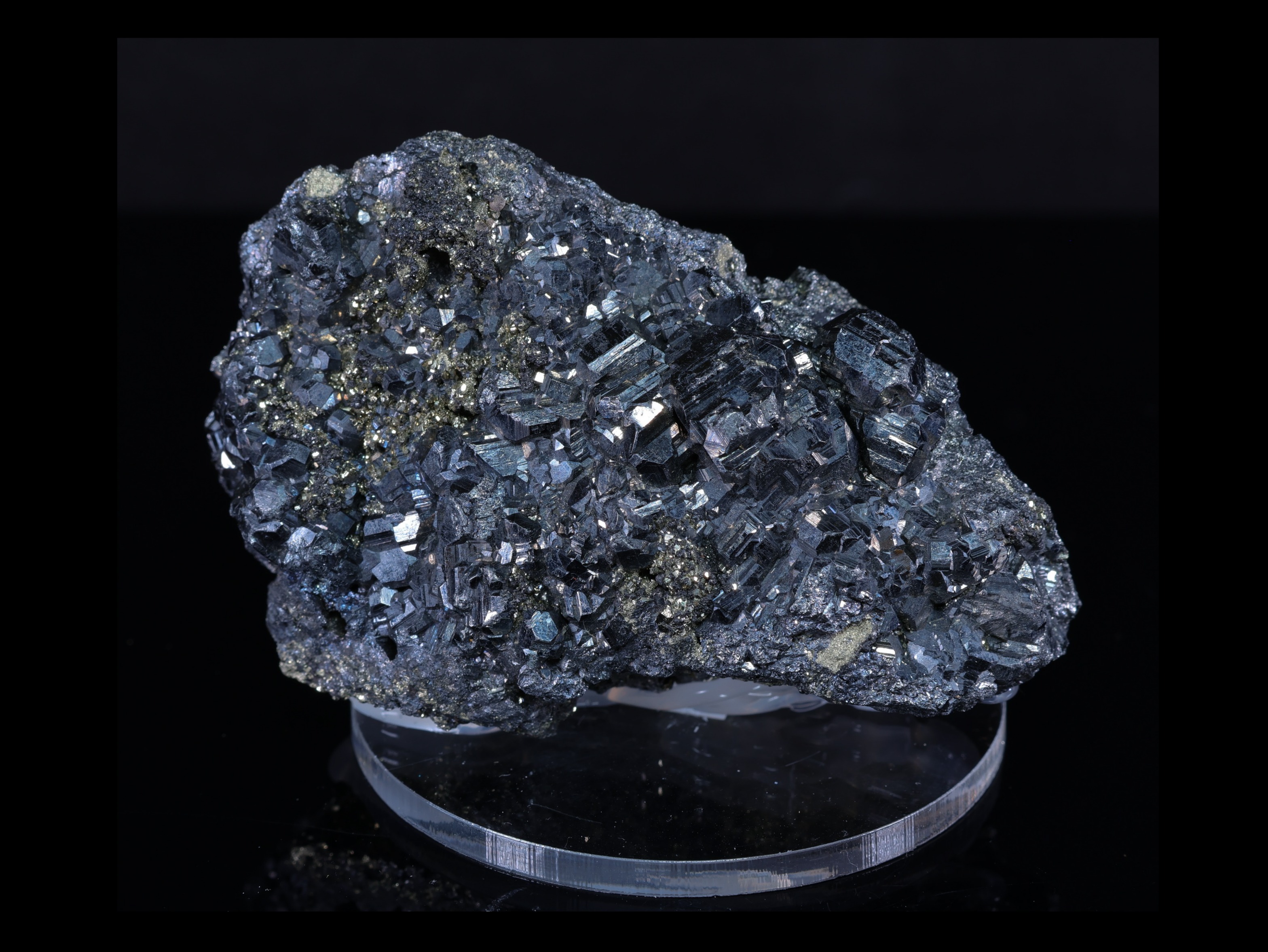
Bournonite is a copper, lead, and antimony sulfide, characterized by a steel-gray color and metallic luster, often forming massive aggregates or tabular crystals.
Properties
- Mohs hardness
- 2.5-3
- Luster
- Metaliczny
- Streak
- Steel-gray
- Density
- 5.83
- Cleavage
- Imperfect on {010}, less perfect on {100}{001}
- Fracture
- Nierówny
- Transparency
- Opaque
- Crystal system
- Orthorhombic
Diagnostic features
## Identification Bournonite can be identified by its steel-gray color, metallic luster, and relatively low hardness (2.5-3 on the Mohs scale). A characteristic steel-gray streak is also present. It often occurs as massive aggregates or tabular crystals. High density (5.83) is also an important diagnostic feature. ## Differentiation from Similar Minerals Bournonite can be confused with other sulfides of similar color and luster, such as galena or tetrahedrite. It differs from galena by the absence of perfect cubic cleavage and lower density. From tetrahedrite, it differs primarily in its crystallographic system (orthorhombic for bournonite, isometric for tetrahedrite) and often crystal habit. The streak of bournonite is steel-gray, while the streak of galena is lead-gray, and tetrahedrite is black or brownish. ## Crystal Forms Bournonite most commonly forms tabular or short prismatic crystals, often striated. Crystals can be single or form twins. It also occurs as massive, granular, or radial aggregates.
Geological environment
## Genesis Bournonite is a hydrothermal mineral, meaning it forms as a result of precipitation from hot aqueous solutions circulating in the Earth's crust. It typically forms in ore veins associated with low-temperature and medium-temperature hydrothermal processes. It often occurs in polymetallic deposits, where it coexists with other metal sulfides. ## Mineral Associations Bournonite often coexists with other sulfides, such as galena (PbS), sphalerite (ZnS), chalcopyrite (CuFeS₂), tetrahedrite (Cu₁₂Sb₄S₁₃), and pyrite (FeS₂). It can also be found in association with quartz, calcite, and barite, which are typical gangue minerals. ## Localities Known bournonite localities include a number of places worldwide. In Europe, it occurs in Romania (Baia Mare), Germany (Harz), England (Cornwall), and France, among others. Outside Europe, significant occurrences have been reported in Bolivia (Oruro), Peru (Cerro de Pasco), the United States (Colorado, Montana), and Mexico.
Rarity
Very Common
For collectors
## Quality Criteria The most prized bournonite specimens are those with well-formed, distinct crystals, preferably with a tabular or prismatic habit, and a clear metallic luster. The size of the crystals, their completeness, and the absence of mechanical damage are also important. Specimens where bournonite coexists with other attractive minerals, forming aesthetic compositions, are particularly sought after. A fresh, bright steel-gray color is more desirable than specimens with dark tarnish. ## Popular Localities Among the most valued bournonite localities are those that yield well-formed crystals. Historically important were deposits in England (Cornwall) and Germany (Harz). Currently, high-quality specimens also come from Bolivia (e.g., San José mine in Oruro) and Peru.
Care and storage
## Cleaning Bournonite is a relatively soft mineral, so it requires gentle cleaning. To remove dust and loose contaminants, it is best to use a soft brush or paintbrush. For heavier soiling, lukewarm water with a small amount of mild soap can be used, followed by thorough rinsing of the specimen with distilled water. Prolonged soaking should be avoided. ## What to Avoid This mineral is sensitive to strong acids, which can damage it or alter its surface. Rapid temperature changes and prolonged exposure to direct sunlight, which can contribute to tarnishing, should also be avoided. Due to its lead content, caution should be exercised when handling specimens, and hands should always be washed after contact. ## Storage Bournonite is best stored in closed display cases or boxes to protect it from dust and moisture. A dry and stable environment is ideal. Specimens should be protected from impacts and abrasions, which can cause mechanical damage due to its relative softness. Storing it away from other, harder minerals will prevent scratching.